For importers of perishable agricultural products, evaluating date samples before placing a bulk order is a fundamental step in quality control and commercial risk management. The difference between an approved sample and the actual product delivered in a 20 foot container can lead to significant financial losses, customs clearance problems, shipment rejection, or quality deterioration during transportation and storage.
A well structured sampling and approval process helps ensure that the dates received from the exporter conform to the agreed quality, packaging, safety, and commercial requirements. This guide presents a practical framework for importing dates from Iran, covering the complete sampling process from preparing a detailed Request for Quotation (RFQ) and evaluating the exporter’s samples to defining measurable product specifications and incorporating the approved quality standards into a binding purchase agreement.
Why Sample Evaluation Matters Before You Commit
Procuring perishable agricultural commodities requires stripping away stylized marketing claims and focusing strictly on verifiable technical specifications. A physical date sample is not provided merely to conduct a subjective organoleptic taste test; rather, it serves as the definitive technical baseline for your entire commercial contract. In the realm of international food trade, identifying a quality defect during the preliminary sampling stage costs little more than standard air courier fees and a few days of operational delay. Conversely, discovering that exact same defect after a forty-foot shipping container has been loaded, dispatched, and docked results in catastrophic financial consequences. These devastating downstream effects include expensive port demurrage charges, mandatory destination customs laboratory testing, costly return freight, and the total erosion of your anticipated profit margins.
Furthermore, Iranian dates exhibit significant seasonal and biochemical variations that mandate strict physical verification prior to capital commitment. Dates harvested fresh during the September or October peak carry a completely different moisture profile compared to late-season inventory that has been held in climate-controlled cold storage for eight months. Without a recent, batch-specific counter-sample, procurement managers operate entirely in the dark regarding the fruit’s current shelf-life viability and structural integrity.
Sample Stage vs. Bulk Delivery Stage Risk
| Risk Parameter | Identification at Sample Stage | Identification at Bulk Delivery Stage |
|---|---|---|
| Correction Cost | Negligible (Air courier freight fees only) | Severe (Demurrage, port storage, lot disposal) |
| Time Lost | 5 to 10 working days | 30 to 60 days of compounding supply chain disruption |
| Buyer Leverage | Maximum (Funds retained, easy pivot to alternative suppliers) | Minimal (Working capital tied up, goods detained at port) |
| Legal Action | Unnecessary (No formal purchase contract executed) | Complex, drawn-out international commercial arbitration |
Step 1 – Requesting Samples from an Iranian Supplier
Submitting a vague, unstructured request for a sample is the primary reason importers receive cherry-picked, non-representative fruit that looks perfect but fails to reflect the actual commercial inventory. Requesting date samples from a supplier requires a highly structured, formal document that unequivocally details your exact commercial expectations and regulatory requirements from the very outset.
Information to Give the Supplier
To guarantee that the exporter dispatches a representative sample drawn from the actual commercial batch you intend to purchase, your formal Request for Quotation (RFQ) and sample request must clearly specify the following parameters:
- Exact Cultivar and Variety: Specify whether your supply chain requires Piarom (Maryami), Mazafati (Kimia), Zahedi, Sayer (Estameran), or Rabbi dates.
- Commercial Grading Metrics: Clearly state the required sizing parameters and grade, such as Jumbo, Standard, Grade A, or Grade B, alongside the expected piece count per kilogram (count/kg).
- Processing and Packaging Format: Indicate if the dates must be pitted (seedless) or unpitted, and outline the precise packaging architecture, whether that involves 10-kilogram bulk food-grade cartons or 550-gram retail-ready Mazafati boxes.
- Intended End-Use: Disclose whether the bulk product is intended for direct retail consumption, industrial repacking, or date paste extraction, as this application dictates your acceptable cosmetic defect tolerance.
- Destination Certifications: List all mandatory clearance documentation required by your destination port’s customs authority, including Phytosanitary Certificates, Health Certificates, and Non-GMO or Organic compliance declarations.
Crucially, you must explicitly instruct the exporter that the physical sample must be extracted directly from the current warehouse lot allocated for your order, rather than sourced from a highly curated exhibition or marketing showcase.
Typical Sample Sizes, Costs and Lead Times
For a comprehensive laboratory and sensory evaluation, a standard volumetric sample size of 1 to 2 kilograms per requested variety or grade is strictly mandatory. This specific volume provides adequate material to conduct destructive moisture testing, meticulously assess visual uniformity, and still retain an untouched portion for future contractual reference.
From a financial perspective, the majority of reputable Iranian export firms will provide the physical fruit at no cost to verified B2B wholesale buyers. However, the international air courier freight fees—typically handled by logistics providers like DHL, Aramex, or Iran Air Cargo—are standardly borne by the importer. As an established industry best practice, procurement managers should negotiate a “Sample Cost Credit” clause upfront, ensuring that any courier fees absorbed during the sampling phase are fully deducted from the final commercial invoice of the bulk container order.
Regarding logistics, geographic location heavily dictates the delivery timeline. Transit from primary Iranian export hubs to commercial destinations across Europe, Asia, or the broader Middle East generally requires 5 to 10 business days via express air freight routing.
Step 2 – Inspecting the Samples on Arrival

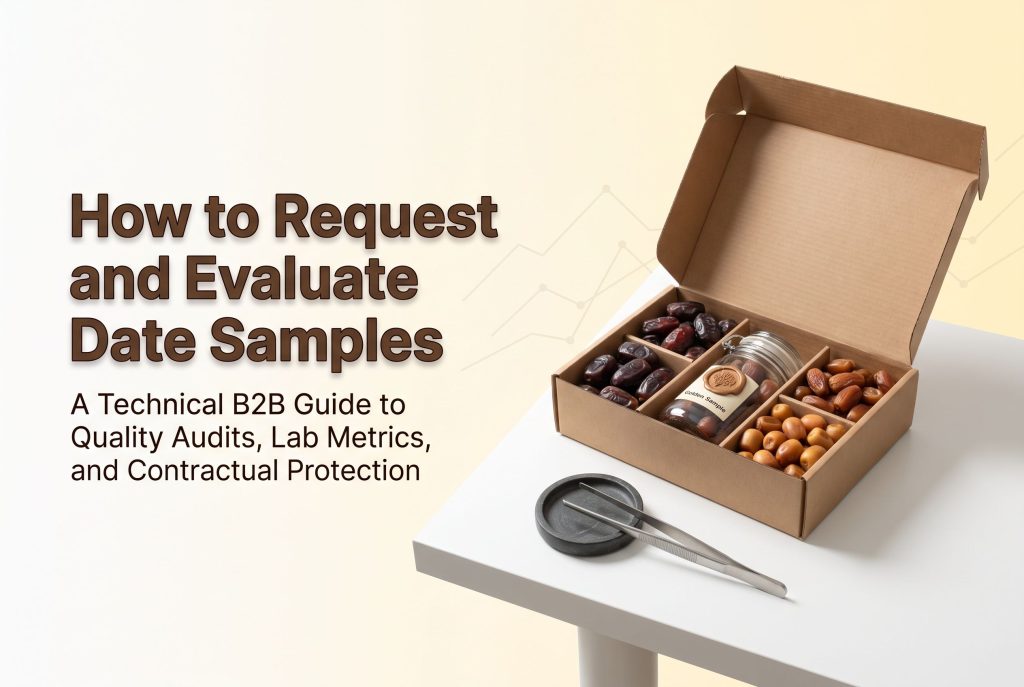
The exact moment the sample arrives at your receiving facility, standard operating procedures dictate immediate, systematic, and documented unboxing. Begin with a strict intake protocol: electronically record the internal temperature of the package upon arrival, capture high-resolution photographs and videos of the tamper-evident seals, and immediately divide the physical shipment into two equal halves. One half is strictly designated for destructive laboratory testing, while the remaining half becomes your sealed, climate-controlled Golden Sample.
Visual and Physical Checks (size, color, texture)
Initial screening requires evaluating the physical uniformity of the date sample against established international agricultural metrics. Implementing a systematic Iranian dates bulk sample inspection actively prevents the downstream acceptance of mixed, ungraded, or poorly sorted commercial batches.
- Size Uniformity and Count: Weigh a precise one-kilogram baseline sample and manually count the individual fruits to verify that the “count per kg” metric perfectly aligns with the supplier’s stated commercial grade.
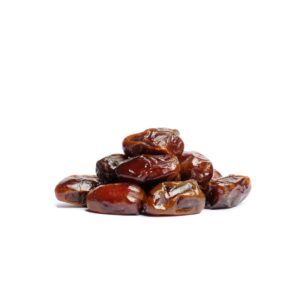
- Skin Separation (Puffiness): Closely examine the dates for loose, blistering, or detached skin. International grading standard tolerances strictly limit excessive skin separation, as it serves as a primary indicator of improper curing, severe temperature fluctuations during transit, or poor warehouse handling.
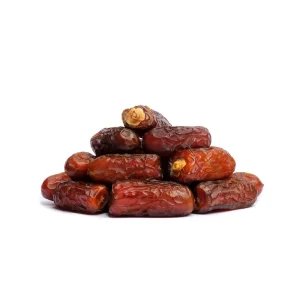
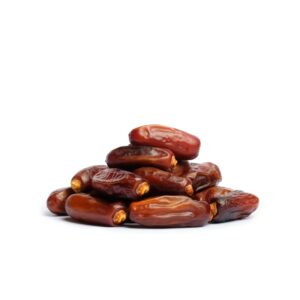
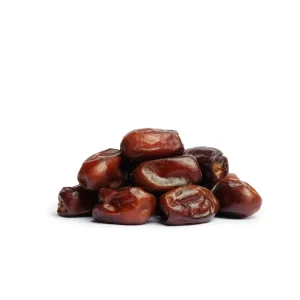
- Color Consistency: Assess the external hue based on the specific cultivar’s baseline. For instance, a premium Mazafati must exhibit a uniform deep black coloration, Piarom should display a rich dark brown with natural golden ridges, and Zahedi requires a consistent light amber tone.
- Texture and Firmness: Gently press the fruit to evaluate its internal structural integrity. The date should yield appropriately for its specific moisture classification without displaying excessive mushiness, unnatural stickiness resulting from syrup leakage, or rock-hard desiccation.
Moisture Content and Shelf-Life Signs
Moisture content—often measured as water activity (a_w)—is unequivocally the single most critical parameter governing the commercial viability and shelf-life of Iranian dates. According to the Food and Agriculture Organization of the United Nations, “the moisture content of dates is the most important factor determining their keeping quality and storage requirements.” Consequently, excessive moisture leads inevitably to rapid yeast proliferation and transit fermentation, whereas insufficient moisture triggers commercial weight loss and undesirable organoleptic dryness.
Standard Moisture Ranges for Key Iranian Date Varieties
| Date Variety | Hydration Classification | Acceptable Moisture Range | Supply Chain Storage Requirement |
|---|---|---|---|
| Mazafati (Kimia) | Fresh / High Moisture | 18% to 25% | Strict cold chain required (0°C to 5°C) |
| Piarom (Maryami) | Semi-Dry | 15% to 17% | Dry, cool ambient conditions |
| Zahedi | Dry to Semi-Dry | 13% to 15% | Standard dry commercial warehouse |
| Sayer (Estameran) | Semi-Dry | 16% to 18% | Standard dry commercial warehouse |
Testing must be conducted using a calibrated digital dried-fruit moisture meter or a highly precise laboratory oven-drying method. Procurement teams must never rely on subjective tactile feel to estimate internal moisture levels.
Taste, Sugar Content and Variety Consistency
Organoleptic assessment moves well beyond a simple subjective taste test; it is designed to identify underlying chemical instability. When sampling the fruit, screen strictly for any off-odors. The presence of sour, yeasty, alcoholic, or distinctly stale smells immediately indicates active fermentation, lipid oxidation, or rancidity.
Additionally, measure the total soluble solids utilizing a refractometer to precisely determine the Brix level. Commercial buyers must remain highly vigilant in identifying artificial sweetening or glazing. A prevalent adulteration tactic within lower-grade bulk date markets involves coating the fruit with inexpensive industrial glucose or date syrup to artificially mask dryness and artificially inflate the shipment’s weight. Furthermore, conduct a strict cultivar audit. Unscrupulous suppliers occasionally blend expensive premium cultivars, such as Piarom, with visually similar but drastically cheaper alternatives like premium Sayer or Khasoei in an attempt to widen their profit margins.
Packaging and Labeling Review
The sample’s primary and secondary packaging must accurately reflect the specific materials intended for the final bulk container shipment.
- Primary Packaging Integrity: Verify the micron thickness and quality of the food-grade poly liner inside the cartons to ensure it adequately protects the fruit against ambient moisture migration during ocean transit.
- Master Carton Durability: Assess the master carton’s corrugated cardboard for maximum stacking strength. Date pallets are exceptionally heavy, and structurally weak cartons will inevitably crush under their own weight during shipping, physically damaging the fruit inside.
- Regulatory Label Clarity: Ensure the printed labels legally and fully comply with your destination country’s strict customs regulations, clearly displaying the exact variety name, net weight, traceable batch number, harvest date, expiration date, required storage conditions, and the certified country of origin.
Step 3 – Comparing Samples to Your Specification
Conducting an evaluation without referencing a written, formalized specification sheet (Spec Sheet) reduces the entire quality assurance process to personal preference, which holds absolutely no legal weight in the event of an international trade dispute. Therefore, your technical laboratory findings must be rigorously cross-referenced against established global agricultural regulatory frameworks.
Grading Standards to Reference
When establishing date fruit quality standards for bulk import, rely exclusively on recognized international classification systems to completely remove ambiguity from your final purchase contract.
- Codex Stan 143-1985: The globally accepted benchmark published by the Codex Alimentarius Commission. It dictates the maximum allowable limits for visual defects, mineral impurities, foreign matter, and critical moisture thresholds.
- UNECE Standard DDP-08: The primary standard utilized within European markets concerning the marketing and commercial quality control of dates. It provides highly specific tolerances regarding sizing uniformity, packaging, and allowable pest damage percentages.
- ISIRI 236: The official national standard maintained by the Institute of Standards and Industrial Research of Iran. It categorizes Iranian export dates into Super/Premium, Grade 1, and Grade 2, detailing the specific test methods and physical characteristics native exclusively to Iranian cultivars.
- USDA Grade Standards for Dates: The essential regulatory framework for any procurement manager importing dates into the United States or Canada, outlining rigorous requirements for defect scoring, color consistency, and overall condition.
Common Quality Red Flags
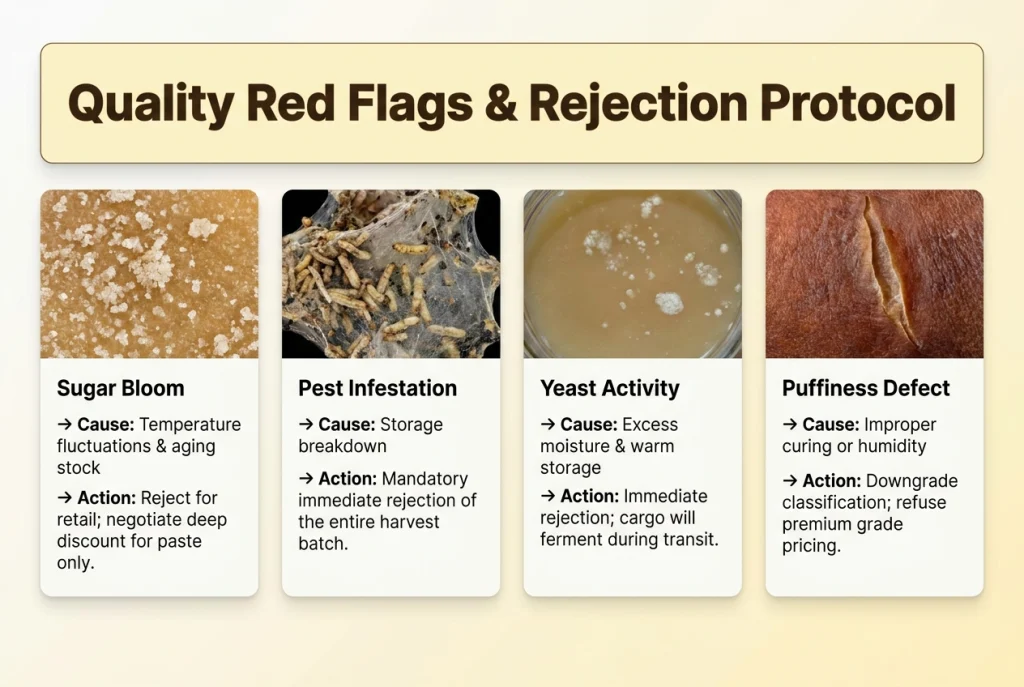
Identifying commercial red flags during the preliminary sampling stage allows your procurement team to decisively reject the lot before committing corporate funds. Use this standardized diagnostic matrix to categorize critical defects found during the inspection phase.
| Quality Red Flag | Root Cause Analysis | Required Buyer Action |
|---|---|---|
| Sugar Crystallization (Bloom) | Severe temperature fluctuations during storage or aging inventory causing natural sugars to migrate and crystallize on the skin. | Reject the lot for premium retail placement; negotiate a deep discount for industrial paste production only. |
| Insect Frass or Webbing | Active or historical live pest infestation occurring during prolonged warehouse storage. | Immediate and total rejection of the entire batch. |
| Sour Odor / Gas Bubbles | High moisture content combined with warm ambient temperatures leading to active yeast fermentation. | Immediate rejection; the shipment will rot completely during ocean transit. |
| Pesticide Residue Excess | Poor agricultural practices resulting in Maximum Residue Limits (MRL) violations. | Reject immediately if laboratory testing exceeds the destination country’s legal MRLs. |
| Skin Separation > 25% | Improper post-harvest curing or excessive humidity exposure during storage. | Downgrade the commercial classification; do not authorize premium grade pricing. |
| Unnatural Oily Gloss | Unauthorized polishing with non-edible mineral oils to artificially enhance visual appeal. | Demand unpolished stock or reject entirely due to severe regulatory food safety risks. |
Step 4 – Moving from Approved Sample to Bulk Order
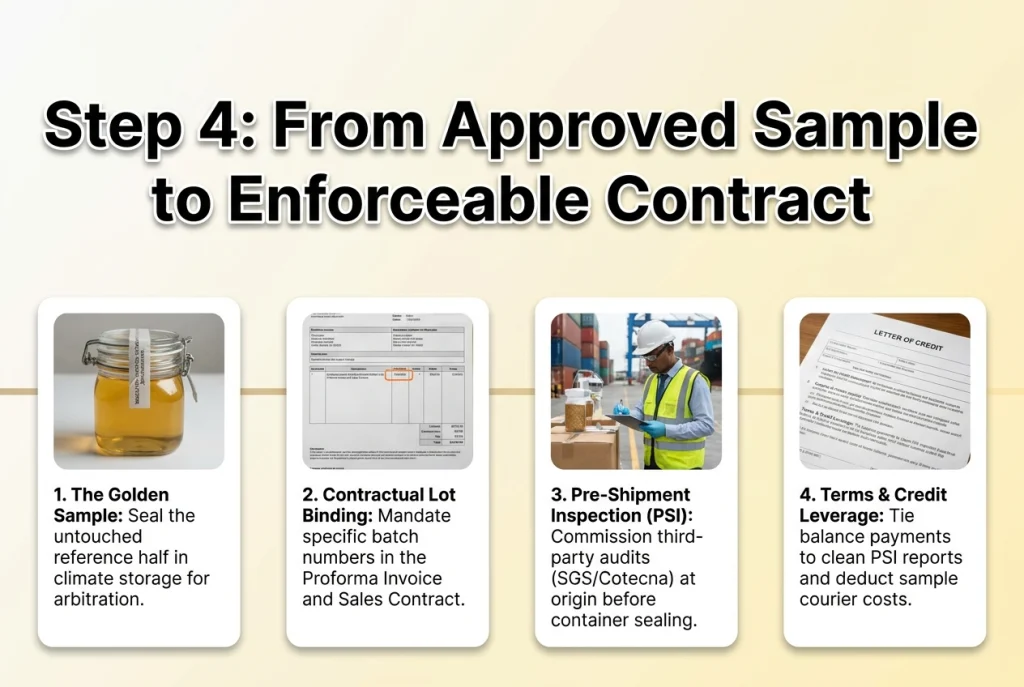
Successfully approving the physical sample does not represent the end of the procurement process; rather, it is merely the vital data-gathering phase required to draft an enforceable, airtight commercial contract. Procurement managers must now systematically translate their physical approvals into binding legal parameters.
Confirming Same-Batch Shipment
To systematically eliminate the catastrophic risk of a supplier executing a “bait and switch,” you must legally anchor the final container shipment directly to the exact sample your team just approved.
- The Golden Sample Protocol: Take the retained, untouched half of your approved sample, seal it securely in tamper-evident packaging, and store it in a strictly climate-controlled environment. This serves as your definitive “Golden Sample” (or counter-sample) for legal arbitration if the final container arrives at port containing inferior goods.
- Proforma Invoice Integration: Demand that the specific Lot Number or Batch Number directly associated with the approved sample is explicitly written into the official Proforma Invoice and the final Sales Contract.
- Pre-Shipment Inspection (PSI): Mandate a comprehensive third-party inspection before the shipping container is loaded and sealed. Contract internationally recognized inspection agencies, such as SGS or Cotecna, to inspect the goods physically at the cold storage facility or at the port of origin (e.g., Bandar Abbas), verifying that the bulk cargo identically matches your approved Golden Sample.
Locking In Price and Terms
The commercial payment structure and shipping terms must accurately reflect the highly perishable nature of the goods and the verified quality level. Establish clear Incoterms that explicitly dictate where operational risk transfers from the seller to the buyer. Buying FOB (Free On Board) Bandar Abbas is fundamentally different from buying CFR (Cost and Freight) or CIF (Cost, Insurance, and Freight) at your destination port, particularly when managing sensitive cold-chain logistics for high-moisture varieties like Mazafati. For example, if the container’s refrigeration unit fails at sea under FOB terms, the buyer bears the total financial loss.
Structure your payment terms to maintain maximum commercial leverage. Never execute a 100% advance wire transfer. A standard, highly secure B2B structure utilizes a percentage deposit (e.g., 30%), with the remaining balance paid strictly against the presentation of original shipping documents (Bill of Lading, Phytosanitary Certificate) and a Clean Inspection Report issued by your third-party PSI agency. Finally, ensure the final contract explicitly includes the previously negotiated clause deducting your initial courier sample costs from the total commercial invoice.
Mistakes to Avoid When Skipping This Step
- Relying entirely on supplier-provided WhatsApp photos and promotional videos instead of demanding physical samples for rigorous hands-on evaluation.
- Estimating critical moisture content through subjective tactile feeling rather than utilizing calibrated laboratory moisture meters or standardized oven-drying protocols.
- Failing to retain a sealed, temperature-controlled Golden Sample, thereby leaving the buyer without any physical, verifiable evidence during a destination port quality dispute.
- Neglecting to proactively cross-reference the supplier’s declared pesticide usage against the strict Maximum Residue Limits (MRL) enforced by the destination country’s Ministry of Health.
- Booking standard Dry Box shipping containers for high-moisture cultivars like Mazafati, which absolutely require active Reefer (refrigerated) containers to prevent rapid transit fermentation.
FAQs
What sample volume should a B2B buyer request for proper date evaluation? A professional B2B buyer should request exactly 1 to 2 kilograms of dates for each specific variety or commercial grade being evaluated. This precise volume allows for 200 to 300 grams of initial visual screening, provides adequate material for destructive laboratory testing (moisture and Brix), and guarantees the retention of a sealed, legally viable reference sample for the duration of the contract.
Who typically pays for date sample delivery from an Iranian supplier? The date sample itself is generally provided completely free of charge by the Iranian supplier, but the international air courier shipping cost is customarily paid by the buyer. In serious commercial transactions, procurement managers routinely stipulate in advance that this specific courier expense will be fully deducted from the final bulk order invoice.
Can high-moisture date samples like Mazafati be tested at ambient room temperature? No, high-moisture dates like Mazafati—which regularly contain over 20% moisture—must be evaluated immediately upon arrival and subsequently stored in a strict cold chain environment at 0°C to 5°C. Leaving these highly sensitive samples at ambient room temperature for more than 48 hours will trigger artificial yeast fermentation, resulting in a completely inaccurate evaluation of the lot’s actual commercial quality.
What is the single most critical quality parameter when evaluating bulk Iranian dates? Strictly controlled moisture content and the absolute absence of live pest infestation are the two non-negotiable quality parameters. Incorrect or excessive moisture levels directly and inevitably lead to widespread yeast fermentation, souring, and total product spoilage while the cargo is locked inside a shipping container during lengthy ocean transit.
Conclusion
Evaluating date samples before authorizing a bulk container shipment stands as an indispensable, non-negotiable risk-management protocol for B2B food commodity importers. By actively transitioning from subjective visual checks to rigorous, documented laboratory assessments of moisture activity, Brix levels, and physical uniformity, wholesale buyers effectively eliminate the primary vectors for supply chain failure. Establishing a verified Golden Sample, integrating third-party pre-shipment inspections, and contractually binding the final shipment to exact international agricultural standards ensures that your working capital is fully protected and the delivered product precisely matches your exacting commercial requirements.
Related Products