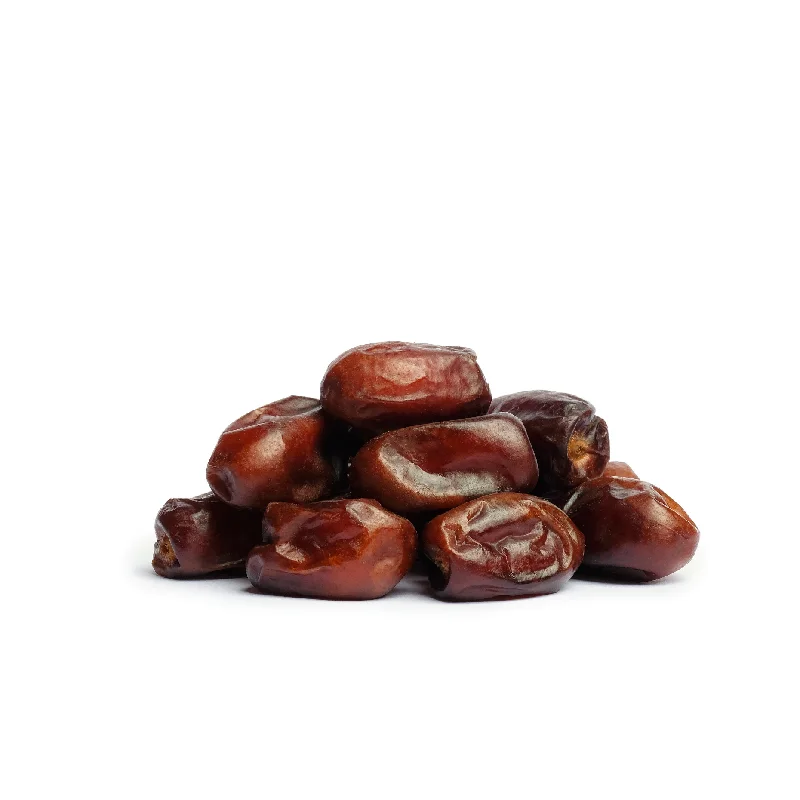

Importing Iranian dates into Europe provides commercial buyers, dried fruit distributors, and food manufacturers access to some of the most profitable, high-yielding cultivars in global trade. Varieties such as Mazafati and Piarom deliver reliable margins across European retail shelves, ethnic markets, and ingredient manufacturing. While new buyers often express caution regarding customs procedures, residue standards, and payment channels, the regulatory roadmap governing these shipments is transparent, predictable, and established. By following European Union food safety laws, standard tariff classifications, and compliant trade corridors, commercial importers can establish secure, lucrative supply partnerships.
The European Market for Iranian Dates
European consumer demand for dates continues to rise beyond traditional holiday periods, driven by health-conscious snacking and the growing use of natural fruit sweeteners. With commercial date production in Europe restricted to minor volumes in Spain and Italy, the European Union imports over 160,000 tonnes annually. The Netherlands acts as the primary trade gateway, receiving bulk maritime containers through Rotterdam for distribution into Germany, France, and Northern Europe. Germany represents the largest direct market for table dates, France sustains high volume for North African and Middle Eastern varieties, and the United Kingdom remains a major destination for both ethnic wholesalers and mainstream supermarkets.
Iranian dates fill specific, high-demand commercial segments across European markets:
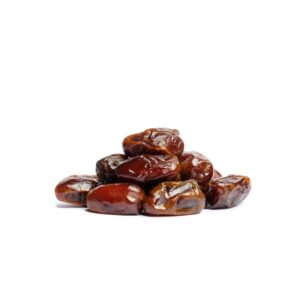
- Mazafati Dates: A fresh, dark date containing 20% to 25% moisture. Mazafati commands high turnover in ethnic retail channels and independent supermarket chains, with peak demand occurring before Ramadan.
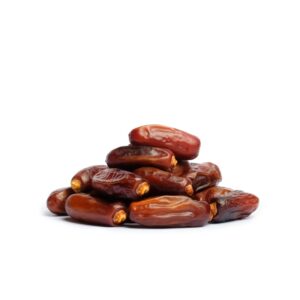
- Piarom Dates (Maryami): A premium semi-dry date with thin skin, an elongated shape, and 15% to 16% moisture. European specialty grocers position Piarom as a refined alternative to Medjool dates.
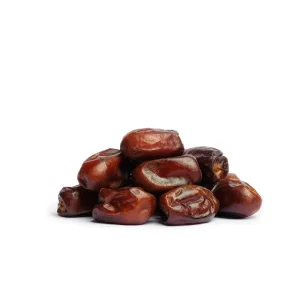
- Sayer Dates (Estamaran): A semi-dry cultivar with easily removed pits and high natural sugar content. Industrial processors purchase Sayer in bulk for date paste, energy bars, baked goods, and syrups.
- Zahedi Dates: A firm, dry date with a golden hue and extended shelf life, serving as an economical option for trail mixes and industrial dicing.
- Rabbi and Kabkab Dates: Value-focused varieties processed into liquid sugars, date purees, and confectionery ingredients.
Securing consistent fruit grades requires sourcing directly from source packers with modern sorting facilities. Working with a dedicated Iranian date supplier ensures that fruit arrives with standard sizing, intact skin, and compliant packaging suited to European retail distribution.
EU Import Regulations for Dates
All commercial shipments of edible dates entering the European Union must satisfy Regulation (EC) No 178/2002, the EU General Food Law. Consignments undergo standard documentary verification, identity checks, and physical inspections at designated Border Control Posts (BCPs) to verify food safety and agricultural health. These rules are uniform across all member states, providing a clear compliance framework for importers.
Food Safety and Hygiene Rules
European food safety rules require date processing and packing facilities in the exporting country to operate under Hazard Analysis Critical Control Point (HACCP) principles. Packing houses must maintain clean processing lines, use potable water, and enforce strict pest prevention controls.
At European border points, agricultural inspectors examine shipments against strict physical standards:
- Consignments must be completely free from live insects, dead storage pests, larvae, and insect webbing, including common warehouse pests like the sawtoothed grain beetle and almond moth.
- Fruit must show no signs of rodent or bird contamination, dirt, stones, or foreign physical matter.
- Dates must be free from active fermentation, rot, and visible mold growth exceeding UNECE Standard DDP-08 limits.
- All packaging materials in contact with dates must comply with Regulation (EC) No 1935/2004, preventing harmful chemical transfer into the food.
Pesticide Residue Limits (MRLs) and Aflatoxins
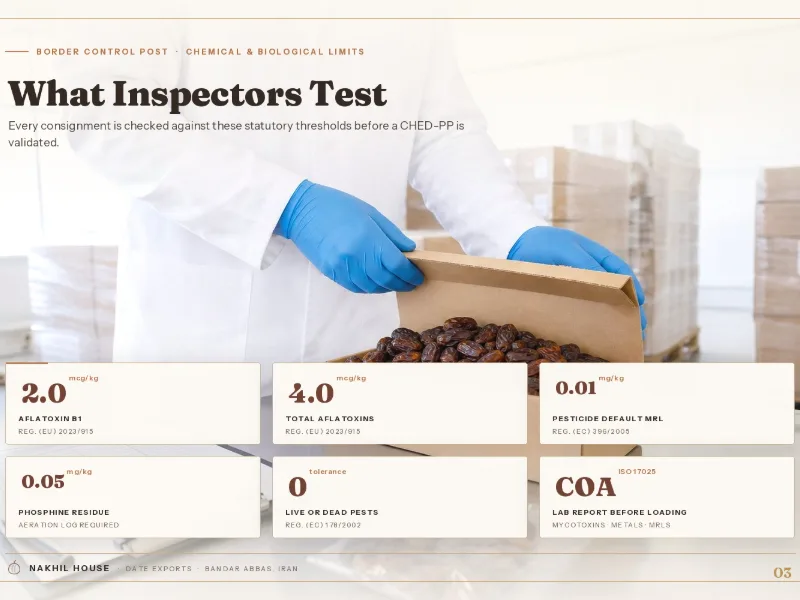
Pesticide management in the European Union is governed by Regulation (EC) No 396/2005, which sets Maximum Residue Limits (MRLs) for agricultural chemicals. If the European Commission has not established a specific tolerance for an active substance, the default statutory limit of 0.01 mg/kg automatically applies. Importers must confirm that origin growers use approved treatments and observe mandatory pre-harvest intervals.
Mycotoxins are strictly controlled under Regulation (EU) 2023/915. For dried dates intended for direct human consumption, European law caps Aflatoxin B1 at 2.0 micrograms per kilogram (mcg/kg), while total aflatoxins (B1 + B2 + G1 + G2 combined) cannot exceed 4.0 mcg/kg. Maintaining dry sorting facilities and strict moisture management prevents mold formation and eliminates aflatoxin risks.
Post-harvest phosphine fumigation is widely used to prevent insect contamination, but the cargo must be properly aerated before departure. Phosphine residues must remain below the European statutory threshold of 0.05 mg/kg. Working with processors who issue verifiable degassing logs guarantees that chemical traces dissipate before destination testing.
The table below summarizes the key chemical and biological limits enforced at European ports:
| Hazard Indicator | EU Regulatory Framework | Statutory Limit / Enforcement Rule |
|---|---|---|
| Aflatoxin B1 | Regulation (EU) 2023/915 | Maximum 2.0 mcg/kg |
| Total Aflatoxins (B1+B2+G1+G2) | Regulation (EU) 2023/915 | Maximum 4.0 mcg/kg |
| Pesticide Residues | Regulation (EC) No 396/2005 | Specific substance MRL, or default 0.01 mg/kg |
| Phosphine Residue | Regulation (EC) No 396/2005 | Maximum 0.05 mg/kg with mandatory aeration log |
| Storage Pests | Regulation (EC) No 178/2002 | Zero tolerance for live or dead infestations |
| Ochratoxin A | Regulation (EU) 2023/915 | Governed under dried fruit contaminant standards |
Importers can avoid customs delays by obtaining a Certificate of Analysis from an ISO/IEC 17025 accredited laboratory before cargo is loaded at the origin port.
Phytosanitary and Plant Health Requirements
Plant health enforcement operates under Regulation (EU) 2016/2031 to protect European agriculture against foreign plant pests. Fresh dates (Phoenix dactylifera) originating outside the European Union require an official Phytosanitary Certificate issued by the Plant Protection Organization of Iran.
Clearing plant health controls involves three practical steps:
- Origin Inspection: The exporter arranges an official inspection at origin to secure a Phytosanitary Certificate confirming the consignment is free from quarantine pests.
- Digital Pre-Notification: Before the vessel reaches Europe, the customs broker inputs shipment details into the European Commission’s online TRACES-NT system.
- CHED-PP Generation: The broker files a Common Health Entry Document for Plant Products (CHED-PP) in TRACES-NT, attaching the digital phytosanitary certificate and transport records.
Once port health inspectors verify the documentation and release the entry, the electronic CHED-PP is validated, clearing the shipment for final customs declaration.
Labeling Requirements
Dates packaged for consumer retail or wholesale trade must comply with Regulation (EU) No 1169/2011 on Food Information to Consumers, alongside UNECE marketing standards. Required details must appear legibly on outer bulk cartons and retail boxes:
- Product Name and Variety: Labels must clearly state the commercial fruit designation and cultivar, such as “Fresh Mazafati Dates” or “Dried Piarom Dates.”
- Country of Origin: Packaging must explicitly state “Country of Origin: Iran” or “Product of Iran.”
- Commercial Quality Grade: The product must display Class Extra, Class I, or Class II grading according to UNECE standards.
- Calibre and Count: Sizing must be marked by count range per kilogram or official size codes.
- Traceability Code: A clear batch or lot number must be printed on every box to support food recall procedures.
- Storage Instructions: High-moisture cultivars like Mazafati must show explicit temperature instructions, such as “Store refrigerated between -2°C and +4°C.”
- Responsible Operator: The full legal name and address of the European importer, packer, or distributor must appear on the packaging.
Tariffs, VAT and HS Codes for Dates

Correct tariff classification determines applicable duty rates and prevents customs disputes. Edible dates fall under Heading 0804 of the international Harmonized System (HS). In the European Union, classification extends to the 8-digit Combined Nomenclature (CN) and the 10-digit TARIC system.
Because Iran does not hold a preferential trade agreement with the EU, imports are subject to standard Third-Country Duty tariffs.
The table below outlines common customs codes, product categories, and baseline duty rates:
| Product Classification | HS / CN Code | TARIC Code | Third-Country Duty Rate |
|---|---|---|---|
| Fresh Dates (Mazafati) | 0804 10 00 | 0804 10 00 10 | 0% to 7.7% based on package net weight |
| Dried Dates (Piarom, Zahedi, Sayer) | 0804 10 00 | 0804 10 00 90 | 7.7% standard duty |
| Date Paste (Macerated Fruit) | 2008 99 99 | 2008 99 99 90 | 18.4% plus agricultural components |
| Date Syrup (Concentrate) | 2007 99 97 | 2007 99 97 90 | 24% plus added sugar duty |
Upon customs entry, member states collect national Value Added Tax (VAT) on the total customs value. European countries classify dates as basic food items, granting them reduced VAT rates:
- Germany: 7% reduced food VAT.
- The Netherlands: 9% reduced food VAT.
- France: 5.5% reduced food consumption VAT.
- Spain: 4% super-reduced food VAT.
- United Kingdom: 0% (Zero-rated) for whole fresh or dried dates.
Importers should confirm exact 10-digit classifications using the European Commission’s Access2Markets portal with their licensed broker before booking cargo.
Required Import Documents

Clearing a commercial date container through European ports requires a standard commercial document set. Preparing these records ahead of vessel arrival eliminates demurrage fees, terminal delays, and physical holds.
A complete import document package includes seven core items:
- Commercial Invoice: Outlines unit costs, currency, total transaction value, packing details, and Incoterms 2020 delivery terms, such as FOB Bandar Abbas or CIF Rotterdam.
- Packing List: Specifies container marks, pallet arrangements, gross weight, net weight, and corresponding batch numbers.
- Ocean Bill of Lading: Acts as the official transport contract and title document, detailing seal numbers, container identifiers, and clean-on-board status.
- Certificate of Origin: Authenticated by the regional chamber of commerce in Iran to verify agricultural origin.
- Phytosanitary Certificate: Issued by the Iranian Plant Protection Organization to confirm freedom from quarantine pests.
- Certificate of Analysis (COA): Laboratory verification from an ISO 17025 accredited facility confirming compliance with EU MRLs, heavy metals, and mycotoxins.
- Fumigation Certificate: Official confirmation of phosphine treatment, recording chemical dosages, exposure periods, and post-fumigation aeration.
Sanctions, Payments and Trade Restrictions
A common misconception among commercial buyers is that Iranian agricultural products face European trade embargoes. Under Council Regulation (EU) No 267/2012, which defines the European sanctions framework, food, agricultural commodities, and humanitarian goods are completely exempt from commercial bans. European businesses can import Iranian dates legally, without quotas, import licenses, or statutory penalties.
Financial transactions require standard international trade structuring because most Iranian commercial banks lack direct SWIFT connections. To avoid banking delays caused by routine compliance filters, European businesses and exporters manage settlements through legal, well-established trade corridors:
- Third-Country Commercial Entities: Contracts and settlements are routinely handled through commercial entities with corporate bank accounts in regional trade hubs like the United Arab Emirates or Turkey, with transactions cleared in Euros or UAE Dirhams.
- Regulated Exchange Houses: Importers utilize licensed currency exchange houses operating under central bank supervision to settle invoices against verified shipping documents.
- Corporate Due Diligence: Importers conduct standard compliance reviews, confirming that contracting entities, vessel operators, and freight forwarders do not appear on European sanctions lists or the US Office of Foreign Assets Control Specially Designated Nationals list.
Using established commercial intermediaries makes payment processing safe, fully compliant, and routine for corporate accounting teams.
UK Import Rules After Brexit
Following Brexit, the United Kingdom manages import controls through an independent regulatory system directed by the Department for Environment, Food & Rural Affairs (DEFRA) and HM Revenue and Customs (HMRC).
The UK trade framework operates with specific procedural steps:
- Border Target Operating Model (BTOM): The UK assesses plant products by biosecurity risk. Fresh dates imported from non-European countries require a phytosanitary certificate and face standard documentary and physical inspections.
- IPAFFS Notification: Consignments arriving at British ports must be registered through the UK Import of Products, Animals, Food and Feed System (IPAFFS) at least 24 hours prior to arrival, rather than through EU TRACES-NT.
- UK Global Tariff: Duties are calculated using the UK Integrated Online Tariff, with dried dates carrying a 7.7% baseline tariff.
- Zero-Rate VAT: Unprocessed fresh and dried dates imported into the UK qualify for 0% VAT, reducing upfront cash requirements for British distributors.
Certifications European Buyers Expect
Meeting legal entry standards guarantees border entry, but winning large retail contracts requires voluntary quality certifications. Supermarket chains and industrial buyers across Europe expect suppliers to demonstrate quality management and responsible sourcing practices.
European procurement teams prioritize four main certification categories:
- Global Food Safety Standards: Certification under GFSI-recognized programs, such as BRCGS Food Safety, IFS Food, or FSSC 22000. These systems verify advanced metal detection, hygiene monitoring, and consistent processing controls.
- EU Organic Certification: Regulated under Regulation (EU) 2018/848. Cultivars like Piarom and Zahedi grow with minimal chemical inputs, making them prime candidates for organic certification through accredited inspection bodies active in Iran.
- Social and Labor Audits: Verified participation in programs like SMETA or amfori BSCI, confirming fair wages, workplace safety, and ethical labor standards.
- Halal and Kosher Approvals: Valued for confirming processing purity across ethnic retail distributors and commercial food processors.
As highlighted in market studies published by the Centre for the Promotion of Imports from developing countries (CBI):
“European buyers increasingly demand certified supply chains that demonstrate full traceability from the farm level to the retail shelf, making food safety documentation non-negotiable for entering mainstream supermarket channels.”
Suppliers who invest in these standards enable European distributors to command higher prices while protecting brand integrity.
Shipping Routes, Logistics and Customs Clearance
Protecting the appearance, texture, and moisture of Iranian dates requires disciplined temperature management during transit. Ocean container freight originating from Shahid Rajaee Port at Bandar Abbas provides the most economical method for shipping commercial volumes.
Container vessels depart Bandar Abbas and transit through regional hubs such as Jebel Ali before completing the voyage to major European ports, including Rotterdam, Hamburg, Antwerp, or Genoa. Typical maritime transit takes 25 to 35 days. For time-sensitive retail deliveries, refrigerated road transport through Turkey provides a reliable overland route, delivering cargo to Central and Eastern Europe within 10 to 14 days.
Logistics success depends on selecting appropriate container equipment for each variety:
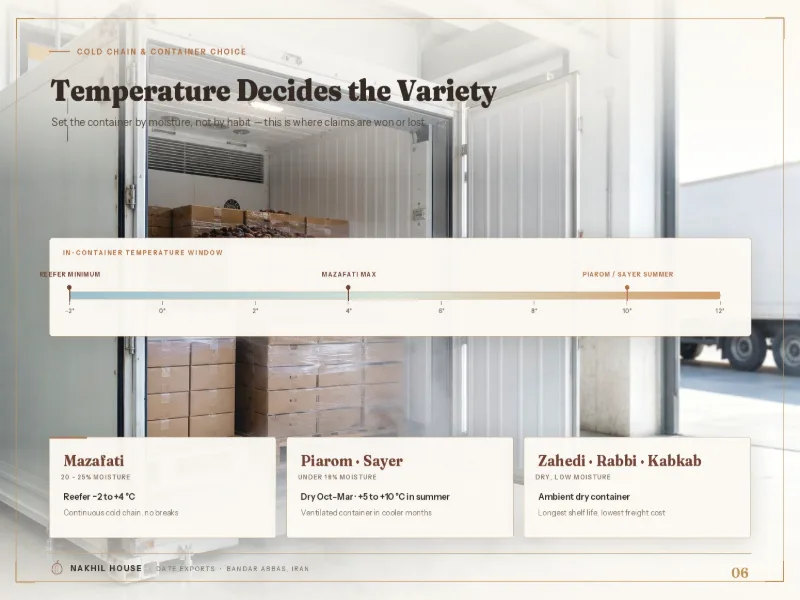
- Mazafati Dates: Mazafati dates contain 20% to 25% moisture and require continuous refrigeration. Shipments must travel in active reefer containers maintained between -2°C and +4°C. Maintaining this cold chain prevents souring, fermentation, skin breakdown, and sugar crystallization.
- Piarom and Sayer Dates: Varieties with moisture levels below 18% can travel in standard ventilated dry containers during cooler shipping windows from October to March. During warmer summer months, reefer transport set between +5°C and +10°C is recommended to prevent fruit darkening.
When the vessel docks, the customs broker submits the Single Administrative Document (SAD), presents the validated CHED-PP, arranges duty settlements, and secures official customs release within 24 to 48 hours.
Market Entry Strategies for Iranian Dates in Europe
Commercial buyers introduce Iranian dates into European distribution through several established business models:
- Specialized Dried Fruit Importers: Selling to specialized trading houses in Hamburg, Rotterdam, or London represents the lowest-risk distribution route. These companies import full container loads, manage customs clearance, and distribute palletized stock to regional wholesalers.
- Industrial Ingredient Supply: Supplying pitted Sayer dates, chopped dates, and date paste directly to food processors represents a high-volume, year-round market. European manufacturers use these ingredients to replace refined sugar in snack bars, breakfast cereals, baby foods, and vegan confectionery.
- Ethnic and Halal Retail Networks: Independent ethnic supermarkets and specialty grocers represent a reliable, high-volume market for fresh Mazafati dates. Commercial demand accelerates sharply during the months preceding Ramadan, making early autumn procurement highly profitable.
- Private Label Supermarket Supply: Packaging graded Piarom and Mazafati dates into custom retail cartons under supermarket store brands provides stable long-term volume. This channel yields high returns for operators who maintain verified BRCGS or IFS facility certifications.
Start Sourcing Iranian Dates for Europe
Building a profitable date import program requires direct origin verification, transparent lab analysis, and reliable logistics planning. Importers who establish clear specifications for moisture levels, sizing, and chemical testing eliminate border clearance risks entirely. Amin Farms provides European food companies with a reliable production partner, combining direct orchard harvesting with modern grading lines, cold-storage infrastructure, and export documentation tailored to European Union border requirements. Direct producer collaboration gives European businesses the quality assurance, competitive pricing, and supply reliability needed to capture growing market share.
Building a Resilient Date Import Pipeline
Importing Iranian dates into Europe is a commercially attractive trade supported by clear European Union food safety laws, standard tariff structures, and fully exempt agricultural trade rules. Success relies on partnering with competent packaging facilities, securing accredited pre-shipment laboratory testing, and selecting appropriate temperature-controlled transport. By following systematic customs documentation and established financial channels, European procurement managers can consistently access premium dates, satisfy strict food safety standards, and expand their market presence.
Frequently Asked Questions
Are Iranian dates subject to EU economic sanctions?
Iranian dates are agricultural food products and remain entirely exempt from EU economic sanctions under Council Regulation (EU) No 267/2012.
What is the exact HS Code used for importing Iranian dates into the EU?
Iranian dates fall under international code HS 0804.10, which expands to ten-digit TARIC codes such as 0804 10 00 10 for fresh fruit and 0804 10 00 90 for dried varieties.
What are the main reasons Iranian date shipments fail EU border inspection (RASFF)?
Shipments fail border inspections if they exceed pesticide residue limits, contain detectable storage pests, show elevated aflatoxin levels, or lack an authentic phytosanitary certificate.
Do Iranian dates require refrigerated transport (Reefer) to Europe?
Fresh varieties like Mazafati require active refrigerated containers set between -2°C and +4°C, while semi-dry cultivars like Piarom can travel in standard ventilated containers during cooler months.
tions
Related Products