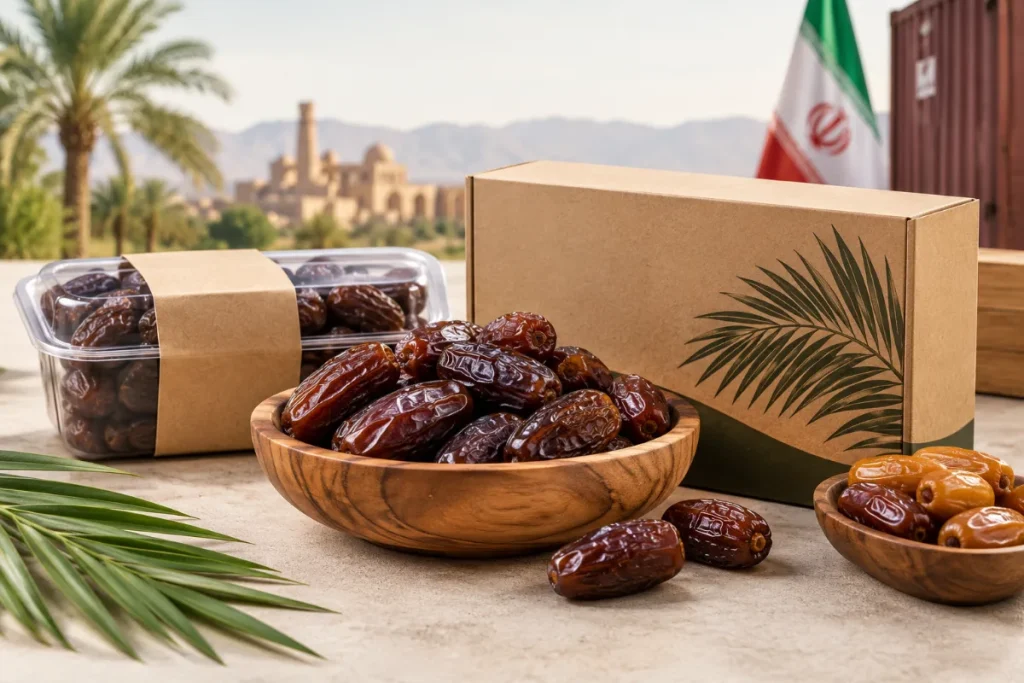
Private label Iranian dates offer a highly profitable opportunity for retail brands and B2B distributors seeking to scale their product lines without agricultural investments. By partnering with direct manufacturers, businesses can bypass volatile commodity markets and secure premium, retail-ready products under their own branding. This guide covers everything from commercial date varieties and packaging structures to import compliance, ensuring your brand achieves a competitive edge and maximum shelf stability.
Why Iranian Dates Work for Private Label Programs
Creating a private label date program separates retail brands from the constraints of standard bulk buying and basic white labeling. Instead of accepting generic product assortments, a customized approach allows companies to define exact fruit sizing, sorting parameters, and brand-specific packaging. Iran offers unmatched climatic diversity alongside competitive production costs, making it the optimal origin for businesses looking to scale.
There are three major competitive advantages when sourcing from this region. Importers can simultaneously secure fresh, semi-dry, and dry date varieties from a single origin point. Lower production costs provide buyers with significantly wider margins compared to purchasing Medjool dates, freeing up capital for premium packaging. Finally, Iranian dates require no artificial syrups, perfectly aligning with consumer demands for clean labels and no added sugar.
Choosing the Right Variety for Your Brand
Selecting the correct date variety is the most critical commercial decision. It directly dictates your required packaging structure and determines whether you must utilize cold chain logistics or ambient dry containers.
Mazafati
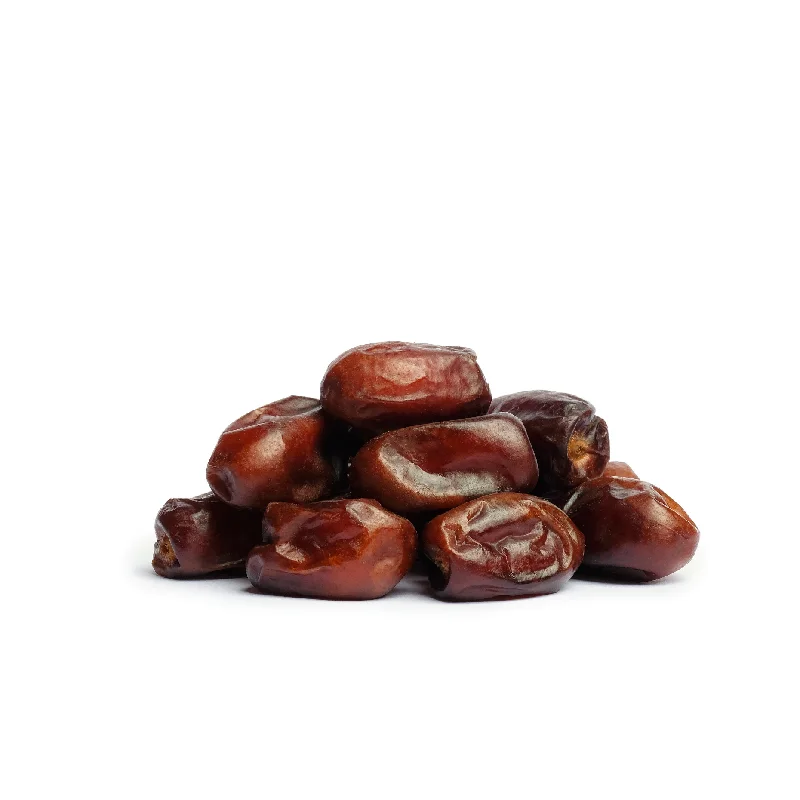
Mazafati is the most popular soft date for the refrigerated sections of global supermarkets. It features a dark coloration, a fleshy texture, and a distinctive caramel flavor. Because its moisture content ranges between 15% and 35% depending on harvest timing, the Mazafati variety requires a strict cold chain. Distributors must utilize reefer containers set between 0 and 5 degrees Celsius to prevent spoilage, making it the ideal product for 400-gram to 600-gram retail boxes in the fresh produce aisle.
Piarom
Piarom stands as the most luxurious option for premium brands and gourmet retailers. It has a thin skin that clings tightly to the flesh, an elongated appearance, and a semi-dry texture with moisture levels strictly below 15%. Because it contains predominantly fructose and boasts excellent shelf life in cool ambient temperatures, Piarom is perfect for high-end health food stores and luxury gift boxes. Its low moisture content drastically reduces the risk of fermentation during international distribution.
Sayer
Sayer, also known as Stamaran, is the most economical and flexible variety for high-volume import and extensive processing. It is a semi-dry date with low moisture generally falling below 15%, providing exceptional shelf life without the need for refrigerated transport. The pit separates effortlessly from the flesh. This makes Sayer the premier choice for brands supplying pitted dates, nut-stuffed products, or chopped dates coated in rice flour for stand-up pouches.
Zahedi
Zahedi serves specific market segments looking for dry snacks and dual-purpose culinary ingredients. It features a golden-brown color, a firm texture, and a milder sweetness that appeals to consumers seeking low-sugar alternatives. Transportation and warehousing for Zahedi are highly cost-effective, and it holds a strong market position across the Middle East, the Indian subcontinent, and the organic dry goods sectors of Europe.
| Variety | Texture & Moisture | Target Retail Segment | Storage/Shipping | Shelf Life |
|---|---|---|---|---|
| Mazafati | Soft, High Moisture (15-35%) | Fresh Produce, Supermarkets | Reefer Container (0-5°C) | 12-18 months (refrigerated) |
| Piarom | Semi-Dry, Low Moisture (<15%) | Premium & Gourmet Retail | Dry Container (Ambient/Cool) | 18-24 months |
| Sayer | Semi-Dry, Low Moisture (<15%) | Processing, Mass Market | Dry Container (Ambient) | 18-24 months |
| Zahedi | Dry, Low Moisture (<14%) | Niche Markets, Baking | Dry Container (Ambient) | Up to 24 months |
Product Formats and Packaging Options
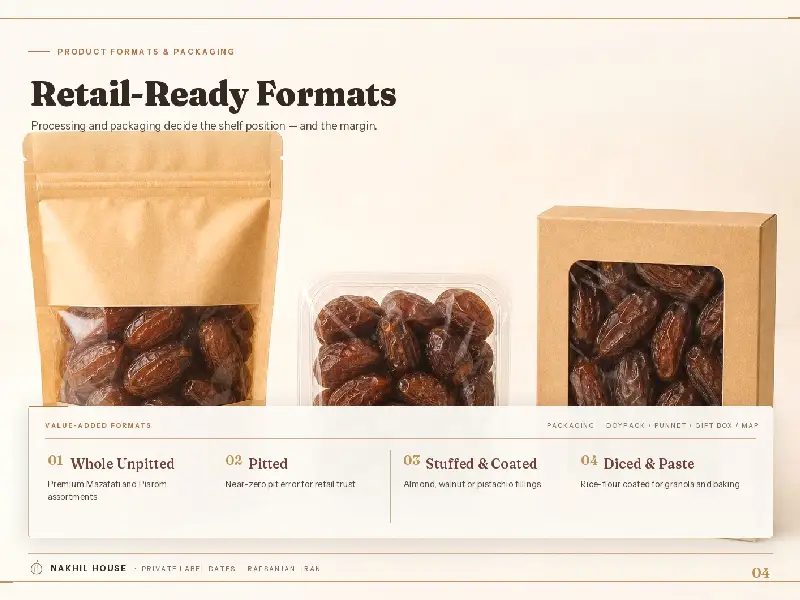
A reliable private label dates manufacturer adds commercial value through specialized fruit processing and advanced retail-ready packaging.
Value-Added Product Formats:
- Whole Unpitted: Intact dates with the pit inside, traditionally used for premium Mazafati and Piarom assortments in high-end boxes.
- Pitted Dates: Mechanically or manually pitted fruit with a near-zero error margin to eliminate consumer complaints.
- Stuffed and Coated: Dates filled with almonds, walnuts, pistachios, or orange peel, then often coated in chocolate to create high profit margins.
- Diced, Chopped, and Paste: Uniform pieces coated with rice flour or dextrose to prevent clumping, serving brands that manufacture granola or industrial baking ingredients.
Retail Packaging Structures:
- Stand-up Resealable Pouches (Doypack): The most popular format in modern retail, featuring zip-locks and transparent windows for consumer convenience.
- Thermoformed Trays and Punnets: Clear plastic or vacuum-sealed containers featuring a top-seal protective film, crucial for maintaining the shape of soft dates.
- Cardboard Window Boxes and Luxury Gift Boxes: Laminated cardboard cartons holding 250 grams to 1 kilogram, lined with food-grade cellophane to maintain hygiene.
- Modified Atmosphere Packaging (MAP): Technology that flushes the package with nitrogen and carbon dioxide to naturally extend shelf life without relying on chemical preservatives.
Quality Standards and Certifications
Defining rigorous technical parameters via a Product Specification Sheet prevents quality disputes during private label contracts. According to the Codex Alimentarius Commission’s Standard for Dates (CXS 143-1985), regulatory standards apply to commercially prepared whole dates packed ready for direct consumption.
This is complemented by UNECE Standard DDP-08, which strictly classifies dates into Extra Class, Class I, and Class II based on uniform sizing and the absence of physical defects. Factory quality control must implement optical sorting, industrial washing, and rigorous scanning via metal detectors and X-ray systems to guarantee the complete removal of foreign matter and stray pits. Standard fumigation or thermal treatments are also necessary to ensure the elimination of live pests.
Export facilities handling private label programs must maintain specific certifications:
- BRCGS or IFS: Mandatory for entry into the majority of European and British supermarket chains.
- ISO 22000 and HACCP: Baseline global standards for ongoing food safety management.
- Halal and Kosher: Required to access specific global demographic markets.
- EU and USDA Organic: Necessary only when a brand orders a certified organic production line.
Labeling, Documents, and Import Compliance
Before printing your custom packaging, your graphical artwork must perfectly match the legal labeling regulations of your target country, such as the FDA guidelines in the United States or EU Regulation 1169/2011.
On-Pack Labeling Requirements:
- Exact product name and variety designation.
- Net weight clearly stated in appropriate local metrics.
- Comprehensive nutrition facts panel.
- Traceable batch or lot number for factory tracking.
- Production date alongside a verified expiration date.
- Proper storage conditions based on the variety.
- Scannable EAN or UPC barcodes.
- Allergen warnings regarding potential pit fragments in pitted products or cross-contamination from nuts in shared facilities.
Export Documentation for Customs:
- Commercial Invoice and detailed Packing List.
- Ocean or ground Bill of Lading.
- Phytosanitary Certificate issued by the Ministry of Agriculture.
- Certificate of Origin proving the exact manufacturing location.
- Health Certificate and Certificate of Analysis (COA) detailing laboratory tests for aflatoxins, pesticide residue, and microbial counts.
- The standardized global customs classification, HS Code 0804.10.
The Private Label Process Step by Step
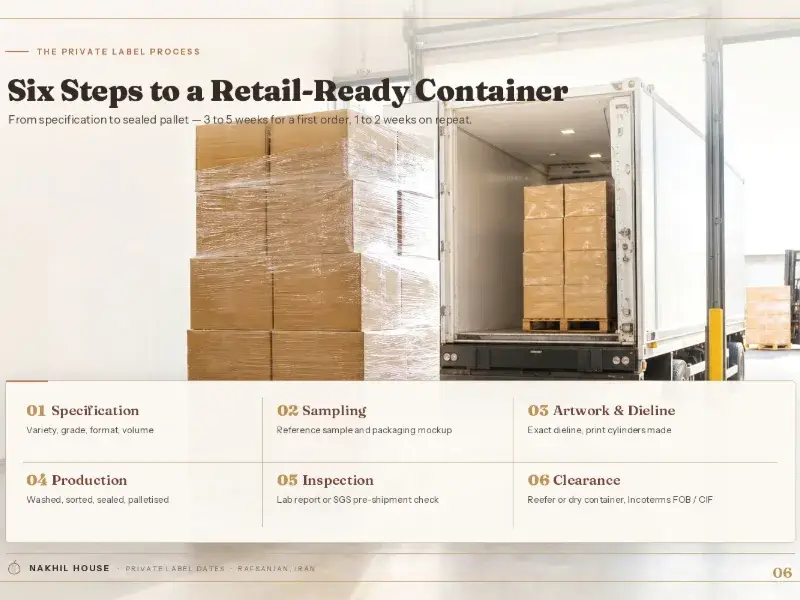
Transforming an initial concept into a finished, retail-ready container requires a structured operational pipeline.
- Consultation and Specification Definition: The brand selects the target date variety, quality grade, processing format, and initial volume requirements.
- Sampling and Approval: The supplier dispatches a physical reference sample of the fruit alongside a structural packaging mockup for a final quality review by the buyer.
- Packaging Dieline and Artwork Preparation: The factory provides an exact dieline template, the buyer’s design team applies their branding, and the factory physically produces the printing cylinders or plates.
- Production, Sorting, and Packing: Raw material is pulled from cold storage, washed, sorted, sealed into retail units, packed inside heavy-duty master cartons, and palletized.
- Pre-Shipment Inspection (PSI): Final quality checks take place. The factory provides laboratory and visual reports, or the buyer hires a third-party inspector such as SGS.
- Customs Clearance and Logistics: The pallets are loaded into a reefer or dry container, sealed by customs, and dispatched according to the agreed Incoterms, such as FOB, CFR, or CIF.
MOQs, Pricing, and Lead Times
Understanding cost structures and minimum order thresholds is essential for planning a successful commercial date rollout.
In private label date manufacturing, Minimum Order Quantities (MOQs) are primarily dictated by two factors. First, international buyers must optimize ocean freight costs, meaning a standard order usually targets a 20-foot or 40-foot container holding between 10 and 24 net metric tons depending on the packaging style. Second, custom packaging requires high minimum print runs to offset the cost of the metal printing cylinders. For brands requiring trial orders, applying custom adhesive labeling to standard stock packaging can dramatically lower the MOQ.
Pricing drivers depend heavily on the chosen date variety and specific size grade, the physical percentage of waste during sorting and pitting, the grammage and material of the retail packaging, the one-time cylinder production costs, and the chosen shipping Incoterm.
Lead times are longer for initial orders, generally requiring 3 to 5 weeks to finalize artwork, manufacture cylinders, and print the flexible packaging. Repeat orders utilize the leftover packaging stock already sitting in the factory warehouse, dropping lead times down to 1 or 2 weeks prior to loading.
How to Choose a Reliable Supplier
The greatest risk when importing dates from Iran is dealing with unverified brokers who possess zero operational control over the sorting lines or cold storage infrastructure. Choosing a direct manufacturer guarantees consistency.
Evaluate potential partners using these five strict criteria:
- Direct access to agricultural orchards and dedicated cold storage: This guarantees year-round supply stability rather than relying solely on the short autumn harvest window.
- In-house processing and packaging infrastructure: Consolidating sorting and packing under one roof minimizes handling damage and prevents quality degradation.
- International financial and logistical capability: The supplier must demonstrate deep knowledge of maritime logistics and offer secure international payment solutions.
- Complete traceability: The facility must be able to track every single retail box back to a specific growing region and harvest batch.
- Target market experience: The manufacturer must thoroughly understand the stringent compliance regulations demanded by target markets like the European Union, the United Kingdom, Canada, Russia, and the Persian Gulf.
Start Your Private Label Date Program
Direct manufacturers are fully equipped to support retail brands, wholesalers, and food distributors looking to launch a highly profitable private label product line. The operations team manages the entire process from selecting the exact date variety that matches your target market to producing the retail packaging, managing the quality control, and executing the international logistics to your destination port. Buyers should prepare their project specifications, request a custom quote, and order a complete reference sample kit to begin the sourcing process.
Frequently Asked Questions
What is the best time of year to lock in contracts for private label Iranian dates?
The best time to secure supply contracts and lock in pricing is between August and October during the fresh autumn harvest in Iran.
Can we combine multiple date varieties or packaging formats in a single container to meet the MOQ?
Yes, you can load a mixed container with multiple date varieties or packaging formats as long as all selected products require identical temperature and humidity conditions for transit.
Who owns the packaging dielines and printing cylinders once produced?
All intellectual property, proprietary structural dielines, and printing cylinders paid for during the initial setup belong exclusively to your brand.
How do you prevent sugar crystallization and fermentation during long sea transits?
We prevent crystallization and fermentation by strictly controlling initial moisture parameters during factory sorting and maintaining uninterrupted cold chain temperature protocols alongside modified atmosphere packaging.
Building a Profitable Date Supply Chain
Launching a successful private label Iranian dates program requires selecting the right fruit variety, utilizing appropriate retail packaging, and partnering with a manufacturer capable of meeting international compliance standards. By controlling the sourcing and packaging process, retail brands and distributors can secure higher profit margins, eliminate supply chain inconsistencies, and deliver a premium, clean-label product directly to their consumers.
Related Products