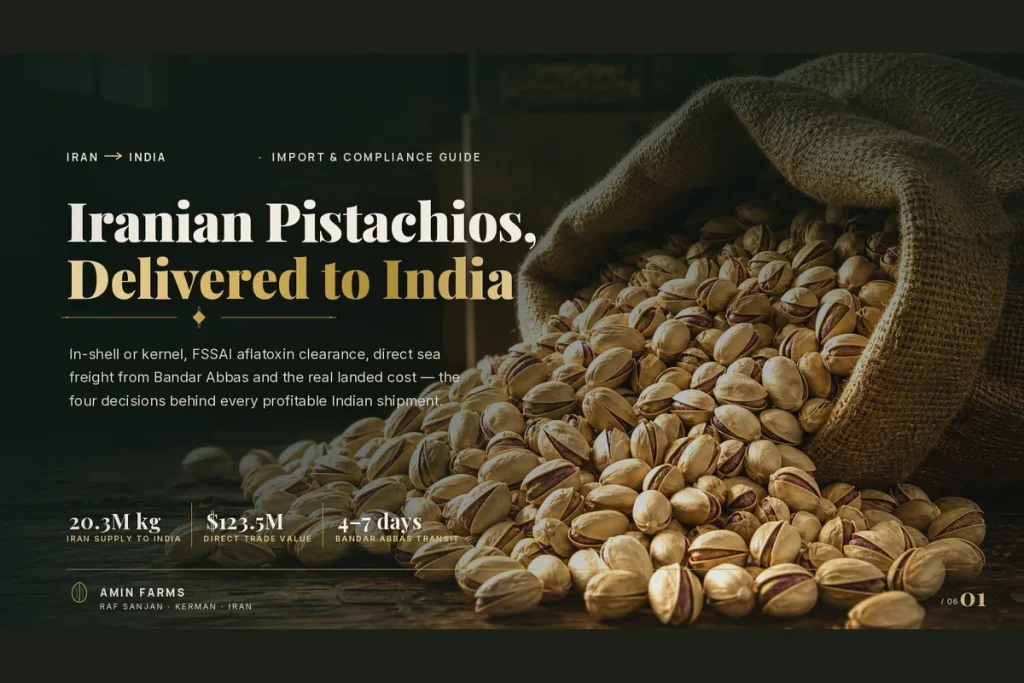
Importing Iranian pistachios into India connects commercial buyers to a domestic market that consumes more than 55,000 metric tons of pistachios each year. Iran supplies roughly 20.3 million kilograms of that total, representing over $123.5 million in direct trade. For Indian wholesale traders, corporate roasters, and commercial food processors, profitability depends on managing four practical priorities: choosing between in-shell nuts (HS Code 08025100) and shelled kernels (HS Code 08025200), meeting strict FSSAI aflatoxin thresholds, selecting direct shipping routes from Bandar Abbas, and accurately forecasting landed costs under Indian customs tariffs.
Why Indian Importers Source Pistachios from Iran
Indian dry fruit buyers consistently turn to Iranian pistachios because of their culinary qualities, high kernel fat content, and logistical convenience. Iranian varieties naturally contain between 54% and 58% unsaturated oil. This dense oil structure allows wholesale processors to roast nuts at temperatures reaching 160°C without scorching the meat, developing a richer flavor than lower-oil alternatives can achieve.
At the same time, India’s sweet manufacturing and confectionery sectors require intensely green kernels for traditional sweets like barfi, kulfi, and festive regional delicacies. Iranian orchards produce early-harvested, green-peeled grades that retain their natural emerald color after chopping, grinding, and baking. From a logistics perspective, direct sea freight from southern Iran reaches western Indian ports in four to seven days. This short voyage protects product freshness and reduces working capital lockup compared to long-distance transpacific shipments.
Iranian vs US and Afghan Pistachios in India
Procurement managers compare origins by looking at oil content, grading consistency, end-use applications, and transit reliability. While California leads in raw global volume and Afghanistan supplies specialty wild crops, Iran remains the core origin for wholesale roasting, luxury gift packing, and commercial confectionery.
| Criteria | Iranian Pistachios | US (California) Pistachios | Afghan Pistachios |
|---|---|---|---|
| Primary Use in India | Wholesale dry roasting, luxury gifting, and industrial confectionery or sweets. | Branded retail snack packs and supermarket consumer lines. | High-end Pista Magaz garnishes and traditional sweet decoration. |
| Flavor and Oil Profile | High oil density (54% to 58%) delivering a rich, full-bodied roasted flavor. | Moderate oil density with uniform moisture, yielding a milder roasted taste. | Concentrated, earthy flavor from wild harvests with dense natural oils. |
| Supply and Grading | Diverse cultivated varieties (Akbari, Ahmad Aghaei, Fandoghi, Kalleh Ghouchi) with exact ounce counts. | Highly standardized industrial grading dominated almost entirely by the Kerman variety. | Small, unstandardized hand-cracked kernels with irregular volume availability. |
| Lead Time to India | 4 to 7 days direct sea transit from Bandar Abbas to Nhava Sheva or Mundra. | 35 to 45 days transit on long-haul container vessels from West Coast ports. | Overland and air freight routes vulnerable to cross-border disruptions. |
California nuts dominate standard consumer snack packets because of their bright, mechanically cleaned shells and uniform appearance. However, their lower oil levels can yield a milder flavor when subjected to traditional Indian spice roasting. Afghan nuts offer distinct flavor and vivid color, but limited agricultural infrastructure prevents suppliers from offering container-level consistency or verified ounce-count sizing. Iranian pistachios provide the practical middle ground: industrial scale, standardized grading, and superior roasting performance.
In-Shell vs Kernel: Which to Import?
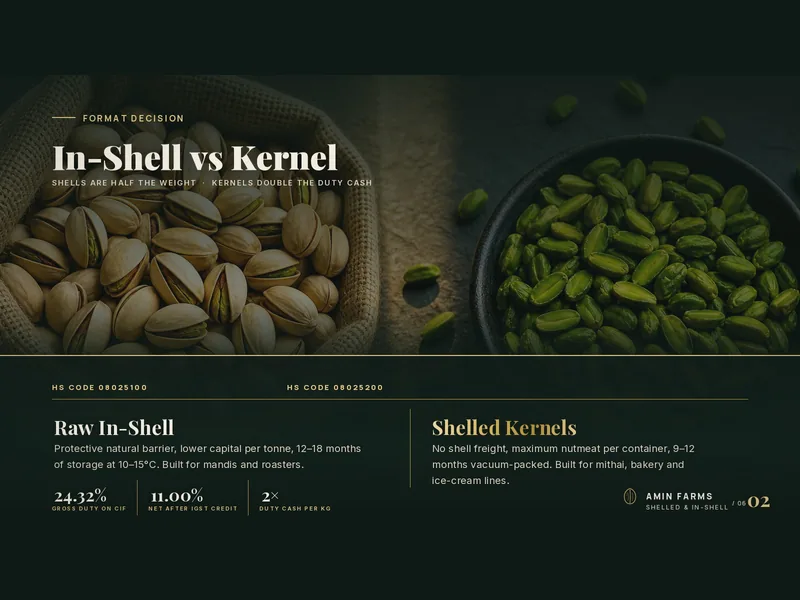
Choose in-shell pistachios if you distribute to wholesale commodity mandis or retail roasting brands, and choose shelled kernels if you supply industrial sweet makers, bakeries, or commercial ice cream producers. In-shell nuts provide a protective natural barrier, require lower initial capital per ton, and store well in bulk warehouses. Kernels eliminate the weight of the shells, maximize usable nutmeat per container, and serve commercial production lines that need immediate ingredients.
Demand by Channel (Retail, Sweets, Dry Fruit Traders)
Matching product format to specific Indian sales channels keeps inventory moving quickly through commercial trade routes:
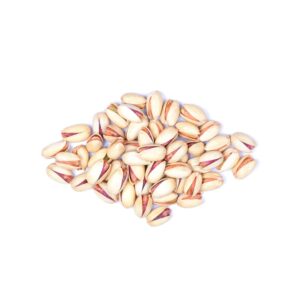
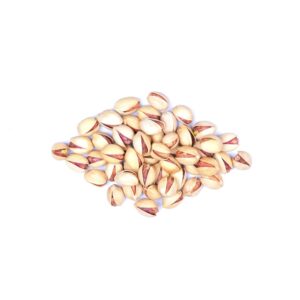
- Wholesale Mandis and Roasters: Major distribution hubs, such as Khari Baoli in Delhi and APMC Vashi in Navi Mumbai, trade large volumes of Naturally Opened and Mechanically Opened in-shell pistachios (Pista Dodi). Local roasters process these bulk nuts with salt or spices before supplying regional neighborhood shops and loose-bin markets.
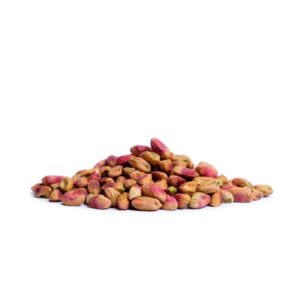
- Mithai, Bakery, and Ice Cream Manufacturers: Commercial food processors require steady volumes of raw pistachio kernels (Pista Magaz). These operations use green peeled kernels and whole purple-skin kernels to create slivered, diced, or powdered ingredients for festive sweets, baked goods, and dairy desserts.
- Modern Retail and Gift Packaging: Supermarket chains and corporate gift packers buy large, uniform, naturally opened in-shell varieties. These nuts are sealed in nitrogen-flushed pouches or packed into gift boxes for Diwali, wedding celebrations, and corporate events.
HS Codes, Price Dynamics and Shelf-Life Differences
In-shell pistachios fall under HS Code 08025100, while shelled pistachio kernels are classified under HS Code 08025200. Although both items carry the same percentage rates in India’s customs tariff, their financial impact differs considerably. Shells make up approximately half of a whole pistachio’s total weight. As a result, processing whole nuts into clean kernels roughly doubles the Free on Board (FOB) price per metric ton. Importers clearing a container of kernels must pay about twice as much cash duty and import tax at the port compared to an equivalent container of in-shell nuts.
Storage requirements also differ between the two formats:
- In-Shell Stability: Whole shells shield the nutmeat from ambient humidity, sunlight, and oxygen. When stored in clean warehouses between 10°C and 15°C, in-shell pistachios retain their crisp texture and low peroxide values for 12 to 18 months.
- Kernel Vulnerability: Removing the shell exposes sensitive fatty acids to air and moisture, accelerating oxidation and rancidity. Kernels must be vacuum-packed in 10-kilogram, nitrogen-flushed, poly-lined cartons to protect their green pigments and maintain freshness across a 9 to 12-month shelf life.
- Aflatoxin Risks: Closed-shell nuts and raw kernels require careful sorting to remove damaged, insect-bitten, or stained nutmeat, preventing contaminated pieces from entering commercial supply chains.
Popular Varieties and Grades for India
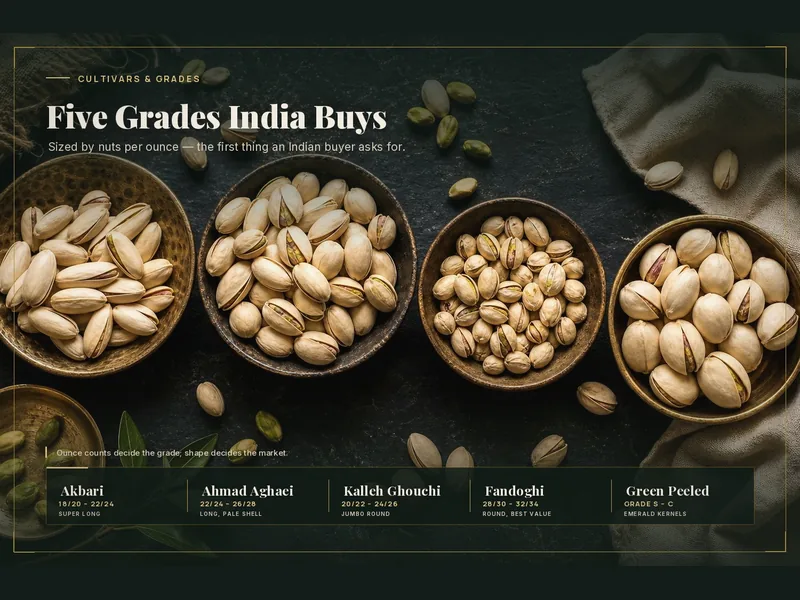
Indian buyers order specific Iranian cultivars based on physical shape, shell appearance, and ounce counts:
- Ahmad Aghaei (Long): Sized from 22/24 to 26/28 nuts per ounce. Recognized by its naturally pale shell and bright red hull blush, this variety is the primary choice for consumer packaging and festive gift boxes.
- Akbari (Super Long): Sized from 18/20 to 22/24 nuts per ounce. This is the largest, most prestigious export grade, featuring an elongated shape that commands top prices in luxury dry fruit stores.
- Fandoghi (Round): Sized from 28/30 to 32/34 nuts per ounce. As the most widely harvested round cultivar in Iran, its competitive price makes it the standard option for mass-market snack packs and budget wholesale roasting.
- Kalleh Ghouchi (Jumbo Round): Sized from 20/22 to 24/26 nuts per ounce. This heavy, wide nut features an open shell, providing a high meat yield and crisp bite.
- Green Peeled and Purple-Skin Kernels: Purple-skin kernels are categorized by physical completeness (whole halves versus splits), while early-harvested Green Peeled Pistachio Kernels are sorted into Grade S (deep emerald), Grade A, Grade B, and Grade C (yellow-green) for commercial food decoration.
FSSAI Food Safety Clearance

Every edible nut consignment entering India must satisfy strict biosecurity regulations enforced by the Food Safety and Standards Authority of India (FSSAI) and the Directorate of Plant Protection, Quarantine & Storage (DPPQS). Customs officers manage these checks through the ICEGATE Single Window Interface for Facilitating Trade (SWIFT), which links customs processing directly with FSSAI’s Food Import Clearance System (FICS) and the Plant Quarantine Management System (PQMS).
As the Food Safety and Standards Authority of India outlines in its Food Import Clearance guidelines, “No consignment of food shall be cleared from customs without a Non-Objection Certificate issued by the Food Safety and Standards Authority of India following satisfactory physical inspection and accredited laboratory analysis.” Passing these inspections requires complete pre-shipment documentation, clean laboratory samples, and correct non-retail carton labels.
Importer Registration, FSSAI License and Plant Quarantine
Before goods leave Iranian ports, the Indian buying company must have active accounts on all relevant regulatory portals:
- Importer Exporter Code (IEC): Issued by the Directorate General of Foreign Trade (DGFT) and linked to the importer’s permanent account and GST numbers.
- FSSAI Central Importer License: Obtained through the Food Safety Compliance System (FoSCoS) portal, authorizing commercial imports under specific food classifications and connecting with FICS.
- Plant Quarantine Permits: Importers must secure an Import Permit (IP) through PQMS or the National Single Window System before shipment, followed by an Import Release Order (IRO) once the ship arrives.
- Mandatory Origin Documentation: Cargo must arrive with a valid Phytosanitary Certificate issued by Iran’s National Plant Protection Organization confirming proper fumigation, a Certificate of Origin, and a batch-specific Certificate of Analysis from an accredited laboratory.
Sampling, Lab Testing and Aflatoxin Limits
After the vessel berths and the container moves to a licensed Container Freight Station (CFS), an FSSAI Authorized Officer inspects the shipment, checks the container seals, and draws composite samples. These samples are sealed and sent to a facility accredited by the National Accreditation Board for Testing and Calibration Laboratories (NABL).
Testing enforces the statutory limits defined in the Food Safety and Standards (Contaminants, Toxins and Residues) Regulations:
- Total Aflatoxins (B1 + B2 + G1 + G2): Capped at 15 µg/kg (parts per billion) for nuts imported for further processing, which includes roasting, salting, blanching, or confectionery manufacturing. For ready-to-eat nuts sold directly to consumers without additional heat treatment, the limit drops to 10 µg/kg (ppb).
- Moisture Content: Must test at or below 5.0% to 6.0%. Keeping moisture low prevents Aspergillus flavus mold from developing during warm ocean voyages.
- Physical Cleanliness and Residues: Consignments must be completely free of live insects, show mold or decay well within statutory allowances, and meet Indian Maximum Residue Limits (MRLs) for agricultural chemicals.
To avoid border rejection, experienced importers require suppliers to perform High-Performance Liquid Chromatography (HPLC) aflatoxin testing at origin right before stuffing the container, ensuring the analytical results match FSSAI testing protocols.
Labeling Requirements for Imported Pistachios
Pistachios arrive in bulk non-retail packaging, including 10-kilogram vacuum boxes, 25-kilogram corrugated cartons, or 50-kilogram woven sacks. These bulk containers must comply with Regulation 10 of the Food Safety and Standards (Labelling and Display) Regulations:
- Name of the food (for example, “Raw In-Shell Pistachios” or “Shelled Pistachio Kernels”).
- Net weight and gross weight in metric units.
- Batch, lot, or code number matching all shipping documents.
- Date of packing and expiry date or best-before timeframe.
- Storage instructions (such as “Store in a cool, dry place below 10°C”).
- Name and physical address of the Iranian processor, along with “Country of Origin: Produce of Iran”.
- Name, address, FSSAI logo, and 14-digit FSSAI Central Importer License number of the Indian buyer.
Indian customs distinguishes between rectifiable and non-rectifiable labeling details. If the importer’s name, address, FSSAI logo, license number, or the green vegetarian mark are missing, customs officers allow workers to apply permanent, non-detachable stickers inside the bonded warehouse.
In contrast, missing processor addresses, unprinted batch numbers, missing origin statements, or omitted production and expiry dates are non-rectifiable defects. Shipments with non-rectifiable errors are denied clearance. In addition, shipments must arrive with at least 60% of their declared shelf life (or a minimum of 3 months) remaining at the time of customs clearance.
Common Reasons for Rejection at the Port
Consignments that fail port inspection receive a Non-Conforming Report (NCR) from FSSAI, leading to mandatory re-export or destruction. The four main causes of border rejection include:
- Transit Aflatoxin Spikes: Excess moisture (over 6.5%) combined with high container temperatures during sea voyages can trigger fungal blooms, pushing aflatoxin levels past the 15 µg/kg threshold.
- Non-Rectifiable Labeling Errors: Missing batch numbers or date discrepancies between carton labels, the Bill of Lading, and the Certificate of Analysis result in immediate administrative holds.
- Shelf-Life Deficits: Consignments that spend too long in origin staging yards and arrive with less than 60% of their declared shelf life remaining are turned away automatically.
- Live Insect Infestation: Finding live storage pests due to improper fumigation triggers an immediate quarantine hold by Plant Quarantine officials.
Port Logistics: Bandar Abbas to Indian Ports
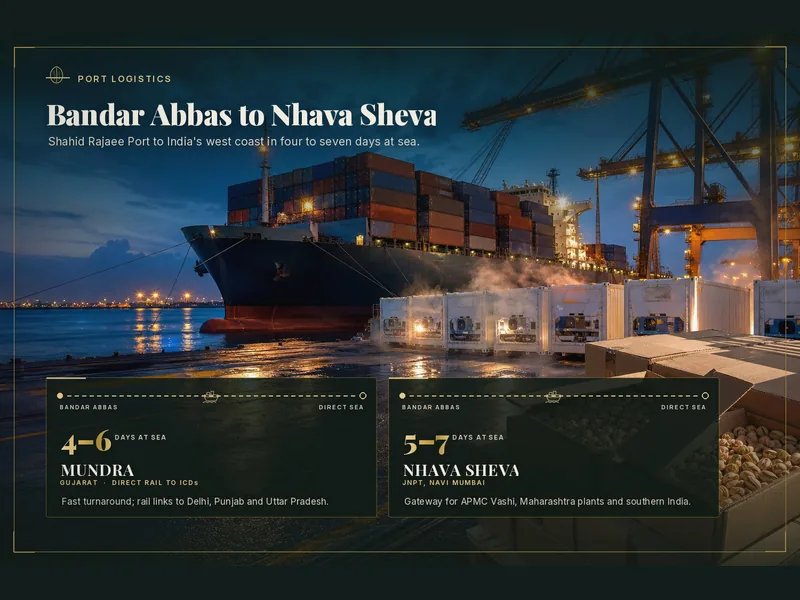
The supply chain starts in the inland orchards of Kerman Province, centered around Rafsanjan and Sirjan. Cargo moves by bonded domestic trucks to Shahid Rajaee Port at Bandar Abbas, Iran’s main container gateway. From there, regional feeder vessels run regular schedules across the Arabian Sea to India’s major western ports.
Main Routes, Transit Times and Container Storage Conditions (Nhava Sheva & Mundra)
Port selection depends on where the nuts will be sold and distributed:
- Nhava Sheva (JNPT, Navi Mumbai): Direct ocean transit takes 5 to 7 days. This is the primary gateway for stock heading to Mumbai’s APMC Vashi market, Maharashtra processing plants, and buyers across southern and central India.
- Mundra Port (Gujarat): Direct ocean transit takes 4 to 6 days. Mundra offers rapid vessel turnaround and direct rail connectivity to Inland Container Depots (ICDs) serving northern trading hubs like Khari Baoli in Delhi, Punjab, and Uttar Pradesh.
- Container Selection (Dry vs. Reefer): Standard 20-foot dry containers carry roughly 11 to 12 metric tons of in-shell nuts in 50-kilogram bags or 10 to 12 metric tons of vacuum-packed kernels. Dry containers work well during cooler winter months if lined with heavy kraft paper and moisture-absorbing desiccant packs. During hot summer months, the monsoon season, or whenever shipping high-value green peeled kernels, importers should use Refrigerated (Reefer) Containers set at 5°C to 10°C with relative humidity below 60% to stop oil breakdown and mold growth.
Customs Clearance Process and Import Duty Structure
Pistachios are assessed under Chapter 08 of the Indian Customs Tariff. The statutory duty rates apply equally to HS 08025100 (in-shell) and HS 08025200 (shelled):
- Basic Customs Duty (BCD): 10% calculated on the assessable Cost, Insurance, and Freight (CIF) value.
- Social Welfare Surcharge (SWS): 10% of the Basic Customs Duty amount, representing an effective 1% charge on the CIF value.
- Integrated Goods and Services Tax (IGST): 12% applied to the combined sum of (CIF Value + BCD + SWS), resulting in an effective tax rate of 13.32% on CIF.
- Total Effective Gross Duty: 24.32% on the CIF valuation. For GST-registered businesses, the 12% IGST portion is fully claimable as an Input Tax Credit (ITC), leaving an effective net duty cost of 11.00%.
Custom House Agents (CHAs) routinely file an advance Bill of Entry on ICEGATE SWIFT before the vessel docks. This allows visual checks and sampling to begin immediately after containers transfer to the CFS, cutting down on demurrage costs.
Payment Methods and Landed Cost
Settling payments for Iranian agricultural trade requires following the Foreign Exchange Management Act (FEMA) guidelines established by the Reserve Bank of India. Importers generally use two payment paths:
- Bilateral Rupee-Rial Trade Mechanism: Designated Indian commercial institutions, such as UCO Bank, hold Rupee Vostro accounts opened by Iranian banks. Importers deposit Indian Rupees directly into the Vostro account to pay for authorized food and agricultural commodities without routing through Western clearing channels.
- Third-Country Settlement Routes: Importers frequently route trade through regional trading companies, primarily based in the United Arab Emirates. Payments move by standard Telegraphic Transfer (TT) or Letters of Credit. Importers must make sure that the Bill of Entry, Commercial Invoice, Certificate of Origin, and bank remittance records match up to satisfy banking audits.
Landed Cost Calculation
Procurement teams calculate per-kilogram landed costs using this straightforward formula:
Total Landed Cost = CIF Value + Basic Customs Duty + Social Welfare Surcharge + IGST + Port and Clearance Charges
Where:
- CIF Value = FOB Price + Ocean Freight + Marine Insurance (converted to INR at the official CBIC customs exchange rate)
- Basic Customs Duty (BCD) = 10% * CIF Value
- Social Welfare Surcharge (SWS) = 10% BCD (equals 1% CIF Value)
- IGST = 12% (CIF Value + BCD + SWS) (equals 13.32% CIF Value)
- Port and Clearance Charges = Customs processing, terminal handling, CFS storage, and inspection fees
Worked Example: In-Shell Pistachios
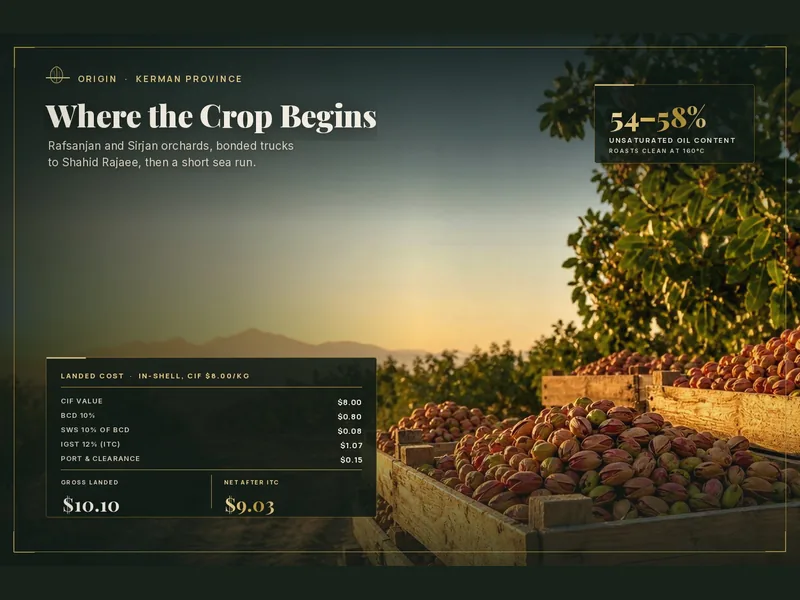
Here is a typical cost calculation for a shipment of raw in-shell pistachios arriving at a CIF valuation of $8.00 per kilogram:
- Base CIF Value: $8.00 per kg
- Basic Customs Duty (10% of CIF): $0.80 per kg
- Social Welfare Surcharge (10% of BCD): $0.08 per kg
- Subtotal for IGST Assessment: $8.88 per kg
- IGST (12% of subtotal): $1.0656 per kg (recoverable as Input Tax Credit)
- Port, handling, and inspection fees: approximately $0.15 per kg
- Total Gross Landed Cost: $10.10 per kg
- Effective Net Landed Cost (after IGST credit): $9.03 per kg
Why Import from Amin Farms
Buying directly from an established origin processor removes trading middlemen and eliminates port clearance risks. Amin Farms provides the technical reliability and processing capacity required by Indian commercial buyers:
- Multi-Generational Farming Heritage: Cultivating pistachios since the early 1900s, the enterprise runs a modern 40,000-square-meter processing complex near Rafsanjan, the center of Iran’s pistachio industry, staffed by more than 400 specialists.
- In-House HPLC Testing: The facility operates dedicated testing laboratories that analyze every export lot for aflatoxins and chemical residues using High-Performance Liquid Chromatography before loading, ensuring full compliance with FSSAI standards.
- Climate-Controlled Silo Storage: Amin Farms uses sealed, temperature-regulated storage silos that keep product moisture below 5.0%, preserving color and crunch across all cultivars, including Ahmad Aghaei, Akbari, Fandoghi, Kalleh Ghouchi, and vacuum-sealed kernels.
- Compliant Documentation: Shipments arrive with complete export paperwork tailored to Indian customs requirements, including pre-approved non-retail carton markings, official Phytosanitary Certificates, and fast vessel dispatch from Bandar Abbas to Nhava Sheva and Mundra.
Frequently Asked Questions
Is import duty higher on in-shell or kernel pistachios in India?
No, the statutory customs duty rate is an identical 24.32% for both forms, though kernels incur roughly twice the cash duty per kilogram because of their higher invoice value.
How long does FSSAI clearance take for pistachio shipments?
FSSAI clearance through the Food Import Clearance System typically takes 5 to 7 working days from physical sampling to the issuance of the Non-Objection Certificate.
Which Indian port is best for Iranian pistachio imports?
Mundra Port is best for distribution across northern India, while Nhava Sheva is optimal for Mumbai and southern regions.
Do bulk 10 kg pistachio cartons require retail nutritional labeling for FSSAI clearance?
No, bulk non-retail cartons are exempt from retail nutritional panels under Regulation 10, but they must still show essential batch, origin, and importer details.
Building a Reliable Import Supply Chain
Running a profitable pistachio import business requires pairing disciplined regulatory compliance with careful product selection. Choosing the right HS code, testing shipments by HPLC at origin to satisfy FSSAI aflatoxin rules, and utilizing short ocean routes from Bandar Abbas helps buyers protect their margins and avoid port detention. Working directly with integrated processors like Amin Farms gives importers the documentation accuracy, stable grading, and reliable supply needed to succeed in India’s competitive dry fruit trade
Related Products