Sourcing bulk nuts requires a precise understanding of commercial specifications to ensure market compliance and profit margins. Navigating Iranian Pistachio Grades can be complex due to varying sizing scales, shell integrity standards, and strict international contaminant limits. In this article, you will learn how the Count-Per-Ounce scale works, how main cultivars differ, and how to verify export standards, including aflatoxin and moisture limits, for seamless global trade.
Why Pistachio Grading Matters for Buyers
Pistachio grading directly determines price per metric ton, processing yield, shelf stability, and customs clearance authorization. Sourcing the correct Iranian Pistachio Grades directly impacts overall profitability and brand reputation. When commercial buyers miscalculate sizing or purity, they face potential import rejections, misaligned packaging costs, or reduced end-product quality. Standardized evaluation allows commercial importers to align raw material costs with exact market requirements.
Professional trade relies on three core evaluation pillars during procurement:
- Physical Sizing and Uniformity: Determines visual appeal, retail pricing tiers, and presentation quality for commercial packaging.
- Shell Integrity: Controls immediate consumer usability versus oil extraction and processing efficiency, distinguishing naturally opened nuts from closed shell options for Iranian pistachio wholesale distribution.
- Chemical and Phytosanitary Compliance: Ensures clearance through European Union, United States, or Gulf Cooperation Council customs based on maximum residue limits and established nut quality control standards.
Pistachio Sizing Systems: Understanding the Count-Per-Ounce (CPO) Scale
The evaluation of Iranian Pistachio Grades relies heavily on standardized weight measurements to categorize raw crops before export distribution. Implementing a consistent pistachio grading system ensures transparency between global suppliers and procurement officers.
The count per ounce pistachios scale, known as CPO, is the international standard unit of measurement used to determine pistachio nut size, defined as the total number of in-shell pistachio nuts contained in one avoirdupois ounce, which equals 28.35 grams.
The standardized testing methodology involves taking a random sample of 142.5 grams, which equals 5 ounces, counting the total nut count, and dividing that figure by 5 to calculate the exact lot size grade.
Common Pistachio Size Ranges
| CPO Range | Size Category | Count per 100g | Primary Commercial Cultivar |
|---|---|---|---|
| 18/20 | Super Jumbo | Under 71 | Premium Akbari |
| 20/22 – 22/24 | Jumbo or Super Long | 71 to 85 | Kaleh Ghouchi or Akbari |
| 24/26 – 26/28 | Medium or Long | 85 to 99 | Ahmad Aghaei |
| 28/30 – 30/32 | Standard or Round | 99 to 113 | Fandoghi |
| 32/34+ | Small Round | Over 113 | Small Fandoghi |
How Size Affects Price and End Use
Nut size directly dictates market valuation and manufacturing suitability. Larger sizes, such as 18/20 and 20/22, command premium wholesale pricing and target luxury retail snacking, high-end gift packs, and boutique distribution across major international markets. Medium to smaller sizes, including 28/30 and 30/32, offer maximum cost efficiency for bulk repacking, industrial snack mixtures, and commercial ingredient processing.
Quality Grades: Open-Mouth, Closed-Shell, and Split Pistachios
Shell condition at harvest dictates whether pistachios enter the in-shell retail market or undergo mechanical shelling for kernel extraction. Understanding these Iranian Pistachio Grades allows commercial buyers to optimize processing efficiency and yield margins.
Open-Mouth Pistachios
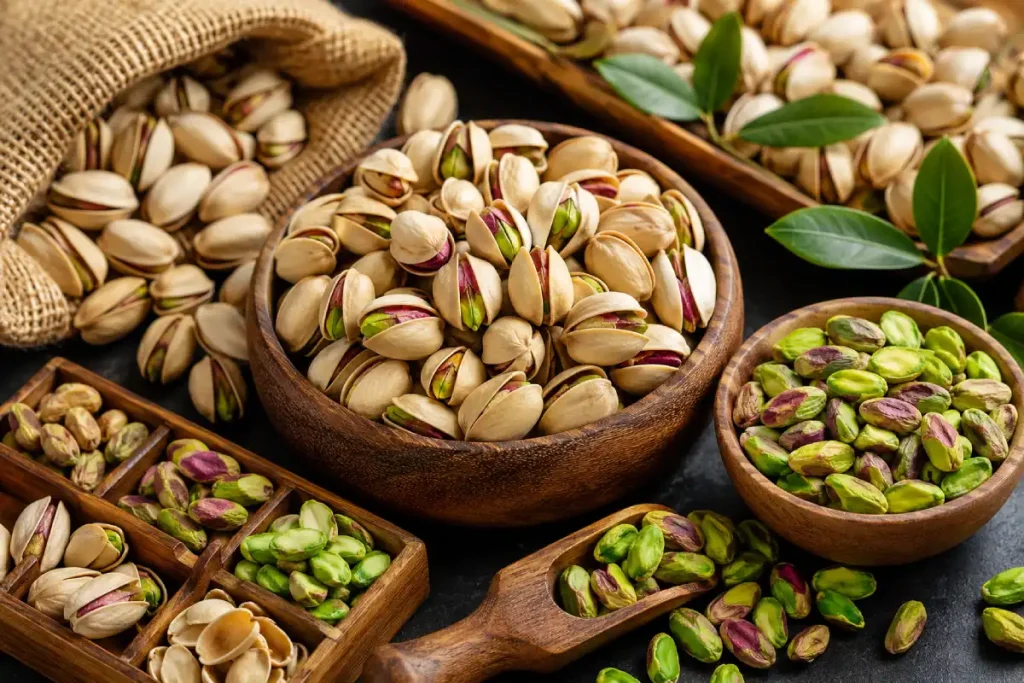
The term open mouth pistachios, known commercially as Khandan, refers to in-shell nuts whose outer shell splits naturally while still maturing on the tree prior to harvest.
Natural open mouth pistachios feature a meat to shell ratio of 52% to 55% kernel weight. They represent the highest grade for direct in-shell snacking due to ease of opening and superior kernel maturation.
Closed-Shell Pistachios
The term closed shell pistachios, known commercially as Kandeh, refers to nuts that remain completely sealed at harvest, requiring mechanical cracking or processing.
Commercial closed-shell lots follow two primary processing pathways:
Mechanical Splitting
Artificially split using cold and hot water thermal shock, known as Abkhandan. This option yields a lower kernel ratio of approximately 45% to 48% and a reduced price point compared to natural open mouth options.
Shelling for Kernels
Mechanically cracked to extract whole raw pistachio kernels for food manufacturing and processing lines.
Kernel Grades and Defect Classification
Official quality standards, such as ISIRI and UNECE guidelines, categorize kernels based on skin color intensity, physical size, and structural defect thresholds.
Grade AA Kernels vs. Pistachio Splits
A pistachio kernel grade AA lot consists of 100% whole, unblemished, fully mature raw pistachio kernels with zero structural damage, whereas pistachio splits refer to mechanically broken halves and pieces generated during shelling.
Color classifications for Green Peeled Pistachio Kernels range from Grade A, representing deep dark green, to Grade D, representing light yellowish green. Grade AA kernels target premium confectionery toppings and retail packs, while splits are utilized for gelato pastes, baklava, and bakery formulations.
Iranian Pistachio Varieties by Grade
Commercial cultivars from Iran offer distinct geometric profiles, kernel to shell ratios, and market demand profiles. Working with reliable bulk pistachio suppliers ensures access to consistent lots tailored to specific regional preferences. Evaluating Iranian Pistachio Grades across these varieties helps procurement managers select the optimal morphology for their packaging lines.
Akbari
The Akbari pistachio is a super-long commercial cultivar characterized by an exceptionally high length-to-width aspect ratio and a distinct naturally open shell.
Standard CPO ranges include 18/20, 20/22, and 22/24. This variety commands the highest market price point and dominates luxury gift markets in the Gulf Cooperation Council region due to its impressive visual size.
read more: Iranian Pistachio Export Company for Global Buyers
Ahmad Aghaei
The Ahmad Aghaei pistachio is an elongated long-type pistachio variety recognized for its bright white shell hull and rich red kernel tip.
Standard CPO ranges include 22/24, 24/26, 26/28, and 28/30. This cultivar is highly favored in European, Indian, and East Asian markets for retail roasting and salting due to its striking color contrast.
Kaleh Ghouchi
The Kaleh Ghouchi pistachio, also classified as Jumbo, is a broad, round-shaped pistachio cultivar known for its large weight per nut and heavy kernel density.
Standard CPO ranges include 20/22, 22/24, and 24/26. Its high fat and oil content makes it ideal for industrial nut pastes, luxury pralines, and bulk snacking distributions.
Fandoghi
The Fandoghi pistachio is a compact, round pistachio cultivar that represents the primary volume benchmark for global wholesale trade.
Common CPO ranges include 28/30, 30/32, and 32/34. This variety accounts for approximately 50% to 60% of total export crops and serves as a primary standard for Iranian Pistachio Grades in volume trading, offering competitive pricing for mass retail repacking.
International Export Standards and Certifications
Technical compliance with destination customs standards is mandatory for successful international trade. Managing Iranian Pistachio Grades requires strict adherence to food safety protocols, laboratory testing, and in-shell pistachios export compliance rules to avoid costly port rejections.
Aflatoxin Limits: EU vs. US vs. Codex
Aflatoxins B1, B2, G1, and G2 are toxic mycotoxins produced by Aspergillus fungi. Official laboratory testing via High-Performance Liquid Chromatography, known as HPLC, is mandatory for verified aflatoxin testing nuts prior to export clearance.
Regulatory thresholds vary significantly across major import regions:
- European Union under EU Regulation 1881/2006 and updates: Ready-to-eat pistachios allow a maximum of 10.0 micrograms per kilogram total aflatoxin and 8.0 micrograms per kilogram B1. Pistachios intended for further processing allow a maximum of 15.0 micrograms per kilogram total and 8.0 micrograms per kilogram B1.
- Codex Alimentarius under CXS 193-1995: Sets a maximum limit of 15.0 micrograms per kilogram total aflatoxin for raw tree nuts.
- United States FDA: Maintains a maximum threshold of 20.0 parts per billion total aflatoxin.
Moisture Content and Shelf-Life Requirements
Maintaining low moisture limits prevents fungal proliferation and maintains sensory crispness during long shipments.
Raw dried in-shell pistachios require a maximum allowable pistachio moisture content of 5.0% to 6.0% under ISIRI Standard 15 and UNECE DDP-10 standards. Roasted pistachios require a maximum allowable moisture content of 3.0% free water content. Properly dried in-shell pistachios maintain quality for 12 to 24 months when stored at cool temperatures below 15 degrees Celsius and relative humidity below 65%.
Packaging Standards for Export
Bulk in-shell shipments utilize 25kg or 50kg multi-wall polypropylene woven bags, or 1000kg Jumbo Bags for commercial processing lines. Shelled kernels require 10kg or 25kg vacuum-sealed aluminum foil bags flushed with Modified Atmosphere Packaging, utilizing a carbon dioxide and nitrogen gas mix, inside corrugated outer cartons to prevent lipid rancidity. Using standard pistachio export packaging for Iranian Pistachio Grades ensures long shelf life and stability during ocean transit.
Pistachio HS Codes for Export
Customs clearance requires exact tariff classification under the appropriate pistachio HS code:
- HS Code 0802.51: Fresh or dried pistachios, in-shell.
- HS Code 0802.52: Fresh or dried pistachios, shelled or kernels.
How to Choose the Right Pistachio Grade for Your Market
Aligning product specifications with regional buyer preferences is crucial for maximizing return on investment. Evaluating Iranian Pistachio Grades against local consumer expectations ensures efficient procurement and sustainable market growth.
European Union
Requires low-aflatoxin lots below 10 ppb. Importers select Ahmad Aghaei or Kaleh Ghouchi in-shell, or Grade AA Green Kernels for premium bakery and gelato manufacturing.
Middle East and GCC Countries
Buyers prefer high visual impact. Target Akbari 18/20 and 20/22 open-mouth naturally split nuts.
India and South Asia
High demand exists for bright white shell aesthetics. Target Ahmad Aghaei 24/26 and 26/28 for festival roasting and retail packs.
China and Far East
High-volume retail snacking drives demand. Target Fandoghi 28/30 and Ahmad Aghaei in vacuum bulk shipments.
Frequently Asked Questions About Iranian Pistachio Grades
What is the main difference between naturally open and mechanically open pistachios?
Naturally open pistachios split naturally on the tree, yielding a higher kernel ratio of 52% to 55% and superior maturity. Mechanically open pistachios are harvested closed and artificially split using water shock, resulting in a lower kernel weight of 45% to 48% and a lower market price.
What is the maximum allowed moisture level for export-grade pistachios?
Under UNECE DDP-10 and ISIRI export standards, raw dried in-shell pistachios must maintain a maximum moisture content of 5.0% to 6.0%. Roasted pistachios must not exceed 3.0% moisture content to prevent fungal development and ensure shelf stability.
Which HS codes are used for Iranian pistachio exports?
In-shell pistachios are classified under HS Code 0802.51, while shelled pistachio kernels are classified under HS Code 0802.52.
How are aflatoxin levels verified prior to international shipment?
Export lots undergo representative sampling tested via High-Performance Liquid Chromatography in accredited laboratories. An official Certificate of Analysis confirming compliance with destination standards, such as under 10 ppb for European Union markets, is issued prior to customs clearance.
Summary
Selecting the right pistachio grade requires balancing sizing metrics, shell opening status, kernel quality, and legal export thresholds. By matching specific varieties like Akbari, Ahmad Aghaei, Kaleh Ghouchi, or Fandoghi with regional buyer preferences, commercial importers minimize operational risks and safeguard profit margins. Relying on accredited laboratory testing and standardized packaging formats guarantees consistent delivery and seamless international clearance across target global markets.
Related Products