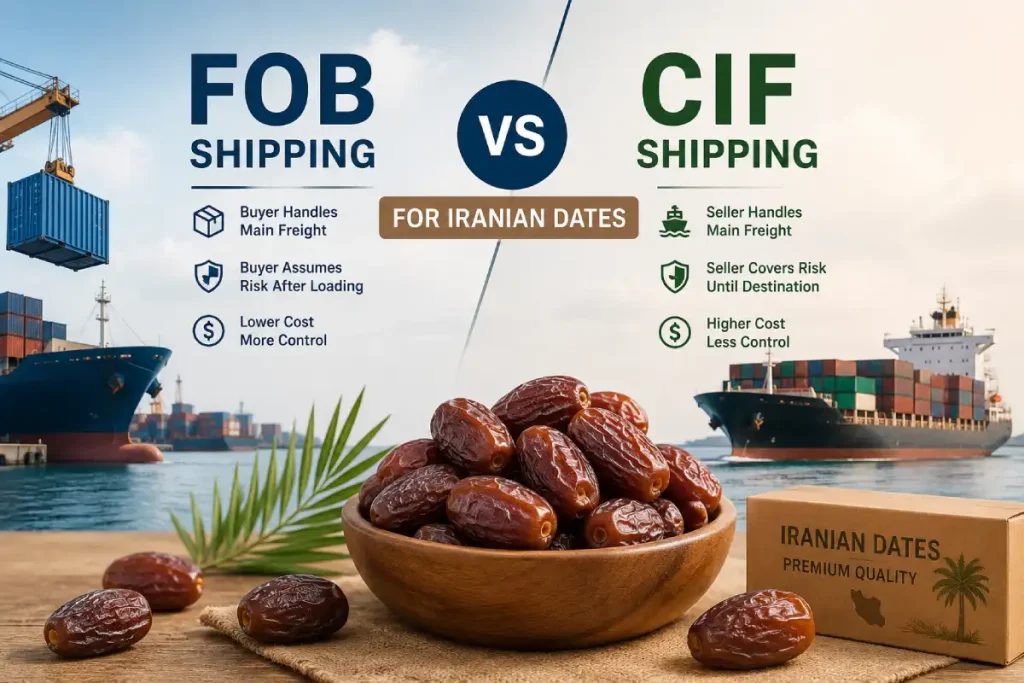
Managing commercial agricultural trade from Middle Eastern terminals requires precise operational planning to preserve target profit margins. Foreign buyers evaluating Iranian date export logistics must choose contract options that balance ocean freight control against destination risk exposure. In this guide, you will discover the key differences between FOB vs CIF shipping for Iranian dates, complete with landed cost calculations, risk transfer rules, and actionable recommendations for your import volume.
What Is FOB? – Free on Board
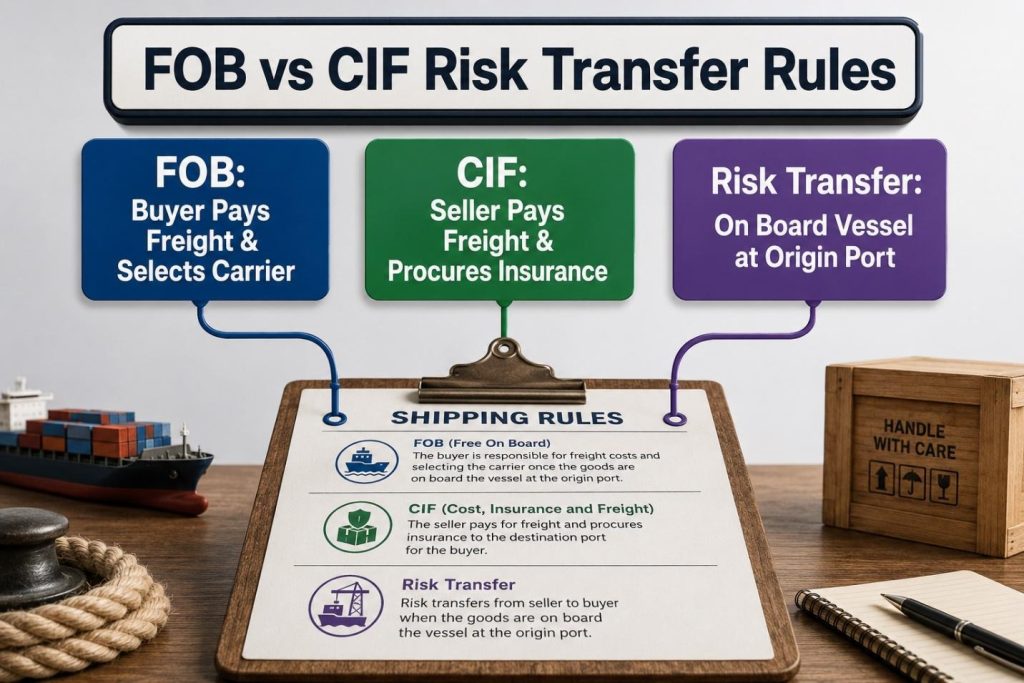
Free On Board, known as FOB, is an Incoterms® 2020 standard specifying that the seller fulfills their delivery obligation when the cargo passes the ship’s rail and is loaded onto the buyer’s nominated vessel at the named port of loading, such as the Port of Bandar Abbas. Under FOB shipping terms, commercial suppliers manage inland transport from regional packing facilities located in Bam or Kerman directly to the Shahid Rajaee Port Terminal. The seller handles Iranian export customs clearance, export packaging, origin terminal handling, and vessel loading. Evaluating FOB vs CIF Shipping for Iranian Dates helps importers decide if managing carrier selection provides better financial control over ocean movement.
Primary operational parameters under FOB include:
- Origin Logistics: The seller manages inland trucking, phytosanitary clearance, export packaging, and terminal handling charges at the port of loading.
- Vessel Nomination: The buyer selects the ocean carrier, negotiates maritime freight rates, and coordinates container loading at the Shahid Rajaee Port Terminal within the Port of Bandar Abbas.
Who Pays for What Under FOB
Under FOB trade terms, financial obligations are split clearly between the seller and buyer at the loading port.
- Exporter Pays: Inland freight from processing facilities to port, terminal handling charges at origin, export duties, and export documentation clearance.
- Importer Pays: Ocean freight transit, marine cargo insurance, destination terminal handling fees, import customs clearance, and final truck transport to local warehouse storage.
Where Risk Transfers to the Buyer
The point of shipping risk transfer occurs the exact second the date cartons pass the vessel rail and are loaded on board at the Port of Bandar Abbas departure terminal. Under FOB terms, any cargo loss, container refrigeration failure, or transit delay during ocean transport remains entirely the financial risk of the buyer.
What Is CIF? – Cost, Insurance, and Freight
Cost, Insurance, and Freight, known as CIF, is an Incoterms® 2020 term requiring the seller to organize ocean transport to the named destination port, cover freight charges, and purchase baseline marine cargo insurance. Commercial buyers analyzing FOB vs CIF Shipping for Iranian Dates often select CIF shipping terms to delegate vessel chartering and maritime booking directly to the producer. Under CIF agreements, the Iranian supplier schedules vessel space, manages origin export formalities, and prepays ocean freight to the destination discharge port, simplifying international procurement for wholesale buyers.
Who Pays for What Under CIF?
Cost obligations under CIF shift major maritime transit expenses back to the export supplier.
- Exporter Pays: Product invoice cost, export customs clearance, origin terminal handling, ocean freight charges to destination port, and baseline marine cargo insurance.
- Importer Pays: Destination port terminal handling charges, import duties and taxes, destination import customs clearance, port demurrage penalties, and final mile trucking.
Where Risk Transfers to the Buyer
A common importer misconception is that liability under CIF remains with the exporter until arrival at the destination port. In practice, shipping risk transfer occurs at the origin terminal once cargo is placed on board the vessel at the Port of Bandar Abbas. Because the seller must purchase marine cargo insurance for the voyage, the buyer receives financial protection through Institute Cargo Clauses C by default, or Clause A policies for reefer shipments.
Cost Comparison: FOB vs CIF for Date Shipments
Evaluating contract structures requires calculating total wholesale date importer costs across every stage of the transit chain. When negotiating FOB vs CIF Shipping for Iranian Dates, trade pricing reflects either buyer-managed freight rates or supplier-bundled logistics packages. Determining how these pricing models structure wholesale date importer costs allows procurement managers to protect operating margins.
Freight and Insurance Cost Breakdown
Agricultural cargo demands distinct container configurations that directly impact freight forwarder costs and container shipping rates.
- Reefer Containers: Required for high-moisture cultivars such as Mazafati dates maintained between 0°C and +5°C, holding 12 to 14 metric tons per 20-foot refrigerated container.
- Dry Containers: Used for low-moisture dry varieties like Piarom, Zahedi, and Sayer dates, holding 18 to 20 metric tons per 20-foot or 40-foot container.
Under CIF terms, suppliers bundle maritime freight and bulk cargo insurance into a single invoice. Under FOB terms, buyers independently negotiate freight forwarder costs to capitalize on lower volume rates.
Hidden Costs Buyers Often Miss
Destination port expenses frequently alter total import expenditure. Unplanned fees at arrival terminals can disrupt your landed cost calculation if overlooked during contract negotiations.
- Destination Terminal Handling Charges: Local fees collected by destination port operators.
- Demurrage and Detention Fees: Penalties charged by shipping lines for delayed container discharge or late equipment return.
- Customs Brokerage and Port Inspection Fees: Expenses associated with destination import customs clearance and food safety testing.
Calculate true landed expenditure using this landed cost calculation formula:
Total Landed Cost = Invoice Cost + Ocean Freight + Transit Insurance + Destination Terminal Fees + Import Duty + Local Trucking
| Parameter | FOB Port of Bandar Abbas | CIF Destination Port | Key Difference |
| Ocean Freight Payment | Importer Pays | Exporter Pays | Exporter books freight under CIF |
| Marine Insurance | Importer Option and Cost | Exporter Procures Policy | Exporter buys minimum Clause C or Clause A policy |
| Risk Transfer Point | Origin Port On Board Vessel | Origin Port On Board Vessel | Identical risk transfer location |
| Logistics Control | High Importer Control | Low Importer Control | FOB enables direct carrier selection |
Which Option Is Better for Small vs Large Date Orders?
Determining the optimal contract term depends on purchase volume and internal supply chain resources. When choosing FOB vs CIF Shipping for Iranian Dates, procurement teams must account for FCL vs LCL shipping conditions. Dates are shipped exclusively in full container loads to prevent odor absorption, humidity damage, and microbial contamination from mixed cargo.
FOB for Experienced Importers with Their Own Logistics
High-volume buyers importing multiple containers of Zahedi or Mazafati dates routinely prefer FOB contracts. Corporate importers leverage global service contracts with major ocean carriers to secure discounted container shipping rates, effectively lowering per-kilogram landed costs below supplier CIF quotes.
CIF for First-Time or Small-Volume Buyers
First-time buyers or smaller wholesale distributors purchasing single container loads benefit from CIF terms. Because FCL vs LCL shipping requirements demand full container commitments, CIF removes the administrative burden of coordinating Middle Eastern ocean routes and negotiating directly with foreign freight carriers.
Impact of Incoterms on Delivery Time and Documentation
Contract terms dictate documentation workflows and vessel departure schedules. Selecting FOB vs CIF Shipping for Iranian Dates impacts how rapidly original paperwork moves through banking channels to destination customs brokers.
Required customs documentation for food imports includes:
- Bill of Lading: Issued as an original set or express release following vessel loading.
- Phytosanitary Certificate: Issued by the national Plant Protection Organization certifying agricultural compliance.
- Certificate of Origin: Authenticated by the Iran Chamber of Commerce.
- Commercial Invoice and Export Packing List: Details net cargo weights, lot numbers, and packaging specifications.
Payment mechanisms such as letter of credit trade finance require strict documentary compliance before the bill of lading is released. While sea freight vs air freight decisions heavily favor ocean transport for bulk dates, air freight is used for early-harvest fresh Rutab dates requiring immediate market delivery.
How Aminfarms Structures FOB and CIF Date Shipments?
Executing date export logistics requires rigid cold-chain enforcement and swift customs clearance. Aminfarms manages direct container loading from certified packing facilities in Bam and Kerman, expediting export clearance at the port of Bandar Abbas to minimize terminal dwell times. Aminfarms provides flexible FOB and CIF contract structures tailored to buyer risk profiles and procurement strategies under 2026 maritime trade regulations.
FAQ: FOB vs CIF Shipping for Iranian Dates
Is FOB cheaper than CIF for Iranian date shipments?
FOB invoice pricing is lower because ocean freight is excluded, but total landed cost calculation depends on whether your freight forwarder costs beat supplier freight rates.
Who handles phytosanitary certificates under FOB vs CIF?
Under both FOB shipping terms and CIF shipping terms, the Iranian exporter is legally required to obtain the official Phytosanitary Certificate prior to vessel departure.
What marine cargo insurance is required for reefer container date exports?
Reefer shipments require specialized marine cargo insurance covering refrigeration failure or Institute Cargo Clauses A all-risk protection rather than basic Clause C policies.
Does CIF include destination import customs clearance?
No, CIF covers maritime transport and insurance to the destination port, leaving import duties, local port clearance, and inland trucking to the buyer.
Conclusion
Selecting trade terms for Iranian date imports requires matching logistics capability with risk management preferences. Evaluating FOB vs CIF Shipping for Iranian Dates enables buyers to optimize procurement strategies. High-volume buyers utilize FOB to reduce ocean transport costs, whereas smaller importers prefer CIF for operational simplicity. Aligning landed costs and risk transfer rules ensures efficient supply chain execution for commercial date imports.
Related Products