Payment methods for importing Iranian dates determine how fast and safely your bulk food shipments arrive. Iran offers excellent wholesale dates, yet international banking rules frequently make new buyers hesitate. By setting up the right financial structure through trading hubs in Dubai or Muscat, you can easily handle import dates from Iran banking compliance. This guide outlines how to execute these transactions and secure your shipments without losing money to fraud or administrative delays.
Why the Payment Method You Choose Matters in Date Importing
Dates spoil quickly if left unprocessed. Therefore, the payment methods for importing Iranian dates directly dictate how fast your supplier sorts, packs, and loads your cargo into reefer containers. If you pick a slow financial channel, your shipment stalls at the facility. Conversely, establishing clear Iranian dates export payment terms upfront guarantees priority handling for sensitive crops. A smart payment structure builds long-term leverage with top-tier Iranian growers and sorting facilities.
Selecting the right financial channel impacts several critical parts of your supply chain:
- Buyer Cash Flow: Staged deposits prevent you from tying up all your capital months before the cargo reaches the destination port.
- Protection Against Non-Compliance: Payments tied to third-party quality inspections mean you only pay for goods that actually match your contract specifications.
- Documentary Clearance Speed: Fast fund transfers accelerate the release of original shipping documents, which prevents expensive demurrage charges when the ship docks.
- Banking Fees: Picking the wrong financial instrument for a small trial order eats up your profit margins through heavy intermediary bank fees.
Banking, Compliance, and Intermediary Hubs in Iran Trade
Moving money directly to Iranian banks from Western countries rarely works due to SWIFT network restrictions. However, banking compliance is standard practice when you import dates from Iran, because agricultural food products fall under humanitarian trade exemptions.
To keep transactions smooth and legal, major Iranian date exporters run registered intermediary companies with active corporate bank accounts in trade hubs like Dubai (UAE), Muscat (Oman), or Istanbul (Turkey). As a buyer, you sign the commercial invoice and contract directly with this third-country entity. Consequently, paying Iranian suppliers safely happens through normal global banking channels. This structure prevents frozen funds, complies with international tax laws, and completely isolates the buyer from sanctions-related banking friction.
Letter of Credit (LC) for Iranian Date Imports
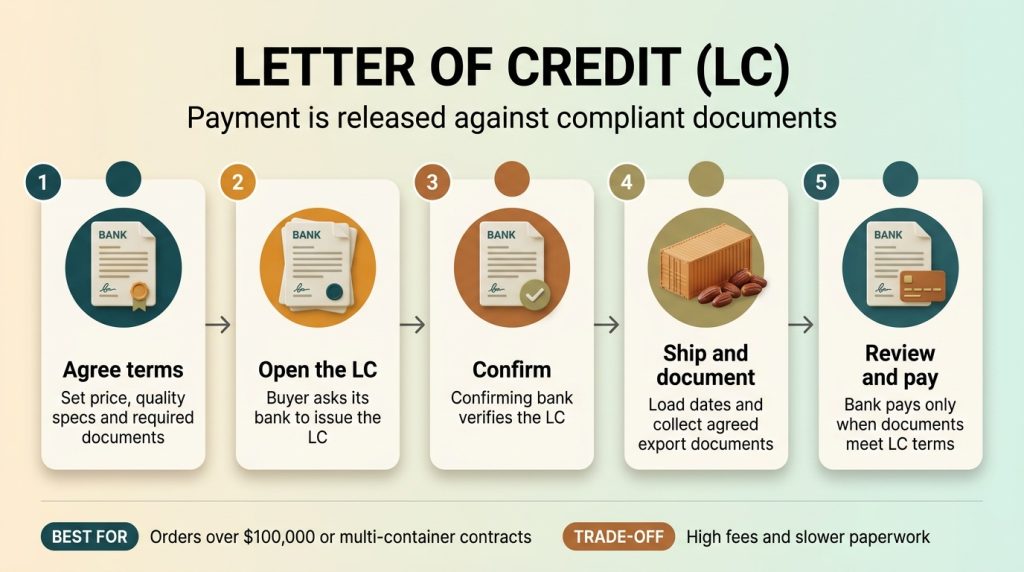
A Letter of Credit (LC) for Iranian dates import acts as an irrevocable bank guarantee, making it the most secure financial tool available for traditional international trade. Because banks cannot route direct LCs into Iran, traders execute them as Back-to-Back LCs through third-party intermediary companies in the UAE or Oman. Alternatively, they use direct bilateral banking systems set up between Iran and specific partner countries like India, China, or Russia.
How LC Works Step by Step
- Proforma and Agreement: You and the seller’s intermediary company agree on the pricing, quality standards, and exact required documents, finalizing a Proforma Invoice (PI).
- LC Issuance: You instruct your bank (the Issuing Bank) to open the LC in favor of the seller’s third-country company.
- Document Verification: A confirming bank in the intermediary country receives the LC, verifies it, and tells the exporter the funds are locked in.
- Loading and Documentation: The exporter loads the dates in Bandar Abbas and collects the required documents, usually a clean Bill of Lading (B/L), Phytosanitary Certificate, Certificate of Origin, and a commercial inspection report.
- Review and Fund Release: The seller presents these exact documents to the bank. The bank strictly checks for errors; if the documents match the LC terms flawlessly, the bank releases the money.
Pros, Cons, and Order Size Requirements
Pros of Using an LC:
- Delivers maximum financial security for buyers who have never worked with Middle Eastern suppliers.
- Guarantees the bank only releases your money when the exact specified documents arrive.
- Removes all risk of losing upfront capital to fake suppliers.
Cons of Using an LC:
- Carries high banking fees that destroy profit margins on smaller orders.
- Requires a rigid, slow documentary process that can delay shipping fresh dates.
- Many suppliers reject LCs for smaller orders because the administrative work takes too much time.
Order Size Requirements:
Due to the heavy banking fees, you should only use an LC for large corporate orders exceeding $100,000, or for annual contracts spanning multiple 40-foot full container loads (FCL). For small-scale or trial shipments, the costs simply outweigh the security benefits.
Telegraphic Transfer (TT): The Most Common Payment Method
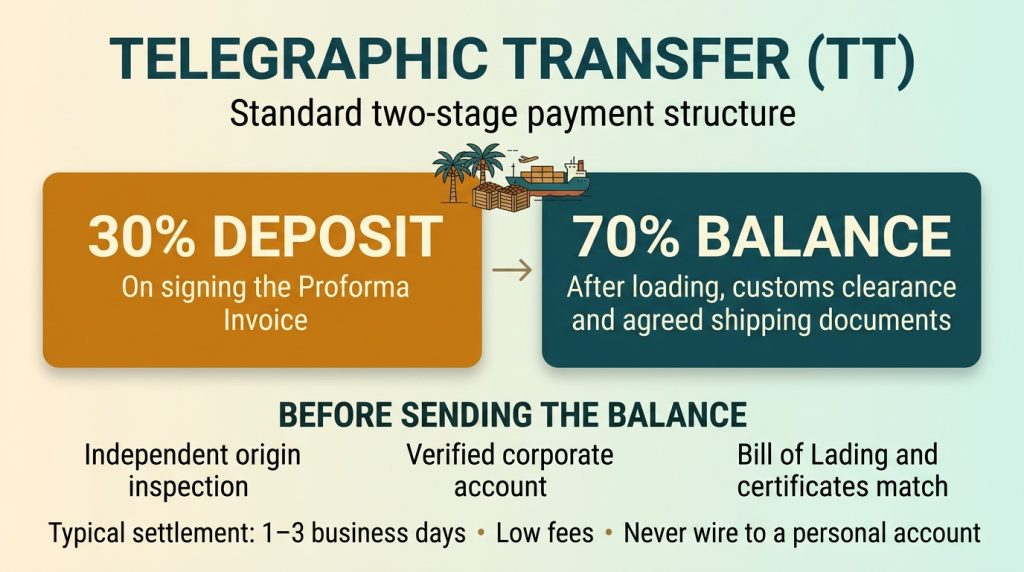
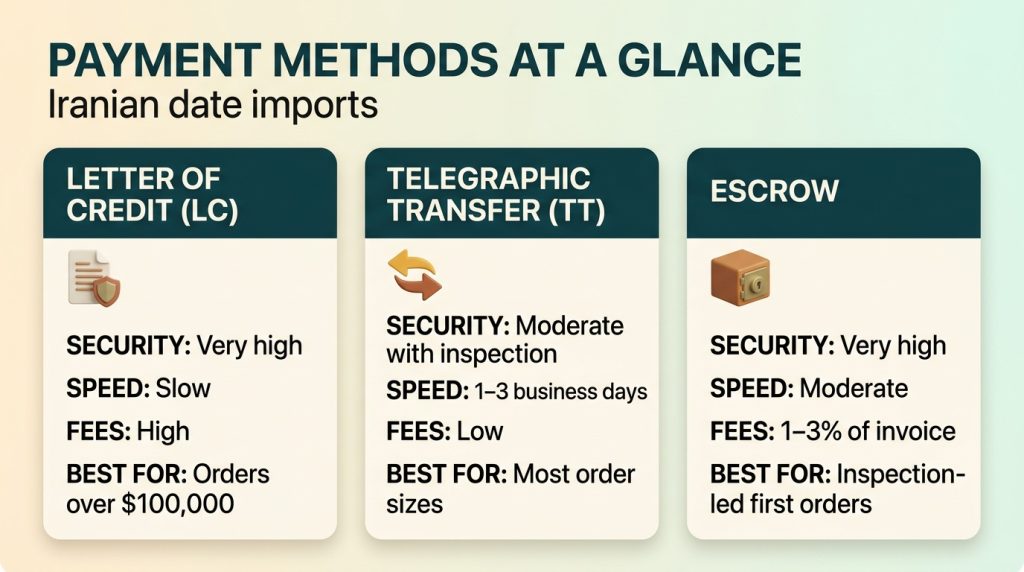
Telegraphic Transfer (TT), or a standard international wire transfer, dominates this market, handling over 80 percent of all date exports from Iran. Buyers send standard international wires in Euros, UAE Dirhams, or Chinese Yuan directly to the exporter’s corporate accounts in Dubai or Muscat. TT payment for Iranian dates gives sellers the immediate cash flow they need to buy cartons, run cold-storage sorting lines, and book reefer containers right at the peak of the harvest season.
The Standard Deposit + Balance Structure (30/70)
Traders manage financial risk by splitting the transfer into two parts. The 30 70 payment terms wholesale dates model serves as the industry standard.
- 30% Advance Payment: You wire a 30 percent deposit when you sign the Proforma Invoice. This acts as a commitment fee, giving the exporter the money to process the dates, secure export packaging, and start the loading procedures.
- 70% Balance Payment: You transfer the remaining 70 percent only after the supplier loads the dates onto the vessel and clears customs. The seller proves this by sending scanned copies of the original shipping documents (Bill of Lading, Phytosanitary Certificate, packing list, and commercial invoice).
For long-term relationships, buyers sometimes settle this balance through Cash Against Documents (CAD) when the vessel arrives at the destination port.
Pros, Cons, and Risk Mitigation Strategies
- Pros: Minimal banking fees, fast settlement times (1 to 3 business days), high flexibility, and better seasonal pricing discounts from suppliers who want fast cash.
- Cons: Sending a 30 percent cash advance carries risk if you fail to vet the supplier’s corporate identity properly.
- Risk Mitigation Strategies: You can eliminate advance payment risks by writing an SGS inspection Iranian dates payment clause into your contract. This forces an independent inspector to verify the cargo physically in Bandar Abbas before you pay the 70 percent balance. Also, always request shipping line container tracking numbers and wire funds strictly to verified corporate bank accounts, never to personal names.
Escrow Services: Secure Third-Party Protection
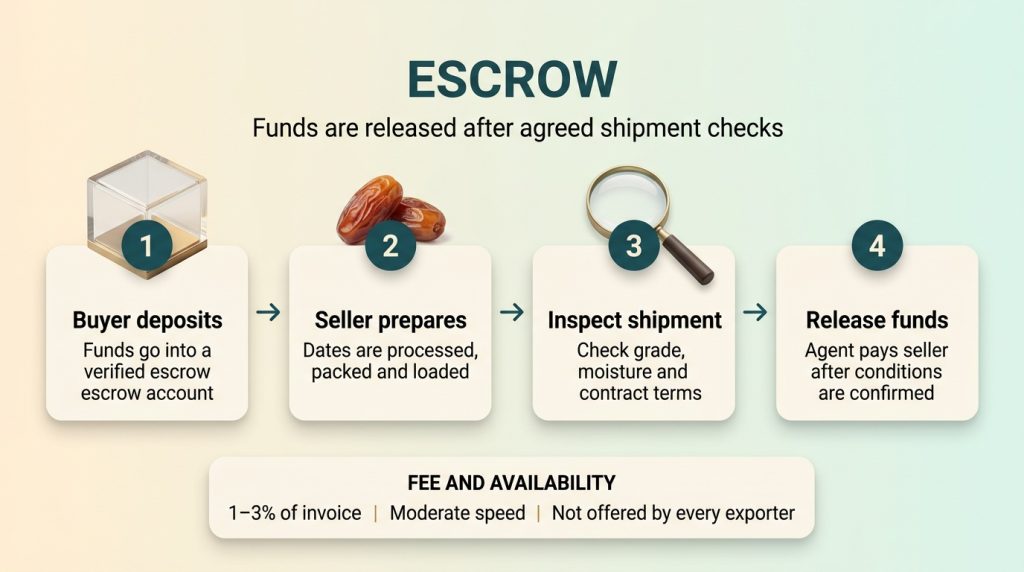
An escrow service for date import holds the buyer’s money in a neutral account until the supplier meets all contract terms. A trusted third-party financial entity manages the funds, releasing them to the Iranian exporter only after the buyer confirms the cargo’s condition or receives third-party inspection documents. This mechanism removes the anxiety for new buyers testing the market, providing a highly controlled environment for B2B transactions.
How Escrow Works for Date Shipments
- Fund Deposit: You transfer the total invoice value into the secure corporate escrow account managed by an international agency partnered with the seller.
- Processing and Loading: Knowing the funds are guaranteed, the exporter pulls the dates from cold storage in Bam or Khuzestan, processes the order, and moves the cargo to the customs terminal.
- Release of Funds: The escrow agent releases the money to the seller only after receiving official confirmation that the shipment meets the contract terms, usually validated by a quality and moisture inspection report at the loading port.
Pros and Cons for Iranian Date Imports
Pros:
- Protects 100 percent of the buyer’s capital.
- Ensures the physical product matches the contracted grade (size, moisture levels, syrup leakage) before the supplier gets paid.
- Drastically reduces commercial misunderstandings and post-delivery disputes.
Cons:
- Escrow agents charge service fees ranging from 1 to 3 percent of the total invoice value.
- Many traditional Iranian agricultural exporters do not use official international escrow platforms.
- Resolving disputes through an escrow platform takes time if disagreements happen regarding quality.
LC vs. TT vs. Escrow: Side-by-Side Comparison
To figure out the most efficient financial channel for your business, look at how these three options perform across key commercial metrics.
| Payment Method | Buyer Security | Processing Speed | Transaction Fees | Ideal Order Volume | Documentation Complexity | Supplier Acceptance |
|---|---|---|---|---|---|---|
| Telegraphic Transfer (TT) | Moderate (relies on independent inspection) | Very Fast (1-3 days) | Low | Any volume (LCL & FCL) | Low | Universally Accepted (>80%) |
| Letter of Credit (LC) | Very High | Slow (requires strict document flow) | High | High volume (>$100k, multi-container) | Very High | Limited to large corporate exporters |
| Escrow Service | Very High | Moderate | Moderate (1-3% of invoice) | Medium to High volume | Moderate | Limited to tech-forward exporters |
Choosing the Right Payment Method for Your Order
Picking the best financial strategy means matching the payment terms to your order volume and your relationship with the supplier. Follow these rules to find safe payment methods wholesale dates Iran scenarios:
- Scenario 1: Trial and LCL Orders (Up to 20 Tons): For initial test shipments or Less than Container Load (LCL) orders, use the 30/70 TT structure combined with an independent third-party inspection. If the supplier offers it, Escrow works perfectly here too. Both provide great security without the heavy banking overhead of an LC.
- Scenario 2: High-Volume FCL Orders (Over $100,000): When buying multiple Full Container Loads (FCL), protect your capital by using a Letter of Credit routed through the seller’s UAE or Omani partner company. If the supplier refuses LC terms, negotiate a TT contract but require extremely strict, independent customs and quality inspections prior to transferring the 70 percent balance.
- Scenario 3: Long-Term and Trust-Based Partnerships: Once you trust a supplier, use a direct TT transfer with a smaller advance payment (like a 20/80 split). This speeds up customs clearance, gets you priority access to premium Mazafati dates B2B payment schedules during the busy harvest season, and secures the best pricing discounts.
Fraud Prevention, Red Flags, and Supplier Verification
Securing your investment requires thorough due diligence to prove you are dealing with a professional exporter. By actively verifying your supply chain partners, you turn international trade risks into a safe, repeatable procurement process. For a full due-diligence process, see our guide on how to verify an Iranian date export company.
Supplier Verification Checklist:
- Check the exporter’s official commercial identity by asking for their business registration or export card from the Iran Chamber of Commerce, Industries, Mines and Agriculture (ICCIM).
- Request the company registration documents for their intermediary receiving company in the UAE, Oman, or Turkey.
- Demand a physical product sample shipped via international courier (DHL or Aramex) before you sign a bulk contract.
- Do a live video tour of the supplier’s cold storage facilities and sorting lines, or hire a local agent to visit the site physically.
Red Flags to Avoid:
- Abnormally Low Pricing: Walk away from quotes that fall significantly below the market floor prices in Bam or Jahrom; scammers always use massive discounts as bait.
- Personal Bank Accounts: Never wire a 100 percent advance payment, and immediately stop talking to the supplier if they ask you to wire funds to a personal bank account instead of a registered corporate entity.
- Refusal of Inspection: If a supplier refuses to include a clause allowing for international third-party inspection (like SGS or Bureau Veritas) at the port of origin, find another vendor immediately.
Conclusion
Successfully importing dates from Iran requires choosing a financial strategy that balances capital security with processing speed. While Letters of Credit offer total protection for massive corporate orders, the 30/70 Telegraphic Transfer remains the most practical and efficient choice for most buyers when routed through legal intermediary hubs in the UAE or Oman and backed by independent SGS inspections. By running basic supplier verification checks and using standard international payment terms, you can confidently secure high-margin dates while completely avoiding financial and compliance risks.
FAQ
Is it legally permissible to pay for Iranian dates under international trade regulations? Yes, agricultural goods hold humanitarian exemptions, and payments route legally through registered intermediary companies in hubs like the UAE or Oman.
What is the safest payment method for a first-time Iranian date order? The safest route is a 30/70 Telegraphic Transfer tied strictly to an independent SGS port inspection, or a verified third-party escrow service.
Can buyers pay in currencies other than USD for Iranian dates? Yes, most suppliers prefer receiving Euros (EUR), UAE Dirhams (AED), or Chinese Yuan (CNY) to avoid USD clearing delays.
Why do many Iranian date exporters prefer payment accounts in the UAE or Oman? These corporate accounts provide direct access to the SWIFT network, allowing fast, legal, and restriction-free currency transfers for international buyers.
Related Products