
The Iran Date Harvest Timeline serves as a definitive logistical framework for international agricultural buyers. Mastering this schedule allows procurement managers to secure volume allocations, guarantee product freshness, and circumvent peak-season freight rates. This brief outlines the exact procurement windows based on biological maturation and regional climate data, stripping away supply chain inefficiencies to deliver highly actionable sourcing intelligence.
Iran Date Harvest Calendar
Integrating the Iran Date Harvest Timeline into procurement models requires understanding that harvesting spans several months. Extraction operations are dictated strictly by the fruit’s biological maturation stages and distinct regional microclimates rather than standard calendar dates.
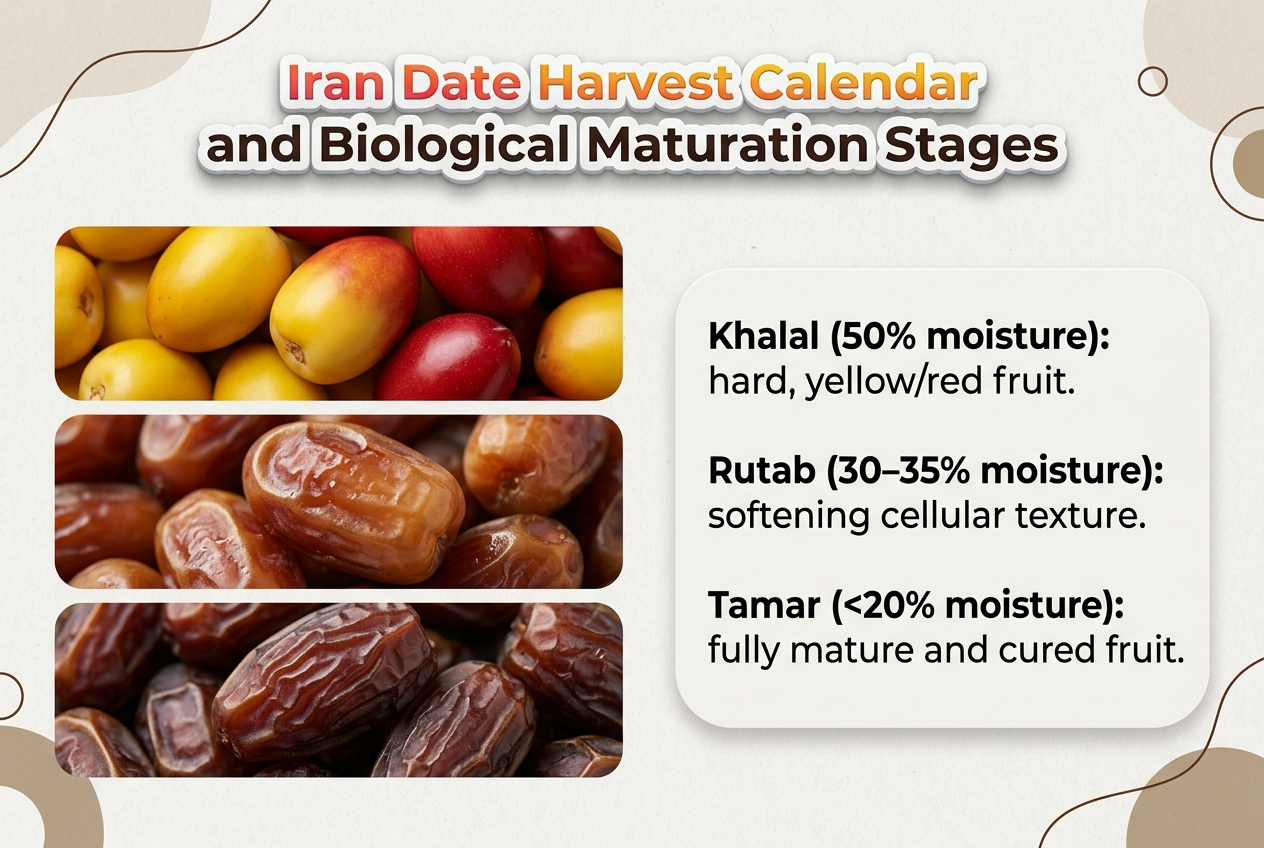
Technical Stages of Date Ripening (Khalal, Rutab, Tamar)
Biological maturation progresses through three distinct botanical phases. The Khalal stage yields a hard, yellow or red fruit retaining approximately 50% moisture. Rutab represents partial ripening, softening the cellular structure as moisture decreases to 30%–35%. Tamar marks full maturation and curing on the palm, yielding a firm structure with moisture dropping below 20%.
Consequently, importers sourcing fresh varieties (such as Mazafati) execute contracts corresponding to the Rutab stage. Conversely, buyers seeking semi-dry commodities (such as Piarom or Zahedi) base procurement on the Tamar stage, which inherently occurs several weeks later.
Overview of the Date Harvest Season in Iran
The core Iran Date Harvest Timeline spans from late July to late October, providing a precise three-month window for global buyers to sequence their supply chain operations.
Why Harvest Timing Matters for Importers
Harvest proximity directly dictates pricing structures and grade availability. Procuring immediately post-harvest secures optimal baseline pricing and guarantees access to premium, calibrated grades before aggregate export markets deplete inventory.
Key Date Producing Regions in Iran
Commercial yields are concentrated across Iran’s southern belt. Provinces including Kerman, Hormozgan, Khuzestan, Bushehr, Sistan and Baluchestan, and Fars possess the specific thermal profiles and soil salinity levels necessary for large-scale, export-grade cultivation.
Climate Factors Affecting Harvest
Harvest initiation is governed by accumulated degree-days (heat units) and ambient relative humidity, which trigger the enzymatic breakdown of sucrose into invert sugars.
Elevated seasonal temperatures accelerate harvest readiness. Importers must continuously monitor southern provincial climates, as extreme heat necessitates expedited freight bookings and rapid contract finalization.
Impact of Annual Weather Shifts on Yield
Meteorological anomalies can shift the Iran Date Harvest Timeline by 10 to 15 days. Unseasonal late-summer monsoons in the southeast or severe heatwaves alter physical quality, occasionally exacerbating skin blistering (epidermal separation) in sensitive fresh varieties, thereby impacting sorting yields.
Main Iranian Date Harvest Months
Extraction operations are segmented into three intervals within the Iran Date Harvest Timeline. Understanding these phases minimizes post-processing lag for international freight forwarding.
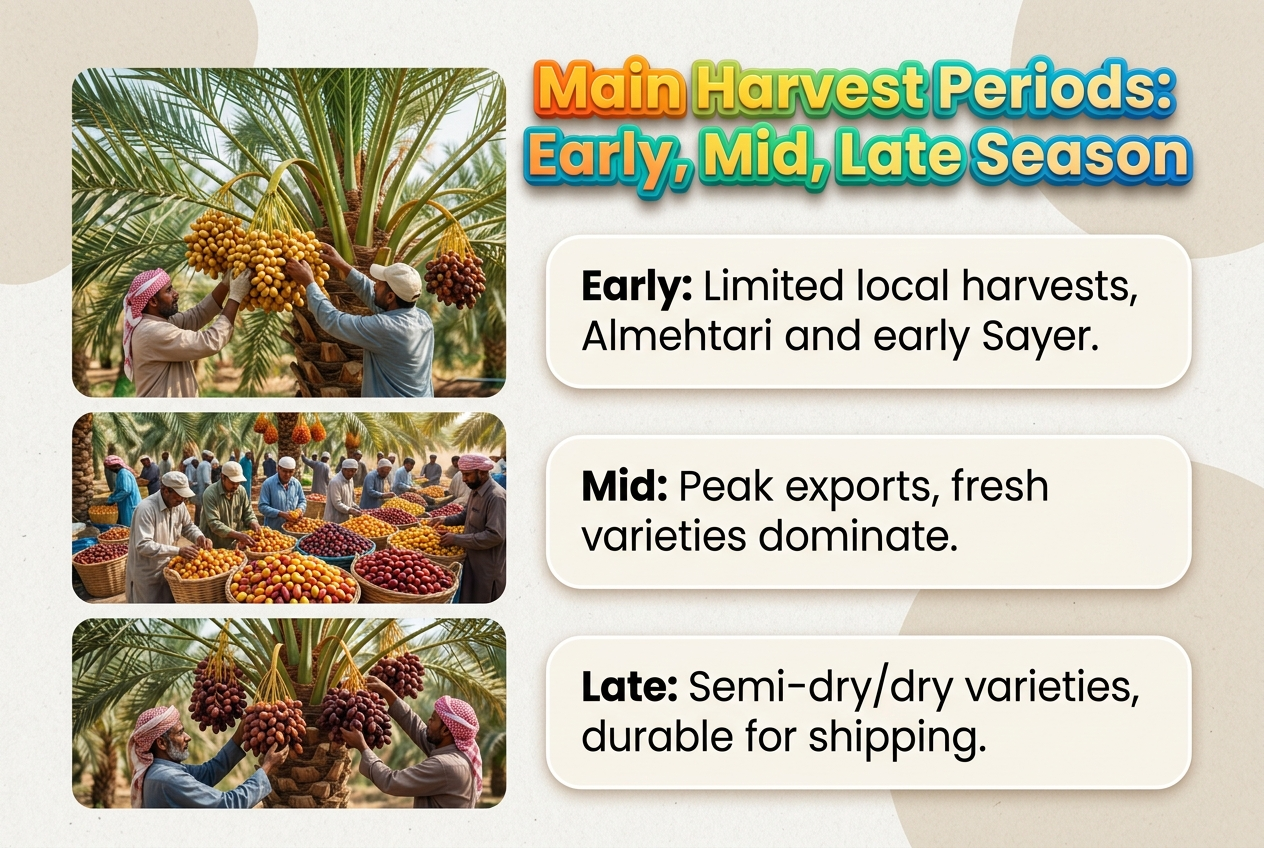
Early Season Harvest (July – August)
Initial harvests yield early-maturing crops in exceptionally arid zones, notably Sistan. Cultivars include Almehtari and early Sayer. Commercial export volumes remain low during this phase, primarily catering to localized demand.
Mid Season Harvest (August – September)
This phase constitutes the peak export processing window. The vast majority of high-demand commercial varieties, particularly fresh cultivars, enter the market, representing the optimal purchasing period for large-volume importers.
Late Season Harvest (September – October)
This phase is dedicated exclusively to semi-dry and dry varietals like Piarom and Zahedi. These dates remain attached to the palm to naturally reduce moisture below 15%, a biological process that fundamentally enhances transport durability.
Harvest Calendar by Popular Iranian Date Varieties
Executing contracts via the Iran Date Harvest Timeline requires varietal precision, as distinct genetic profiles dictate independent maturation cycles.
| Variety | Harvest Window | Moisture Classification |
| Mazafati | Late August – Mid September | Fresh (Rutab) |
| Kaloute | Early September | Semi-Fresh |
| Piarom | Late September – Late October | Semi-Dry (Tamar) |
| Zahedi | Mid September – October | Dry (Tamar) |
| Sayer (Estamaran) | Late August – Early September | Semi-Dry |
| Kabkab | Mid September | Semi-Fresh / Syrupy |
| Rabbi | Early – Mid September | Semi-Dry |
| Shahani | Late September | Soft / Syrupy |
Mazafati Date Harvest Season
Procured from late August to mid-September. As the primary fresh export, Mazafati experiences intense demand in Northern European and Russian winter markets. To maintain cellular integrity, it requires immediate cold storage parameters maintained strictly between -5°C and +5°C.
Kaloute Date Harvest Season
Harvested in early September. Kaloute serves as a highly durable, cost-effective substitute for Mazafati in CIS markets, offering superior shelf-life during extended overland transit due to its slightly lower moisture content.
Piarom Date Harvest Season
Collected from late September to late October. Piarom is an elite commercial grade requiring extended palm-maturation to achieve its characteristic chewy texture and stabilized semi-dry moisture profile.
Zahedi Date Harvest Season
Secured from mid-September through October. Zahedi’s inherently low moisture negates the need for refrigerated logistics, rendering it highly economical for standard dry-container ocean freight to global destinations.
Sayer (Estamaran) Date Harvest Season
Processed from late August to early September. Exhibiting a robust shelf-life exceeding 18 months, Sayer acts as a cornerstone commodity for industrial processing, dicing, and retail repackaging operations.
Kabkab Date Harvest Season
Peaks in mid-September. Characterized by dense syrup content, Kabkab is procured simultaneously for direct consumer retail packaging and secondary industrial paste extraction.
Rabbi Date Harvest Season
Rabbi Date is harvested strictly from early to mid-September. Originating from extreme arid zones, this semi-dry varietal is optimized for stable, non-refrigerated warehousing, minimizing holding costs for distributors.
Shahani Date Harvest Season
Collected in late September. Its predominantly soft and sweet composition dictates its primary application as a raw material input for high-volume paste, syrup, and industrial sweetener manufacturing.
Harvest Timing by Major Date Producing Provinces
Topographical variations inherently stagger the Iran Date Harvest Timeline across provincial boundaries, predictably altering regional supply availability.
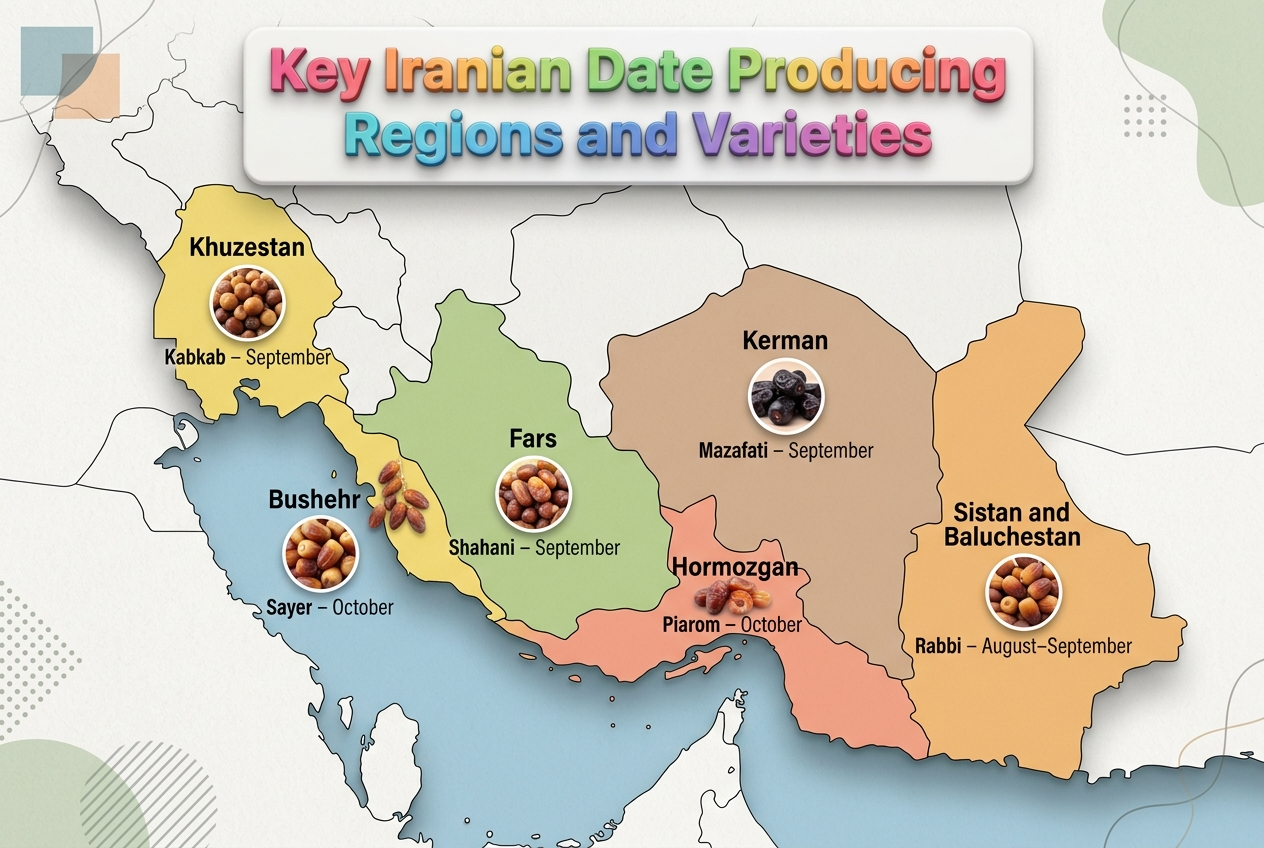
Kerman Province (Bam – Mazafati Dates)
Harvesting peaks aggressively throughout September. The region of Bam operates as the primary logistical epicenter for fresh dates, with mechanical sorting and cold storage facilities operating at maximum throughput.
Hormozgan Province (Piarom Dates)
Extracted systematically in October. The mountainous topography cools the ambient environment, significantly protracting the maturation cycle and resulting in a later, premium dry yield.
Khuzestan Province (Sayer Dates)
Spans late August through September. Intense regional heat facilitates rapid, on-tree curing, thereby accelerating the commercial readiness of the crop for export packaging.
Bushehr Province (Kabkab Dates)
Finalizes in September. Elevated coastal humidity directly impacts fruit texture, demanding highly precise extraction timing to prevent excessive moisture retention and subsequent spoilage.
Sistan and Baluchestan Province (Rabbi Dates)
Occurs uniformly throughout September. The extreme dry heat characterizing this province is paramount for cultivating stable semi-dry varietals that actively resist post-harvest degradation.
Fars Province (Zahedi and Shahani Dates)
Stretches from mid-September into October. Fars encompasses diverse climatic zones, accommodating the simultaneous commercial cultivation of both resilient dry and high-moisture soft varieties.
How Harvest Timing Affects Export Availability
Mapping procurement to the Iran Date Harvest Timeline prevents supply chain bottlenecks by properly accounting for mandatory regulatory and phytosanitary processing delays.
Fresh vs Semi Dry Dates Availability
Fresh dates (Rutab stage) are export-ready immediately but require active reefer container procurement. Conversely, semi-dry dates necessitate an additional 2 to 3 weeks post-harvest to execute rigorous sorting, sizing, and mandatory phytosanitary fumigation protocols before customs clearance.
Peak Export Periods
The bulk export operational phase runs consistently from October through March. This timeframe correlates directly with origin processing finalization and global retail demand escalation.
Aligning Purchases with Global Demand Cycles (Ramadan & Winter Markets)
Strategic procurement aligns agricultural outputs with cold-weather consumption spikes. Northern climates drive high demand for caloric commodities during winter. Executing contracts in September ensures inventory traverses customs and reaches northern distribution centers by November, simultaneously securing volumes well ahead of cyclical Ramadan demand surges.
Storage and Cold Chain After Harvest
To halt enzymatic degradation and microbial proliferation, harvested fresh fruits must be rapidly chilled below a core temperature threshold of +5°C.
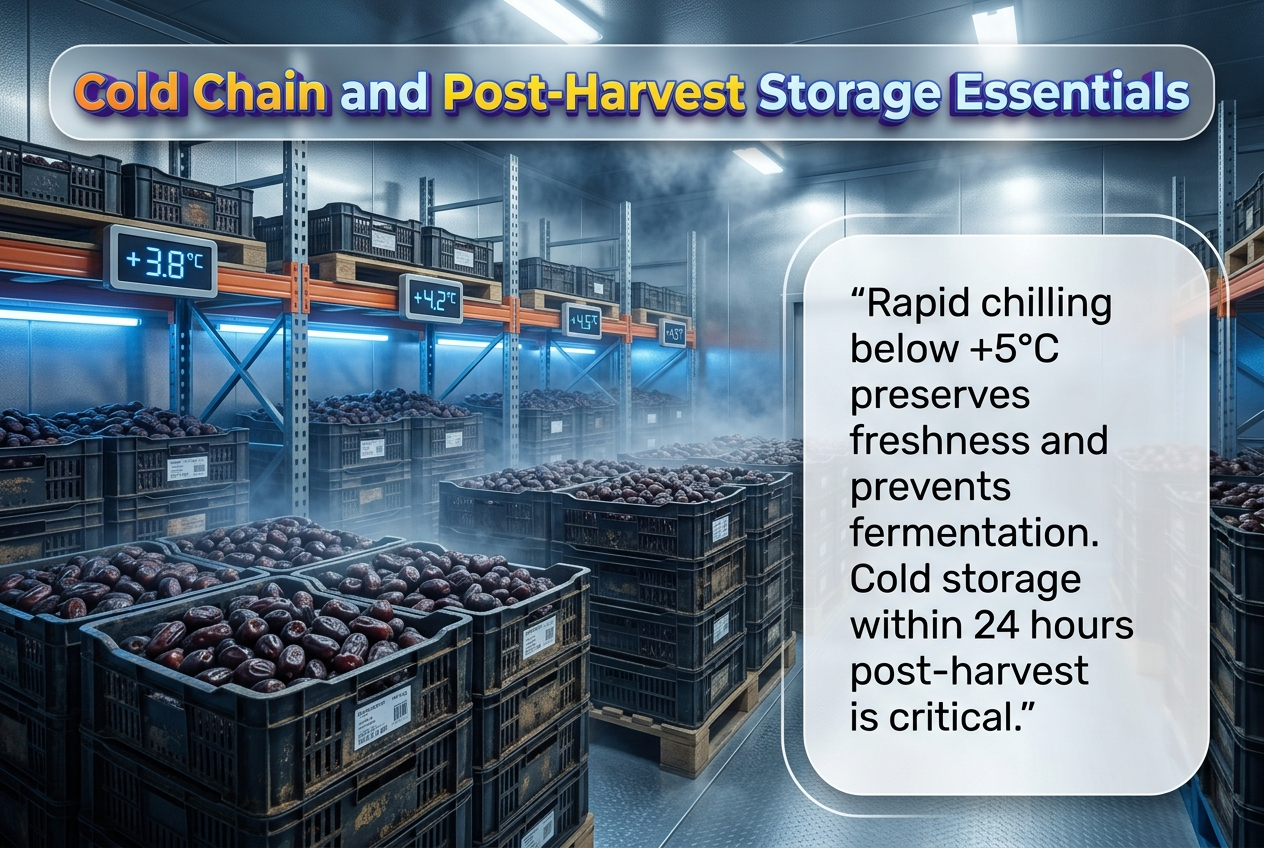
Fresh exports must transition from plantations into actively monitored cold stores within 24 hours of harvest. Delayed logistics induce irreversible fermentation and sugar crystallization, rendering cargo entirely unfit for wholesale distribution.
Logistics and Transit Times for Northern Corridors
Strategic freight routing leverages ambient environmental cooling. Utilizing the International North-South Transport Corridor (INSTC), terrestrial routes via Astara, or Caspian Sea maritime lines requires 10 to 18 days of transit. Scheduling shipments late in the Iran Date Harvest Timeline (November) toward northern climates significantly reduces reliance on costly active refrigeration for semi-dry cargo loads.
Post-Harvest Quality Control and Sorting
Industrial standardization occurs immediately following extraction. Commodities undergo mechanical washing, rigorous metal detection, optical size grading, and standardized bulk packaging. Crucially, dry varieties are subjected to required fumigation cycles to eliminate biological contaminants and comply with destination-port phytosanitary standards.
Frequently Asked Questions (FAQs) About the Iranian Date Harvest
The following data resolves standard logistical inquiries regarding the Iran Date Harvest Timeline.
When is the best time to sign a contract for importing dates from Iran?
July or August. Engaging suppliers immediately prior to extraction locks in baseline pricing, circumvents seasonal volatility, and secures priority allocation of prime yields.
Do I need refrigerated shipping for all Iranian dates?
No. Fresh commodities like Mazafati explicitly demand reefer transport, whereas stabilized varietals (Sayer, Piarom, Zahedi) are routinely transported in standard dry containers.
How long does it take to process dates for export after they are picked?
Processing mandates 7 to 14 days. Durations fluctuate based on intrinsic varietal moisture, specific packaging configurations, and destination customs protocols.
Conclusion
Mastering the Iran Date Harvest Timeline allows importers to optimize end-to-end supply chains, mitigate freight expenditure, and guarantee the structural integrity of all procured varietals. By aligning purchasing protocols with this biological schedule, buyers position their inventory to capture maximum revenue during peak winter and holiday market cycles. To circumvent peak-season pricing constraints, procurement directors are advised to contact certified suppliers in July to finalize capacity mapping.
Related Products