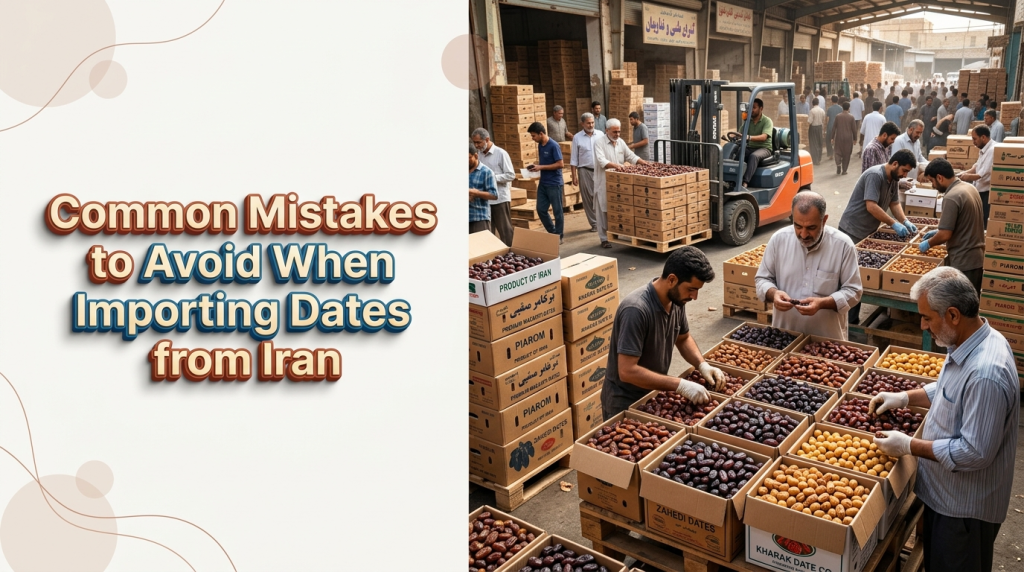
Iran dominates global date cultivation, presenting substantial margin opportunities for international B2B buyers. Sourcing high-demand cultivars like Mazafati at competitive factory rates is highly lucrative. However, this decentralized supply chain harbors severe quality control and logistical vulnerabilities. Navigating this terrain requires robust regional expertise and proactive risk mitigation. Understanding the Common Mistakes to Avoid When Importing Dates from Iran is imperative for establishing a resilient, profitable procurement strategy.
Why the Iranian Date Market is Unique?
Southern provinces such as Kerman, Hormozgan, and Bam offer distinct agronomic advantages, yielding exclusive date varieties. Yet, these regions rely heavily on fragmented, small-holder farming, resulting in inconsistent raw material grading. Processing facility standards fluctuate wildly from automated plants to manual packing sheds. Furthermore, cross-border logistics targeting northern latitudes demand specialized oversight of complex corridors, specifically Caspian Sea maritime routes and overland Caucasus networks. Failing to grasp these regional nuances is one of the foundational Common Mistakes to Avoid When Importing Dates from Iran.
Mistake 1: Failing to Properly Verify the Supplier
Supplier verification in international trade is the systematic auditing of a vendor’s legal, operational, and financial capacity prior to contracting.

Inadequate due diligence is the primary catalyst for supply chain failure. Overlooking comprehensive supplier verification ranks highly among the Common Mistakes to Avoid When Importing Dates from Iran, as it exposes buyers to fraud and substandard cargo.
The Middleman Trap: Trading Companies vs. Direct Factories
Many apparent suppliers are mere brokers procuring mixed-grade stock for relabeling. This intermediary structure inflates procurement costs and strips the buyer of quality control regarding sorting parameters and cold storage hygiene. Importers must prioritize vertically integrated processing facilities that manage the product directly from the harvest to the export pallet.
Not Checking Past Export History and Certifications
Certifications including ISO 22000 and HACCP are non-negotiable operational baselines. For northern markets, verifying a supplier’s export track record specifically to the Eurasian Economic Union (EAEU) is critical. Inexperience with regional customs unions inevitably triggers border rejections due to strict documentation and compliance parameters.
The Importance of Requesting Recent Samples (and Lab Results)
Requesting generic product samples is insufficient for quality assurance. Buyers must stipulate that samples originate exclusively from the current harvest, rather than previous-year cold storage. These physical samples must be accompanied by recent, independent laboratory analyses detailing moisture levels, pest presence, and microbial counts.
Conducting Virtual or Third-Party On-Site Audits
Commissioning locally based, internationally accredited third-party inspectors (such as SGS or equivalent bodies) to audit facilities in Bam or Bandar Abbas before dispersing advance payments drastically mitigates risk. These independent audits validate facility hygiene, operational capacity, machinery status, and actual inventory levels.
Mistake 2: Misunderstanding Date Varieties and Quality Grades
In agricultural export, a “Quality Grade” dictates acceptable defect percentages, precise dimensional sizing (in millimeters), and skin separation tolerances, while “Variety” denotes the specific botanical cultivar.
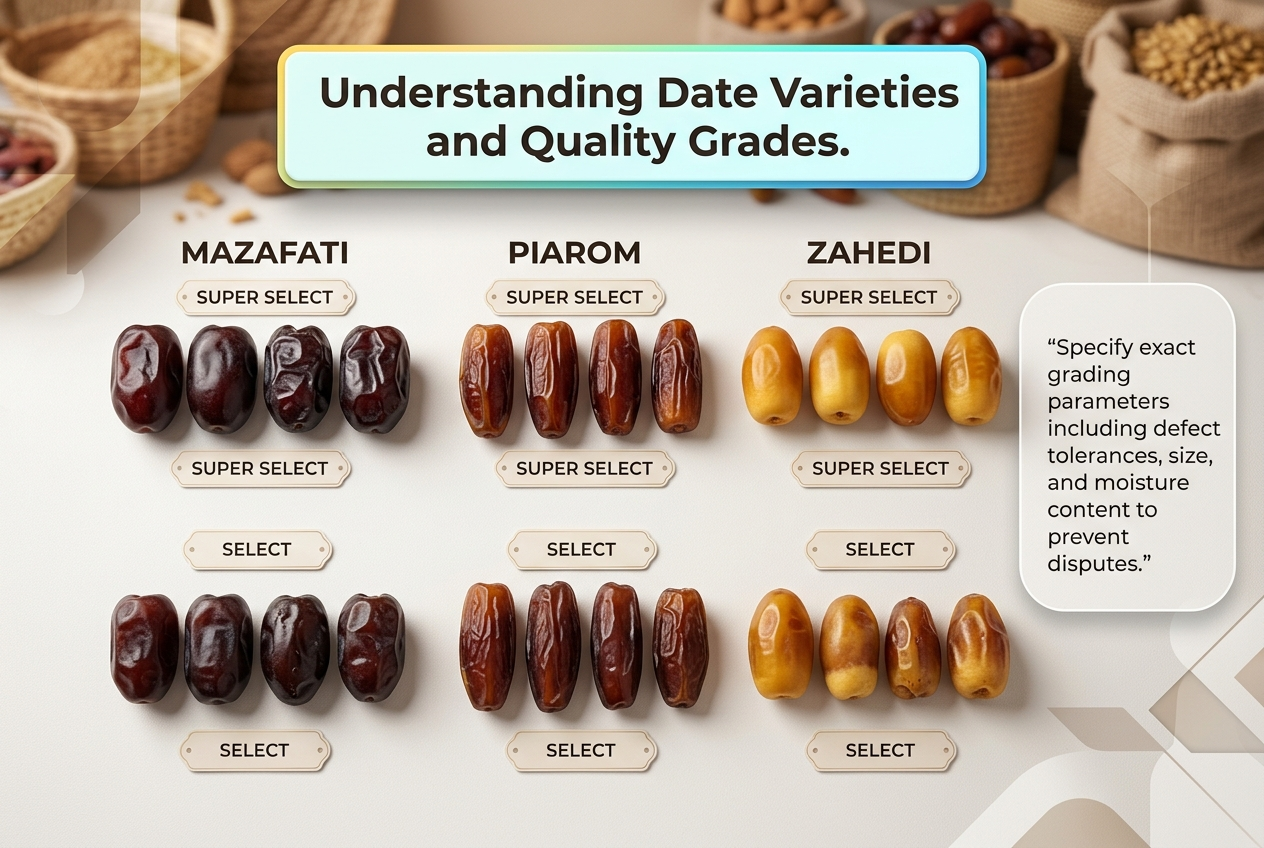
Ambiguity in product specifications destroys profit margins. Ignoring strict grading parameters is a persistent entry on the list of Common Mistakes to Avoid When Importing Dates from Iran, leading to immediate commercial disputes upon arrival.
Assuming All “A-Grade” Dates Are the Same
“A-Grade” lacks global standardization. An Iranian supplier might permit 10% skin delamination (separation of skin from flesh) in their premium tier, whereas the buyer’s retail market accepts zero tolerance. Procurement contracts must explicitly quantify acceptable defect parameters, physical dimensions, maximum defects per kilogram, and exact color profiles.
Overlooking Moisture Content (Crucial for Shelf Life)
Moisture content measures the water percentage within the fruit, classifying dates into dry (under 15%), semi-dry (15% to 20%), and fresh (20% to 35%) categories.
High moisture accelerates fermentation during prolonged transit to colder northern climates. Furthermore, dates naturally lose mass as they dehydrate in transit. This dehydration alters the net weight received:
Weight Loss = Initial Mass × (Δ Moisture%)
Purchasing high-moisture cargo without accounting for this formula means receiving fewer net kilograms upon arrival, directly impacting unit costs.
Ignoring the Specific Storage Needs of Each Variety (Fresh vs. Semi-Dry)
Storage requirements fluctuate drastically by cultivar. Subjecting all dates to uniform logistics guarantees spoilage.
| Variety | Moisture Profile | Required Transit Temperature | Logistical Mandates |
| Mazafati / Kalute | Fresh / High Moisture | -5°C to +5°C | Uninterrupted active cold chain required; highly susceptible to thermal abuse. |
| Piarom / Zahedi | Semi-Dry / Dry | Ambient (Cool & Dry) | Standard dry containers acceptable; must be shielded from humidity. |
Misaligning Varieties with Regional Consumer Preferences
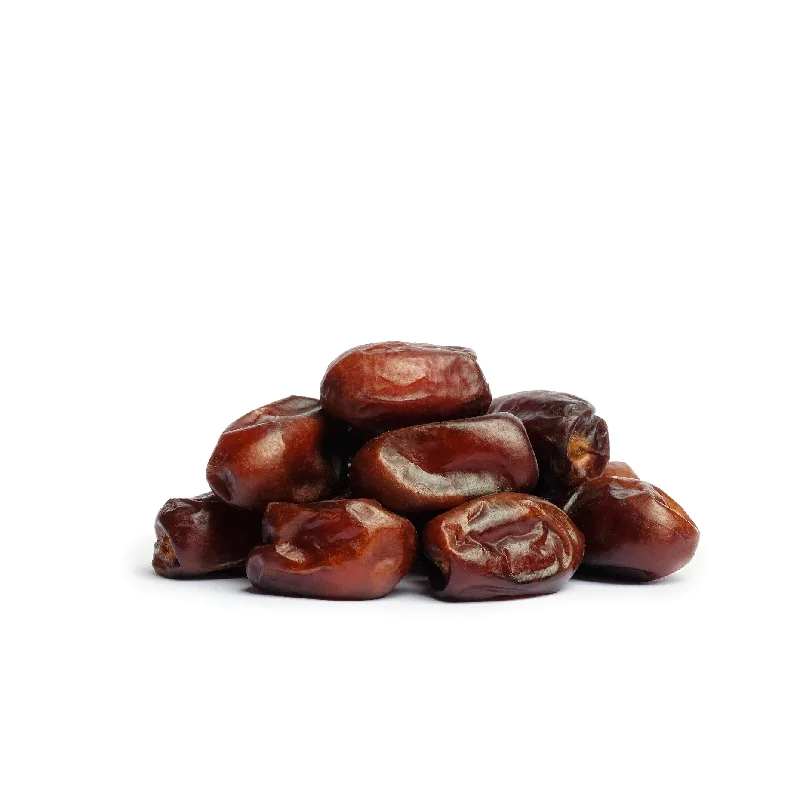
Northern consumer demographics exhibit a strict preference for dark, high-moisture, soft dates (like Mazafati and Kalute) consumed as confectionery. Importing dry, pale varieties into these specific territories without an industrial off-taker invariably causes severe inventory stagnation and reduced sell-through rates.
Mistake 3: Neglecting Proper Packaging Standards
Export packaging involves utilizing certified corrugated materials designed to withstand specified degrees of vertical compression and atmospheric moisture over extended transit durations.
Packaging serves as the primary structural defense for perishable cargo. Compromising on carton integrity remains one of the most destructive Common Mistakes to Avoid When Importing Dates from Iran.
Using Weak Outer Cartons for Long-Distance Sea Freight
Edge Crush Test (ECT) and burst strength are industrial metrics that quantify a corrugated box’s structural resistance to vertical weight and lateral puncture.
Standard 3-ply cartons inevitably disintegrate under the immense humidity of maritime holds crossing the Caspian Sea or the kinetic stress of overland trucking routes. Export mandates strict adherence to heavy-duty 5-ply cartons with high ECT ratings to prevent cargo collapse and product crushing.
Failing to Meet Destination Country Labeling Laws
Northern customs zones enforce rigid compliance regarding product labeling. Shipments lacking the mandatory EAC (Eurasian Conformity) mark, localized bilingual nutritional panels, explicit production dates, and registered importer details face immediate confiscation or extensive delays at border crossings.
Ignoring Private Label Opportunities Early in the Deal
Executing Cyrillic or localized packaging directly at the Iranian sorting facility dramatically reduces unit costs. Opting to relabel pallets upon arrival at the destination incurs redundant labor expenses, requires secondary handling of the product, and delays critical market entry.
Mistake 4: Logistics and Cold Chain Failures
The cold chain is an uninterrupted sequence of refrigerated production, storage, and distribution activities designed to maintain a given temperature range and preserve product shelf life.
Transporting perishable agriculture demands flawless logistics. Cold chain ruptures represent the most catastrophic of the Common Mistakes to Avoid When Importing Dates from Iran, frequently resulting in total cargo loss.
Shipping Fresh Mazafati Dates Without Reefer Containers
A Reefer Container is an actively refrigerated shipping unit that maintains a constant internal microclimate via integrated cooling systems, regardless of external ambient temperatures.

Utilizing standard dry containers for Mazafati guarantees spoilage. Temperature volatility inside standard boxes causes rapid fermentation, souring, and fungal growth. Mazafati requires continuous, uninterrupted transit strictly maintained between -5°C and +5°C.
Underestimating Transit Times and Port Congestion
Standard transit estimates rarely account for systemic bottlenecks at terrestrial borders (such as Astara) or Roll-on/Roll-off (Ro-Ro) vessel delays at Makhachkala and Astrakhan ports. A projected 10-day route frequently stretches to 30 days, severely straining cold chain endurance and equipment fuel reserves.
Lack of Coordination with Local Customs Brokers
Pre-assigning a specialized customs broker at the destination frontier accelerates clearance. Uncoordinated paperwork leaves perishable inventory stranded in quarantine yards while documents are translated and verified, completely neutralizing previous investments in active refrigeration.
Failing to Monitor Temperature Data Loggers During Transit
Buyers must explicitly stipulate the installation of digital temperature data loggers inside the sealed reefer container. Extracting this data upon arrival provides irrefutable, timestamped evidence of cold chain continuity. This data is the sole acceptable proof for initiating insurance claims in the event of thermal abuse by the carrier.
Mistake 5: Errors in Export Documentation and Compliance
Export compliance entails the precise alignment of commercial, transport, and phytosanitary documents to meet the legal entry requirements of the destination country.
Bureaucratic precision is just as critical as product quality. Documentation discrepancies form a substantial subset of the Common Mistakes to Avoid When Importing Dates from Iran, causing immense demurrage fees.
Incomplete Phytosanitary and Fumigation Certificates
A Phytosanitary Certificate is an official governmental declaration confirming that agricultural exports have been inspected and are devoid of quarantine pests and pathogens.
Lacking this original document, or the requisite Methyl Bromide fumigation record, guarantees immediate cargo rejection and subsequent destruction by destination customs authorities. There is zero tolerance for missing phytosanitary data.
Mismatched Commercial Invoices and Packing Lists
Total mathematical alignment across the Commercial Invoice, Packing List, and Bill of Lading is compulsory. A discrepancy of merely one kilogram between the stated documents and the physical border weighbridge scale will trigger intensive secondary inspections, full cargo unloading, and punitive financial penalties.
Ignoring Regional Customs Union Regulations
Markets governed by strict economic zones enforce rigorous Maximum Residue Limits (MRLs) for agrochemicals and pesticides. Suppliers must provide accredited laboratory documentation proving the dates comply with these specific jurisdictional thresholds prior to export clearance.
Mistake 6: Overlooking Seasonal Harvest Times and Demand Surges
Seasonal procurement strategy involves timing bulk purchases to align with post-harvest supply peaks, ensuring optimal pricing and maximum logistical availability.
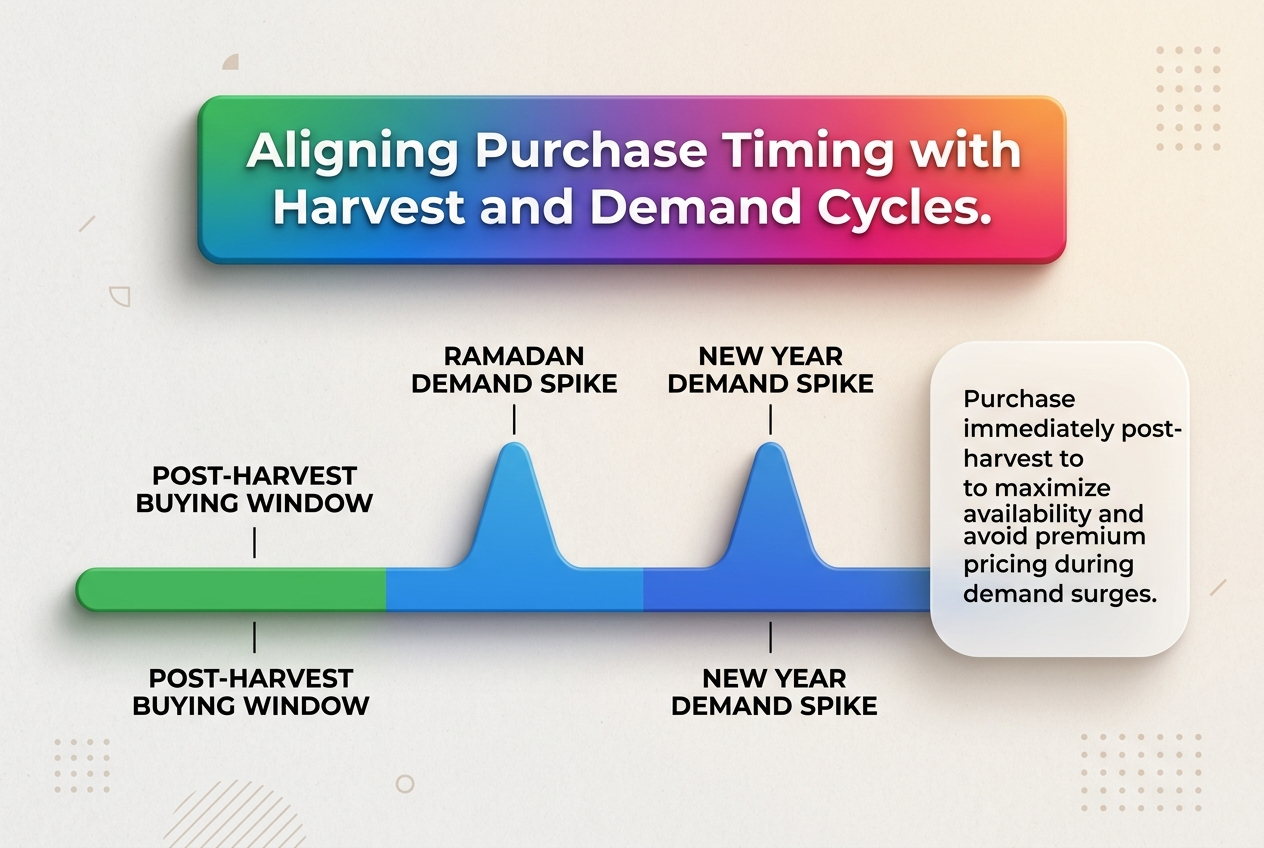
Timing market entry incorrectly inflates acquisition costs. Ignoring the agricultural calendar is a frequent addition to the Common Mistakes to Avoid When Importing Dates from Iran.
Buying at Peak Season Premium vs. Post-Harvest Rates
The optimal procurement window opens immediately post-harvest (late September through October) when supply is abundant and quality is peak. Delaying purchase orders until right before peak consumption cycles (such as Ramadan or regional New Year holidays) subjects buyers to inflated premium pricing and a severe shortage of available refrigerated transport.
Mistake 7: Ignoring Pre-Shipment Inspection (PSI) Protocols
Pre-Shipment Inspection (PSI) involves deploying an independent auditor to physically verify order specifications, random carton weights, and packaging integrity at the supplier’s warehouse just prior to container loading.
The PSI acts as the importer’s final financial firewall. Releasing final funds without independent verification is arguably the most fatal of the Common Mistakes to Avoid When Importing Dates from Iran. Disbursing the final 70% to 80% balance without an approved PSI report shifts all liability to the buyer. Once substandard cargo crosses the Iranian border, initiating legal recourse or reclaiming funds is practically unfeasible.
Conclusion
Procurement from the Iranian agricultural sector requires strategic foresight, robust contractual definitions, and rigorous quality assurance protocols. The Common Mistakes to Avoid When Importing Dates from Iran are universally tied to inadequate vendor vetting, ambiguous product specifications, and logistical complacency regarding the cold chain. By enforcing precise grading parameters, mandating independent third-party audits, and securing dedicated refrigerated transit, B2B buyers can effectively neutralize these operational hazards. A disciplined, compliance-first approach ensures that navigating the Common Mistakes to Avoid When Importing Dates from Iran results in a highly profitable, scalable, and resilient regional supply chain. Ultimately, the absolute best defense against the Common Mistakes to Avoid When Importing Dates from Iran is actionable, data-driven preparation.
Frequently Asked Questions (FAQs)
What is the most reliable transit route for Iranian dates heading north?
Optimal routing heavily depends on seasonal weather conditions and border traffic. Terrestrial freight via overland borders (Astara) is generally faster but highly susceptible to severe congestion. Alternatively, direct reefer vessels traversing the Caspian Sea provide stable cold chain environments but face erratic, weather-dependent sailing schedules.
How can I ensure the Mazafati dates don’t sour during transit?
Souring is prevented through strict temperature and moisture control. Contractually mandate active reefer containers locked between -5°C and +5°C, confirm via independent lab testing that pre-shipment moisture content is below 20%, and deploy internal digital data loggers to record temperature compliance throughout the entire voyage.
What certifications are mandatory for importing dates into Eurasian markets?
Clearance requires flawless documentation. Essential paperwork includes the original Phytosanitary Certificate, an authenticated Certificate of Origin, EAC-compliant localized outer packaging, and flawlessly synchronized Commercial Invoices and Packing Lists that match border weighbridge data exactly.
Related Products