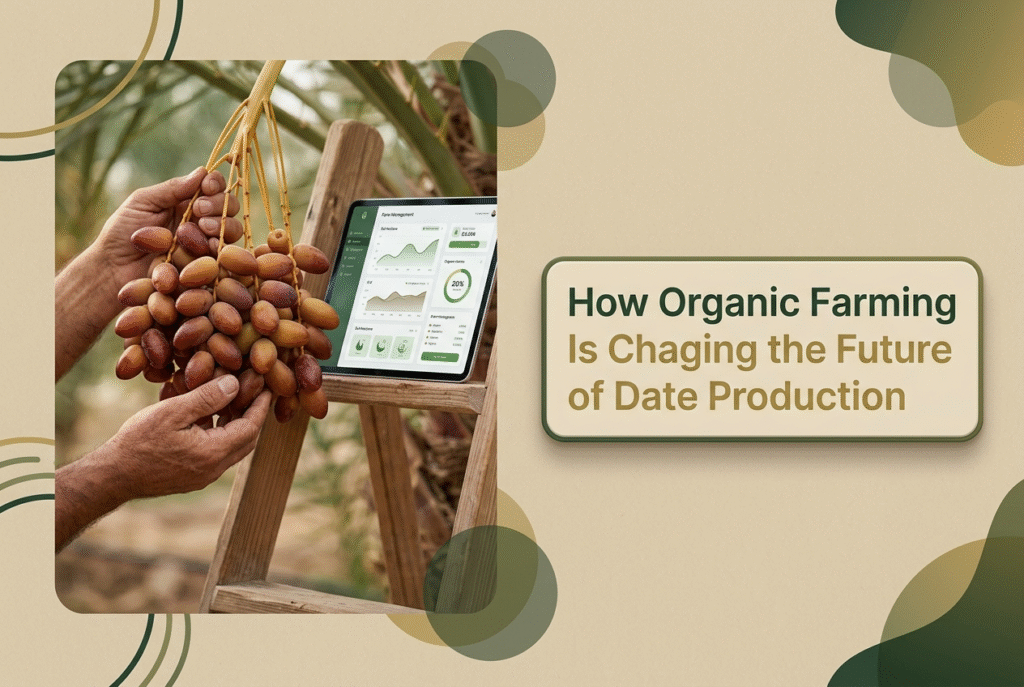
Sustainable agriculture is becoming a practical necessity in arid regions where date palms support farm income, rural employment, and export trade. Producers are facing stricter residue limits, rising water stress, and stronger buyer demand for verified cultivation standards. As a result, many growers are reassessing input use, soil management, and orchard ecology to protect both productivity and market access. This transition is especially relevant in major date-producing countries across the Middle East, North Africa, and beyond. In this article provided by Amin farms, we will explore the core principles, market demand, benefits, and modern techniques shaping the future of Organic date Farming.
Overview of Organic Farming in Date Production
The foundation of sustainable date cultivation is a management system that improves soil function, controls pests through preventive methods, and aligns production with recognized organic standards.
What Is Organic Date Farming
Organic date Farming is a certified date palm production system that relies on approved organic inputs, biological nutrient cycling, ecological pest management, and documented compliance with organic regulations, while excluding synthetic fertilizers, most synthetic pesticides, and genetically modified materials from orchard operations.
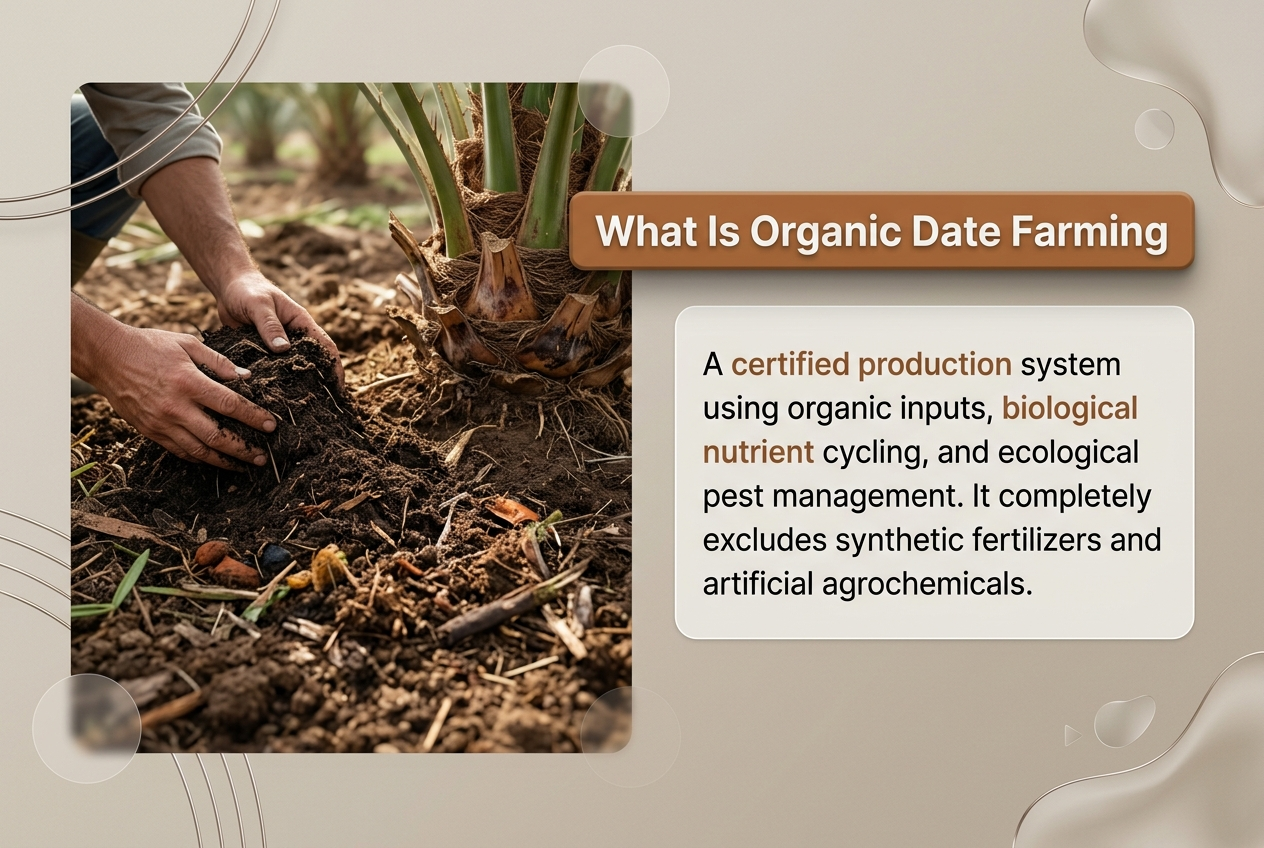
It means growing dates with natural fertilizers and biological pest control instead of depending on artificial agrochemicals.
This approach is not only about replacing one input with another. It requires a complete management framework covering soil fertility, irrigation, pest prevention, harvest hygiene, storage separation, and traceability. In commercial orchards, organic status must also be supported by records, inspection, and certification.
Key Principles of Organic Agriculture
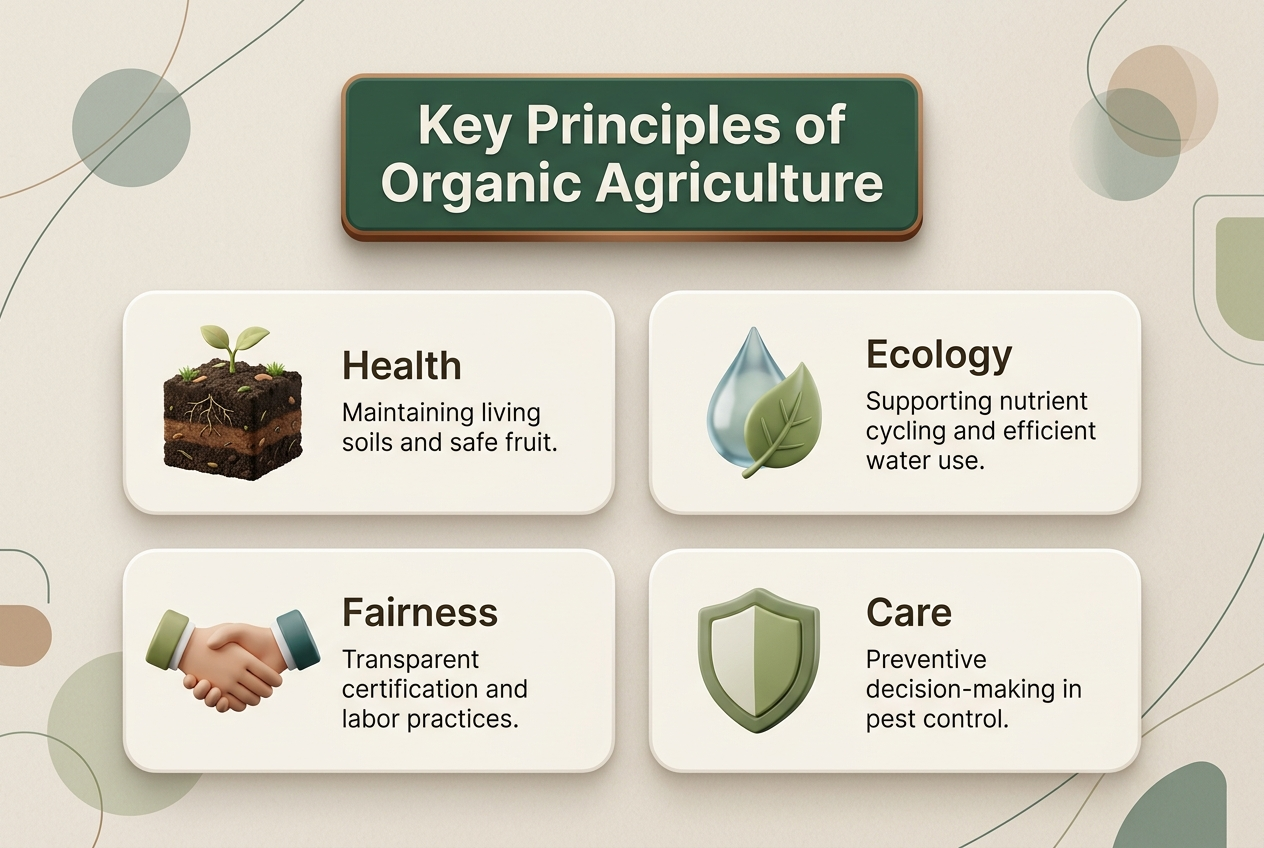
Organic date production follows four recognized principles: health, ecology, fairness, and care.
In date palm systems, health means maintaining living soils, safe working conditions, and fruit free from prohibited residues. Ecology means managing palms in a way that supports nutrient cycling, beneficial organisms, and efficient water use in dry climates. Fairness applies to labor practices, transparent certification, and responsible input sourcing. Care requires preventive decision-making, especially in pest control, pruning, and irrigation scheduling.
For date groves, these principles are practical rather than theoretical. They influence whether a farm maintains root-zone fertility, protects pollinating activity, and sustains long-term orchard productivity under desert conditions.
Differences Between Conventional and Organic Date Cultivation
The main difference is that conventional systems usually depend on synthetic correction, while organic systems depend on preventive orchard management and biological inputs.
| Production Area | Conventional Date Cultivation | Organic Date Cultivation |
| Fertilization | Synthetic NPK and soluble fertilizers | Compost, manure, vermicompost, approved mineral amendments |
| Pest control | Chemical insecticides and miticides | Biological control, sanitation, traps, approved organic materials |
| Weed management | Herbicides | Mechanical control, mulching, limited cover management |
| Soil strategy | Input-response model | Soil biology and long-term fertility building |
| Compliance | General farm regulation | Formal certification, audit, and traceability |
This distinction affects residue risk, labor demand, water efficiency, and export value. In practice, Organic date Farming requires more planning, but it often creates a stronger long-term production base.
The Growing Demand for Organic Dates
The market is expanding because consumers and importers increasingly want dates that meet both nutritional expectations and verified production standards.
Global Market Trends
International demand for certified organic dates has increased, especially in Europe and North America.
Organic Medjool and Deglet Noor dates are gaining shelf space in premium retail, health food chains, and private-label categories. This trend is tied to growth in clean-label snacks, natural sweeteners, and minimally processed foods. Importers also place greater emphasis on residue compliance and traceability, which gives certified suppliers a commercial advantage.
Industry trade data from recent years consistently show stronger demand for premium packed dates with organic claims, particularly in markets where consumers are already familiar with certified produce. For exporters, Organic date Farming is increasingly linked to market access rather than branding alone.
Consumer Preferences for Organic Products
Buyers choose organic dates mainly because they associate them with safety, transparency, and dietary quality.
Organic dates appeal to consumers who prefer natural sweeteners, plant-based foods, and products with fewer concerns about pesticide residues. They also fit the expectations of buyers following vegan, whole-food, or reduced-additive diets. In many cases, certification itself is part of the value because it provides an audited production claim instead of a marketing statement.
For date producers, this means the purchase decision is no longer driven only by fruit size and appearance. Production method now influences retail acceptance and brand trust.
Nutritional Advantages of Organic Dates
Organic dates can offer nutritional advantages, although results depend on cultivar, soil condition, irrigation quality, and harvest timing.
Dates naturally provide fiber, potassium, magnesium, and phenolic compounds. Research on organic cropping systems broadly indicates that well-managed organic fruits may show stronger antioxidant profiles under certain conditions, partly due to slower nutrient release and balanced plant metabolism. Organic systems also reduce the likelihood of synthetic chemical residues reaching the final fruit.
This does not mean every organic date is nutritionally superior in every case. However, when orchards are managed correctly, Organic date Farming can support fruit quality that aligns well with health-focused consumer demand.
Benefits of Organic Farming for Date Cultivation
Organic management benefits the orchard environment and can improve the quality and safety of the harvested fruit.
Improved Soil Health
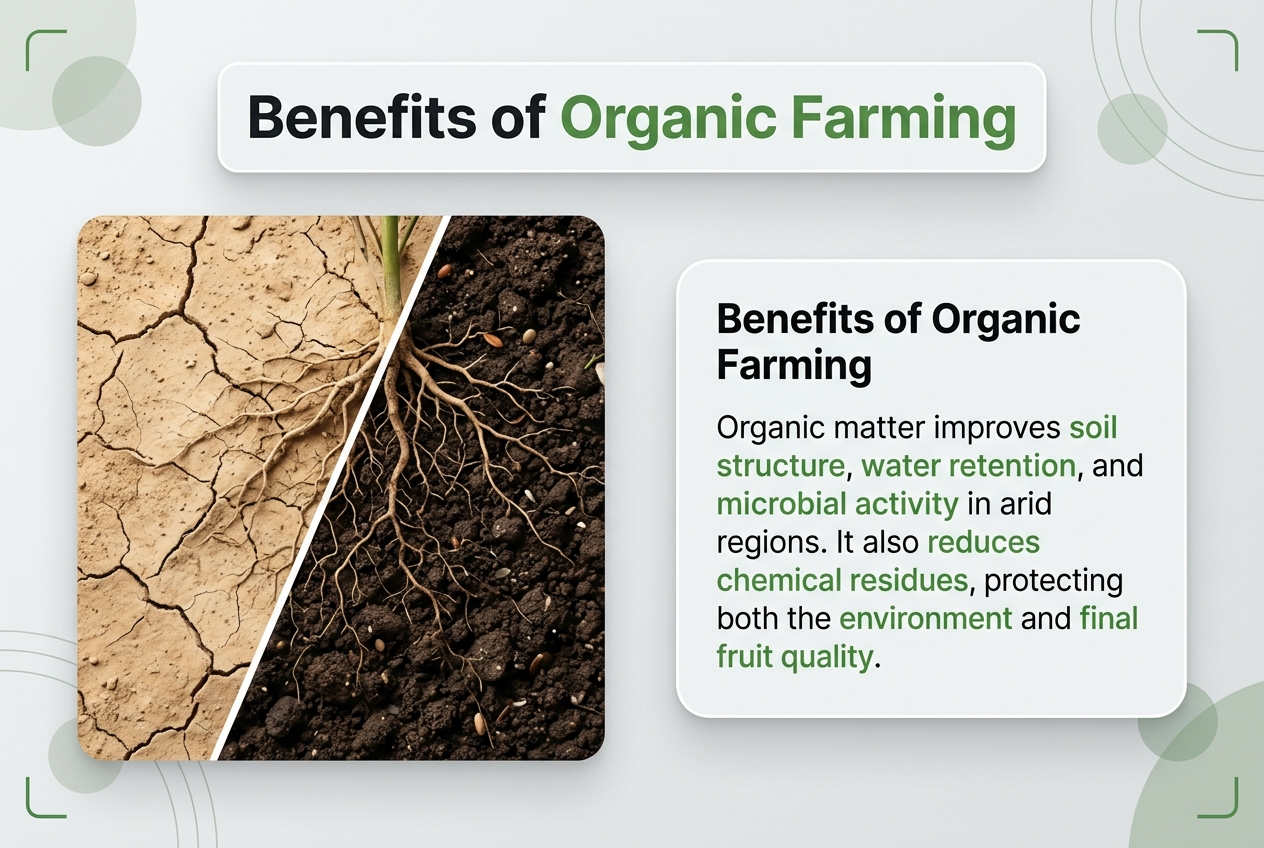
Organic matter significantly improves the performance of date-growing soils, especially in sandy and low-fertility conditions.
Date plantations in arid regions often suffer from weak soil structure, low carbon content, and rapid moisture loss. Compost, green manure, and decomposed farmyard manure improve water retention, microbial activity, aggregate stability, and nutrient buffering. These changes matter because the date palm depends on a functional root zone for stable fruit development under heat stress.
Over time, Organic date Farming builds a more biologically active soil system, which can reduce nutrient loss and improve irrigation efficiency.
Reduced Chemical Residues
The key benefit is that organic production removes most synthetic pesticide and fertilizer inputs from the orchard system.
This directly lowers the risk of prohibited residues on fruit and reduces exposure risks for workers involved in spraying, pruning, thinning, and harvest. It also helps exporters meet residue standards in regulated markets, where rejected shipments can create serious financial losses. For farms serving premium buyers, lower residue risk is both a safety issue and a commercial advantage.
Environmental Sustainability
Organic management improves environmental protection by reducing contamination pressure and strengthening ecological stability around the orchard.
Date farms in dry regions often depend on sensitive groundwater reserves. Lower use of synthetic inputs helps protect these water sources from nitrate loading and chemical contamination. Organic soil-building practices also support beneficial organisms, reduce erosion, and lower dependence on energy-intensive manufactured fertilizers. In this sense, Organic date Farming contributes to a more resource-efficient and environmentally responsible production model.
Enhanced Product Quality
Organic practices can improve final fruit quality when fertility, irrigation, and harvest timing are controlled carefully.
Growers often report better texture, more balanced ripening, and stronger flavor concentration under biologically managed systems. These results are usually linked to healthier soils and more stable moisture management rather than rapid chemical feeding. Shelf life can also benefit when fruit is harvested at the correct maturity stage and handled under strict post-harvest hygiene. Quality improvement is therefore a management outcome, not an automatic result of certification.
Challenges of Organic Date Farming
The transition is feasible, but it is technically demanding and usually more complex than conventional orchard management.
Pest and Disease Management
The main challenge is controlling economically serious pests without the routine use of synthetic chemicals.
Date palms are vulnerable to red palm weevil, date moth, scale insects, mites, and several disease pressures that increase when pruning wounds, humidity, or orchard sanitation are poorly managed. Organic systems depend heavily on prevention, monitoring, and rapid response. If scouting is weak, infestations can spread before biological or mechanical measures are effective.
This is one of the reasons Organic date Farming requires disciplined field inspection and trained labor.
Combating the Red Palm Weevil and Date Moth Organically
The most effective organic strategy is integrated management based on monitoring, sanitation, and approved biological tools.
For red palm weevil, pheromone traps are widely used for monitoring and mass trapping. Infested tissue must be removed quickly to limit breeding sites, and pruning wounds should be minimized and protected where permitted under organic protocols. Entomopathogenic fungi such as Beauveria bassiana are used in some systems as part of biological suppression.
For date moth, physical protection is important. Bunch bagging, field sanitation, and early detection help reduce larval damage. Organic farms also rely on orchard hygiene to interrupt pest cycles. No single measure is sufficient; consistent monitoring is the decisive factor.
Certification and Compliance
Standards such as USDA Organic and EU Organic require a formal organic system plan, field history, approved input records, harvest handling protocols, storage separation, and annual inspection. Most farms must complete a transition period of about three years before full certification is granted. During this period, growers often face higher management costs without receiving the full organic price premium.
For serious producers, compliance is not optional administration. It is the basis of legal market access.
Higher Production Costs
Manual weed control increases labor requirements. Organic fertilizers and compost logistics can be expensive, particularly in large orchards far from input sources. Pest management also requires more time for monitoring and preventive action. In many cases, yields decline temporarily while the soil system and fertility program stabilize. Because of this, Organic date Farming should be planned as a medium- to long-term investment model.
Climate Change and Yield Consistency
Extreme heat, irregular rainfall, salinity pressure, and changing pest behavior can all reduce yield stability. Organic orchards must respond through better mulch use, stronger soil carbon management, more precise irrigation scheduling, and cultivar-specific nutrient planning. These methods can improve resilience, but they require data, field discipline, and adaptation over time. Yield consistency is achievable, but not without strong technical management.
Modern Techniques Supporting Organic Date Production
Modern technology is helping organic growers manage orchards more precisely without compromising compliance.
Biological Pest Control
Biological control is a practical way to suppress pest populations while preserving orchard ecology.
In date orchards, natural enemies such as parasitoid wasps, predatory insects, and microbial biocontrol agents can help manage scale insects, mites, and other pests. Their success depends on regular monitoring, correct timing, and avoidance of disruptive chemicals. Biological control is most effective when it is integrated with sanitation and habitat-aware orchard management rather than applied as an isolated measure.
Organic Fertilization Methods
The most effective organic fertilization programs are based on soil testing, palm age, and irrigation conditions.
Common inputs include farmyard manure, vermicompost, composted crop residues, and approved bio-stimulants. These materials improve nutrient cycling and root-zone biology rather than delivering only rapid nutrient release. In commercial orchards, fertility planning must also consider salinity, micronutrient balance, and the timing of fruit development. This is a central operational requirement in Organic date Farming.
Water Efficient Irrigation Systems
Efficient irrigation is essential because date palms need careful water management to maintain fruit quality under hot conditions.
Drip irrigation remains the most effective system for many orchards because it delivers water directly to the active root zone while limiting evaporation. Subsurface irrigation can reduce surface losses further in some soils. Smart scheduling based on soil moisture and evapotranspiration data improves water productivity and protects soil structure. These systems are especially valuable in organic farms where soil integrity must be preserved.
Integration of IoT and Smart Monitoring
Smart monitoring improves organic management by giving growers timely data instead of relying on visual judgment alone.
Soil moisture sensors help avoid both under-irrigation and unnecessary leaching. Salinity sensors support better root-zone management in water-scarce regions. Drone imaging and canopy analysis can detect early stress, uneven growth, or localized pest pressure before visible damage becomes severe. Digital logs also simplify certification records and input tracking. Increasingly, Organic date Farming is combining traditional biological methods with data-driven orchard control.
Economic Impact on Farmers and Producers
The financial effect depends on whether higher production discipline is matched by stronger market returns.
Access to Premium Markets
Certified organic dates usually gain access to higher-value buyers and better price positioning.
Retail chains, specialty importers, and health-focused brands often pay a premium for certified fruit that meets grading, traceability, and residue standards. This premium can help offset the additional labor and compliance costs associated with organic management. However, premium pricing is not guaranteed. It depends on reliable certification, consistent fruit quality, and strong post-harvest handling.
Long Term Sustainability for Growers
The strongest economic argument is long-term orchard resilience.
Soils with better structure and biological activity are more likely to sustain productivity under water stress and input price volatility. Farms that reduce chemical dependency may also lower long-term environmental and compliance risks. In this sense, Organic date Farming supports a business model based on durability rather than short-term yield correction. For growers managing multigenerational orchards, that distinction is commercially important.
The Future of Organic Date Production
The industry is likely to expand because policy support, export demand, and precision agriculture are moving in the same direction.
Several countries in the MENA region are investing more in sustainable agriculture, irrigation efficiency, certification support, and agri-export development. At the same time, improvements in biological inputs, orchard monitoring, and supply-chain traceability are reducing some of the barriers that previously limited organic scale-up. As these systems mature, organic date production will become more standardized and commercially accessible.
Circular Economy in Date Processing
The future of date production will increasingly include zero-waste processing and by-product recovery.
Date pits can be processed into animal feed ingredients or roasted for coffee-alternative products. Fronds and other plant residues can be composted and returned to the orchard as organic matter, or in some cases used in fiber-based packaging. This model lowers waste disposal costs, improves resource efficiency, and creates secondary value streams. It also strengthens the economic logic of organic orchards by linking production with full biomass utilization.
Conclusion
Organic date production is changing the industry through stronger soil management, lower residue risk, improved environmental performance, and better access to premium markets. It also demands more from the grower: tighter monitoring, certified compliance, higher labor input, and long-term planning. Even with these constraints, the model is increasingly viable because it aligns orchard health with buyer expectations and resource protection. For serious producers seeking durable profitability and consistent fruit quality, Organic date Farming is a practical and future-oriented standard for date cultivation.
Related Products