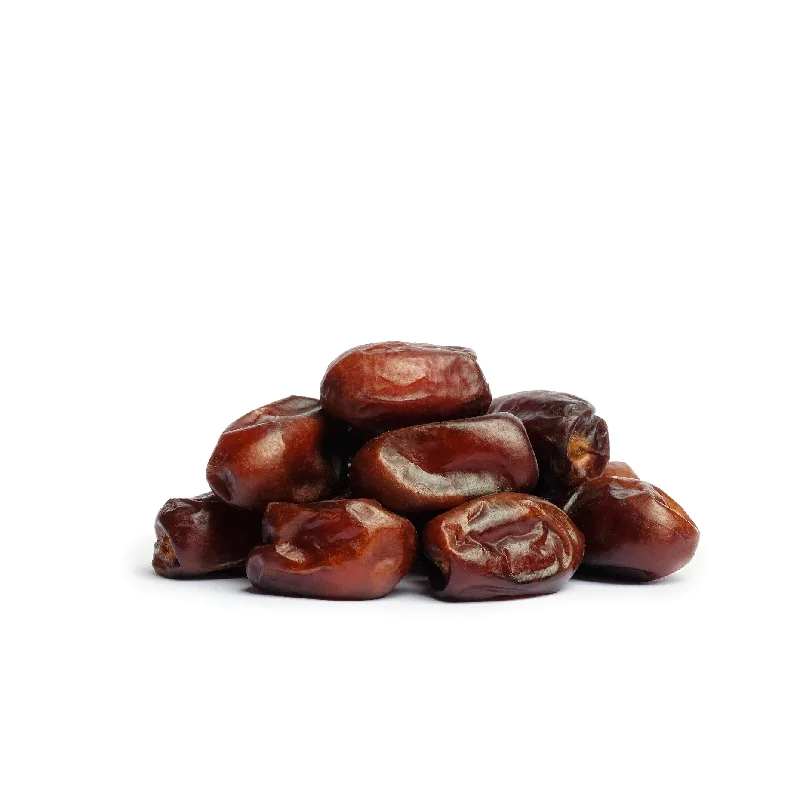
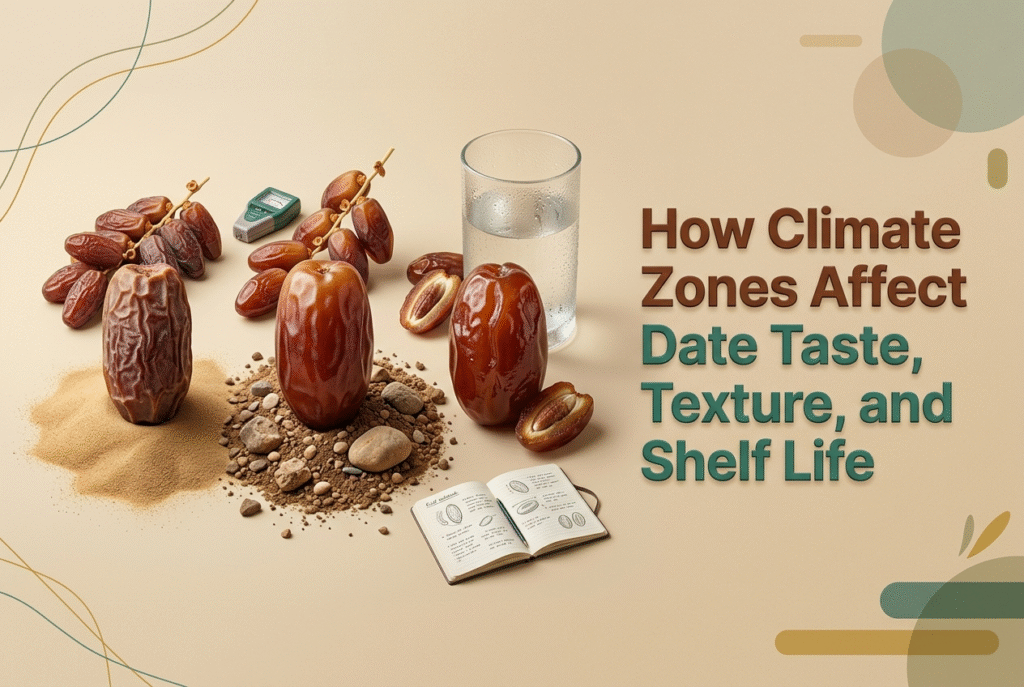
The date is a fruit whose final characteristics are a direct expression of its growing environment. While the genetic potential is set by the variety of the date palm, the climate is the artist that shapes its ultimate quality, influencing everything from its sugar profile to its physical density. The interplay between temperature, humidity, and sunlight dictates the biochemical reactions within the fruit as it ripens, resulting in a vast spectrum of possible outcomes from a single cultivar. This article provides a detailed analysis of how climate zones affect date taste, texture, and post-harvest stability, offering insights for both producers and consumers.
Overview of Date Palm Cultivation and Climate Sensitivity
The date palm (Phoenix dactylifera L.) is a highly specialized plant with precise and demanding climatic requirements. It cannot be cultivated commercially in just any warm location; its success is confined to regions that can provide a specific sequence of environmental cues necessary for fruit development, maturation, and curing.
Ideal Growing Conditions for Date Palms
Successful date production requires long, intensely hot summers with temperatures consistently above 30°C (86°F) for optimal fruit development. Crucially, the flowering and ripening periods must coincide with periods of minimal rainfall and low relative humidity to prevent pollination failure and fungal diseases. Agronomists often use the concept of Growing Degree Days (GDD) to quantify the cumulative heat a crop receives. Date palms require a high accumulation of GDD to complete their fruiting cycle, a condition met only in a select few of the world’s climates.
Why Climate Plays a Critical Role in Fruit Quality
Climate directly governs the key biochemical processes inside the fruit, such as sugar conversion, water evaporation, and the development of aromatic compounds. The intensity and duration of heat accelerate enzymatic activity, while ambient humidity dictates the rate of moisture loss from the fruit. Understanding these fundamental processes is the key to understanding how climate zones affect date taste.
The following section identifies the primary climate classifications where dates are successfully cultivated.
Major Climate Zones Where Dates Are Grown
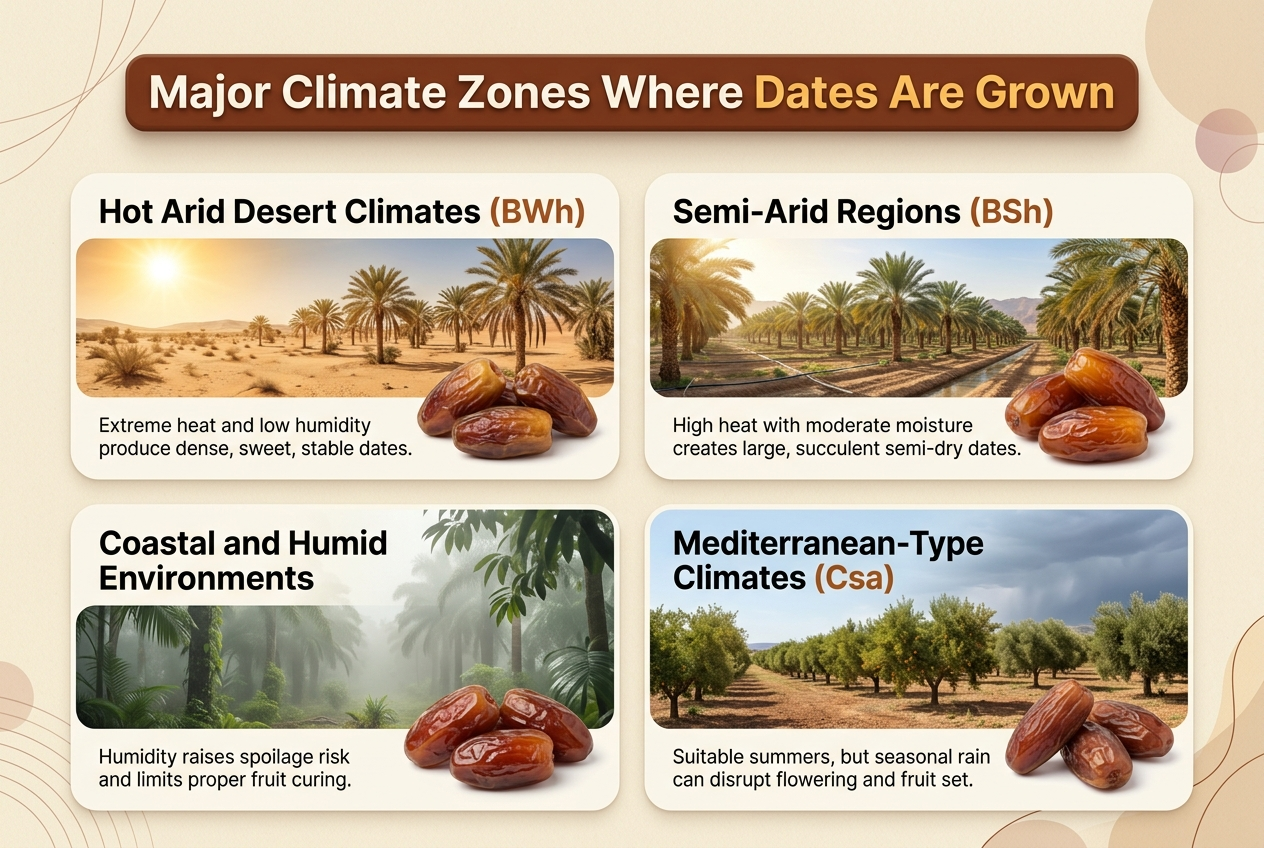
Date cultivation thrives primarily in regions defined by specific Köppen climate classifications, each imparting unique characteristics to the fruit.
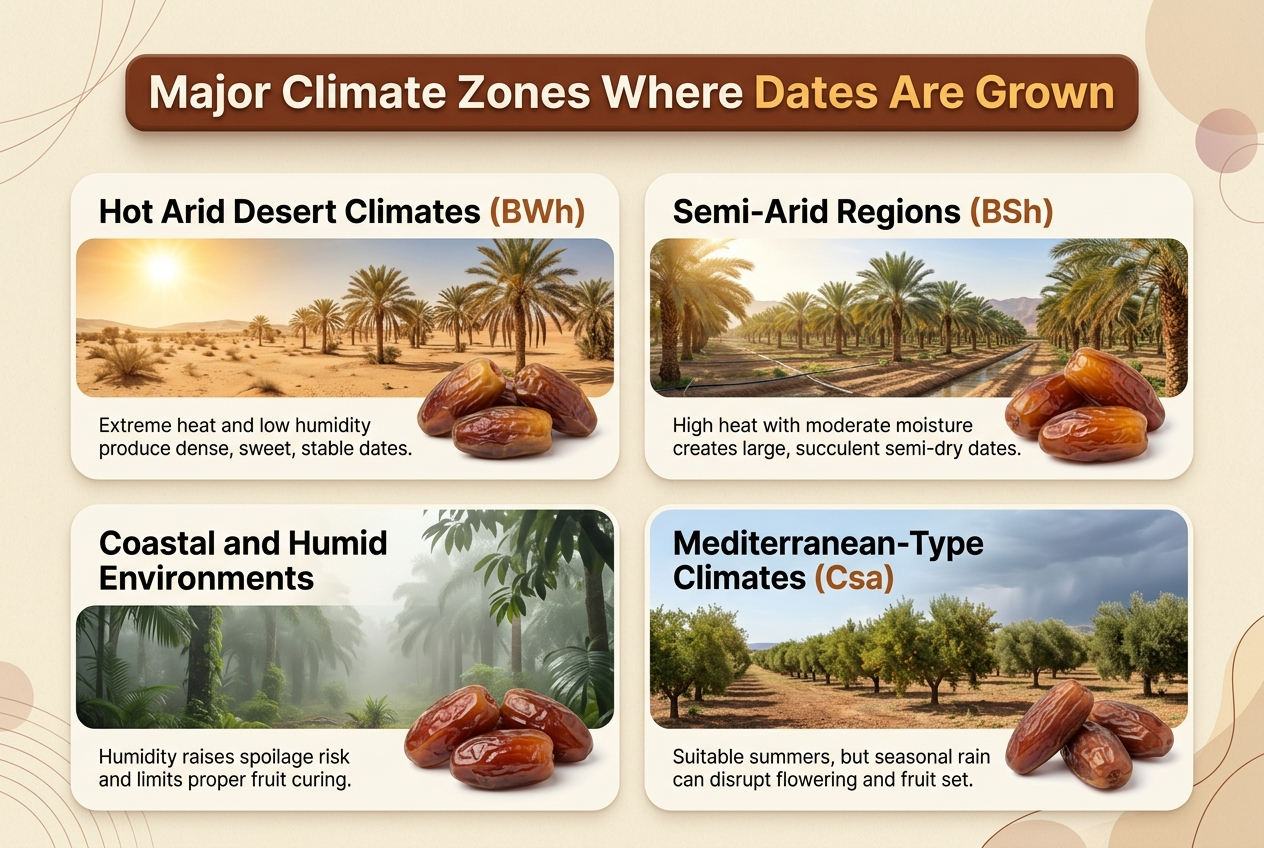
Hot Arid Desert Climates (BWh)
This is the classic environment for date cultivation, typified by the Arabian Peninsula, North Africa’s inland Sahara, and parts of the Middle East. These regions experience extreme summer heat, high solar radiation, and exceptionally low humidity. This intense, dry heat maximizes sugar concentration by accelerating both sugar production and natural dehydration on the palm, leading to the dense, chewy, and highly stable dates typical of varieties like Deglet Noor or Sukkari.
Semi-Arid Regions (BSh)
Found in areas like California’s Coachella Valley, the Jordan Valley, and parts of Iran, semi-arid climates feature high summer heat but may have slightly more moderate humidity or greater diurnal temperature fluctuations. This environment allows the fruit to develop high sugar content without losing excessive moisture, making it ideal for larger, softer, semi-dry varieties like the world-renowned Medjool, which retains a succulent, fleshy texture.
Coastal and Humid Environments
These regions present significant challenges for commercial date cultivation. High ambient humidity can interfere with wind-driven pollination, dramatically increases the risk of fungal diseases like black scorch (Ceratocystis paradoxa), and prevents the fruit from properly curing on the tree. Dates grown in these conditions often have lower sugar content, higher water activity, and a propensity for fermentation and spoilage, limiting their commercial viability.
Mediterranean-Type Climates (Csa)
Regions with hot, dry summers but cooler, wetter winters can support date cultivation, though not without risks. While the summer conditions are often adequate for fruit ripening, untimely winter and spring rains can disrupt the critical flowering and fruit set stages. This demonstrates how climate zones affect date taste not just through summer heat, but through year-round weather patterns.
We now turn to the specific biochemical mechanisms that link climate to flavor.
Impact of Climate on Date Taste
The distinct flavor profiles of dates are the direct result of biochemical compounds whose formation is governed by environmental factors.
Sugar Accumulation and Sweetness
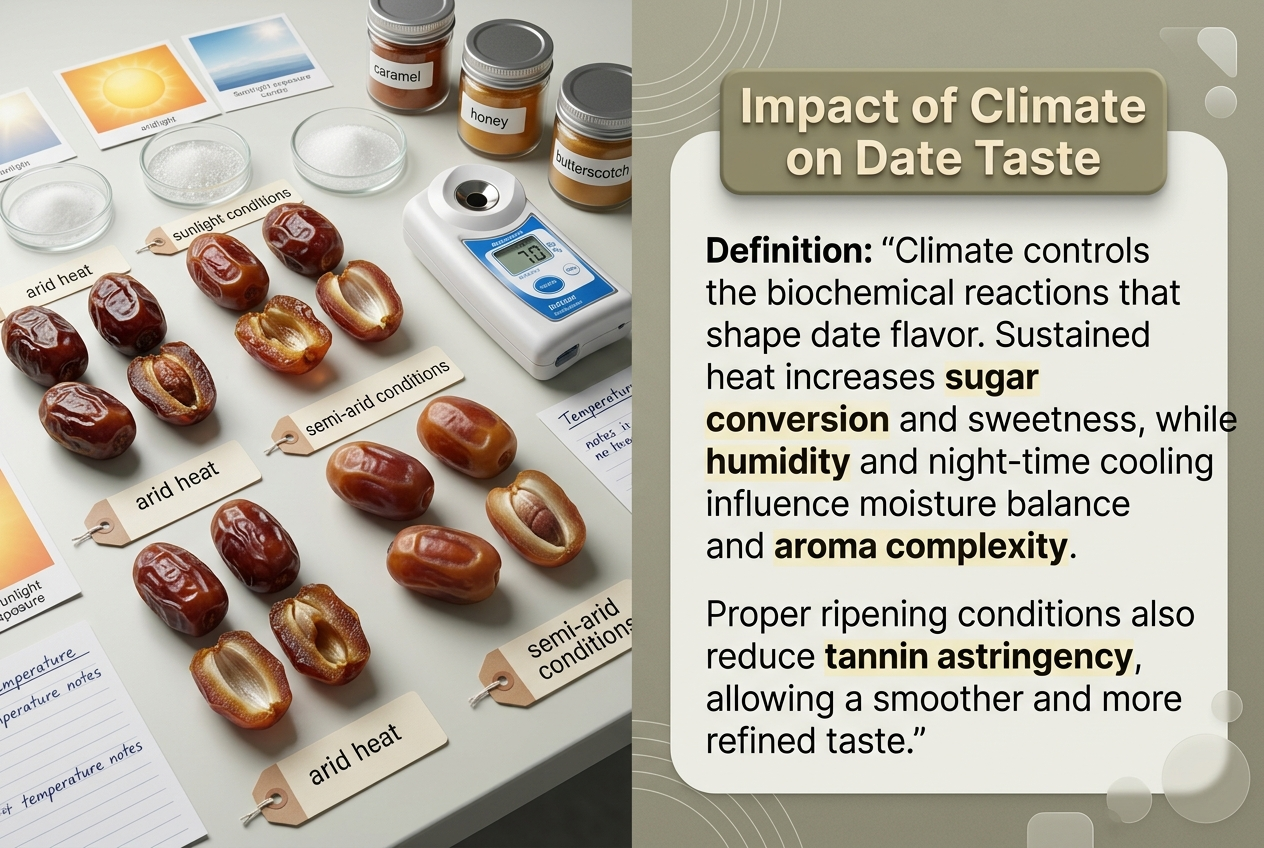
The sweetness of a date is determined by the activity of the enzyme invertase, which converts sucrose produced by the palm into the simpler sugars glucose and fructose during ripening. High, sustained heat accelerates this enzymatic process, leading to intensely sweet fruit with a high percentage of invert sugars. The final level and type of sweetness is a primary answer to the question of how climate zones affect date taste.
Flavor Complexity and Aroma Development
The characteristic caramel, honey, and butterscotch notes in dates come from a complex mixture of volatile organic compounds (VOCs). Research suggests that slower ripening in slightly more moderate semi-arid climates, with their cooler nights, can allow for the development of a more complex and nuanced aromatic profile compared to the rapid, sugar-focused ripening that occurs in intensely hot arid zones.
Influence of Temperature and Sunlight
The total hours of intense sunlight are directly proportional to the rate of photosynthesis, which drives the initial production of sucrose in the palm’s leaves. This sugar is then translocated to the fruit. Furthermore, the significant drop in night-time temperatures common in many semi-arid desert regions can influence the final balance of sugars and organic acids, contributing to a more refined and less one-dimensionally sweet flavor.
The Role of Tannins and Astringency
Unripe dates possess high levels of soluble tannins, which create an unpleasant, astringent sensation in the mouth. The intense heat and dry conditions of a proper ripening climate are essential for the polymerization of these tannins. This process converts them into insoluble forms, effectively neutralizing their astringency. Inadequate heat results in a poorly ripened, astringent fruit, further illustrating how climate zones affect date taste.
Texture is inextricably linked to taste, as it governs how flavor is perceived.
Impact of Climate on Date Texture
A core part of how climate zones affect date taste is how that taste is delivered through the fruit’s physical texture.
Moisture Content and Softness
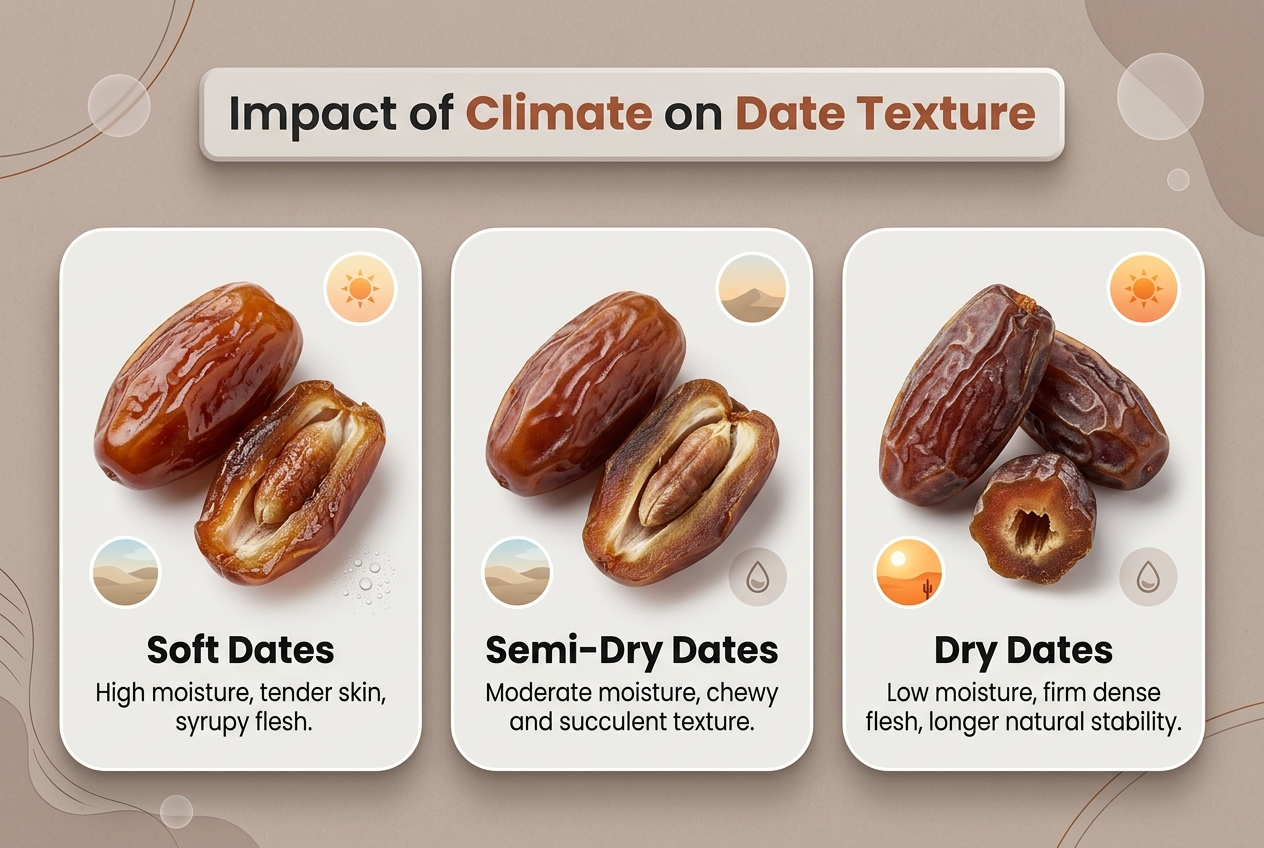
The final moisture content of a date is directly linked to the ambient humidity and rainfall during its maturation. The extremely low humidity in arid climates naturally dehydrates the fruit on the palm, creating a firm, chewy texture. Conversely, the slightly higher ambient humidity in semi-arid zones or the presence of late-season moisture results in softer, more succulent flesh as the fruit retains more water.
Fiber Structure and Flesh Density
Consistent water availability via irrigation, combined with climatic conditions, influences the development of the fruit’s cell structure. The interplay between heat and water management affects the formation of pectin and cellulose, which are responsible for the fruit’s fibrous structure. This can lead to either a dense, compact texture or a soft, almost melting one.
Differences Between Soft, Semi-Dry, and Dry Dates
These common industry classifications are direct outcomes of climatic influence on moisture and sugar.
Date categories are primarily defined by their final moisture content and dominant sugar type. Soft dates (e.g., Barhi) have high moisture (>30%) and primarily invert sugars. Semi-dry dates (e.g., Medjool) have moderate moisture (20-30%). Dry dates (e.g., Thoory) have low moisture (<20%) and a higher proportion of sucrose.
Climate is the main factor that determines if a date variety becomes soft and syrupy, chewy and firm, or hard and almost crystalline when it fully ripens.
Table: Date Texture Classification by Climatic Influence
| Category | Typical Moisture | Texture Profile | Dominant Climate Type | Example Variety |
| Soft | > 30% | Tender, delicate skin; very soft, syrupy flesh. | Semi-Arid (harvested early) | Barhi |
| Semi-Dry | 20-30% | Plump, chewy; fibrous but succulent flesh. | Semi-Arid (BSh) | Medjool |
| Dry | < 20% | Firm to hard; dense, crystalline flesh. | Hot Arid (BWh) | Thoory |
The climate of origin also predetermines how well a date will store after harvest.
Climate Effects on Shelf Life and Storage Stability
The climate where a date is grown and harvested is a primary determinant of its intrinsic storage potential.
Humidity and Post-Harvest Spoilage
Dates harvested in more humid climates naturally have a higher water activity (awa_waw)—a measure of the unbound water available for microbial growth. This makes them highly susceptible to spoilage from yeasts and molds, such as Aspergillus species, significantly shortening their shelf life unless they are refrigerated or dried further.
Temperature Effects on Moisture Loss
Conversely, dates grown in very hot, dry climates have already undergone significant natural dehydration on the palm. This process lowers their water activity to a point that inhibits most microbial growth, granting them exceptional natural stability and a much longer shelf life at ambient temperatures. This is a crucial aspect of how climate zones affect date taste and its preservation.
Mold Growth and Microbial Risks
Unseasonal rain or periods of high humidity near harvest time pose a significant threat. This introduces excess moisture onto the surface of the ripening fruit and can introduce field-borne microbes. This contamination poses a major post-harvest challenge, often requiring immediate artificial drying to prevent widespread spoilage.
Concrete examples help to illustrate these climatic effects.
Case Studies: Comparing Date Varieties Across Climates
Observing a single variety grown in different environments provides a clear illustration of how climate zones affect date taste.
Medjool: The Semi-Arid Champion
A Medjool date grown in its ideal semi-arid climate, like the Jordan Valley, becomes large, exceptionally soft, and develops a rich, caramel-like sweetness. If the same variety were cultivated in a more humid, subtropical environment, the resulting fruit would likely be smaller, have a lower sugar concentration due to less intense heat, and be at a much higher risk of spoilage from mold and fermentation.
Deglet Noor: The Arid Aficionado
The Deglet Noor, often called the “Queen of Dates,” achieves its signature translucent amber color and nutty, delicate flavor only in the intensely hot, dry climates of Algeria, Tunisia, and the American Southwest. Grown in a cooler, semi-arid climate, it often fails to accumulate sufficient sugar or lose enough moisture to develop its classic firm texture and may remain overly soft and less flavorful.
Growers have developed strategies to manage these climatic variables.
Agricultural Practices to Adapt to Different Climate Zones
Producers actively use horticultural techniques to mitigate climatic disadvantages and enhance a region’s natural advantages.
Irrigation Management
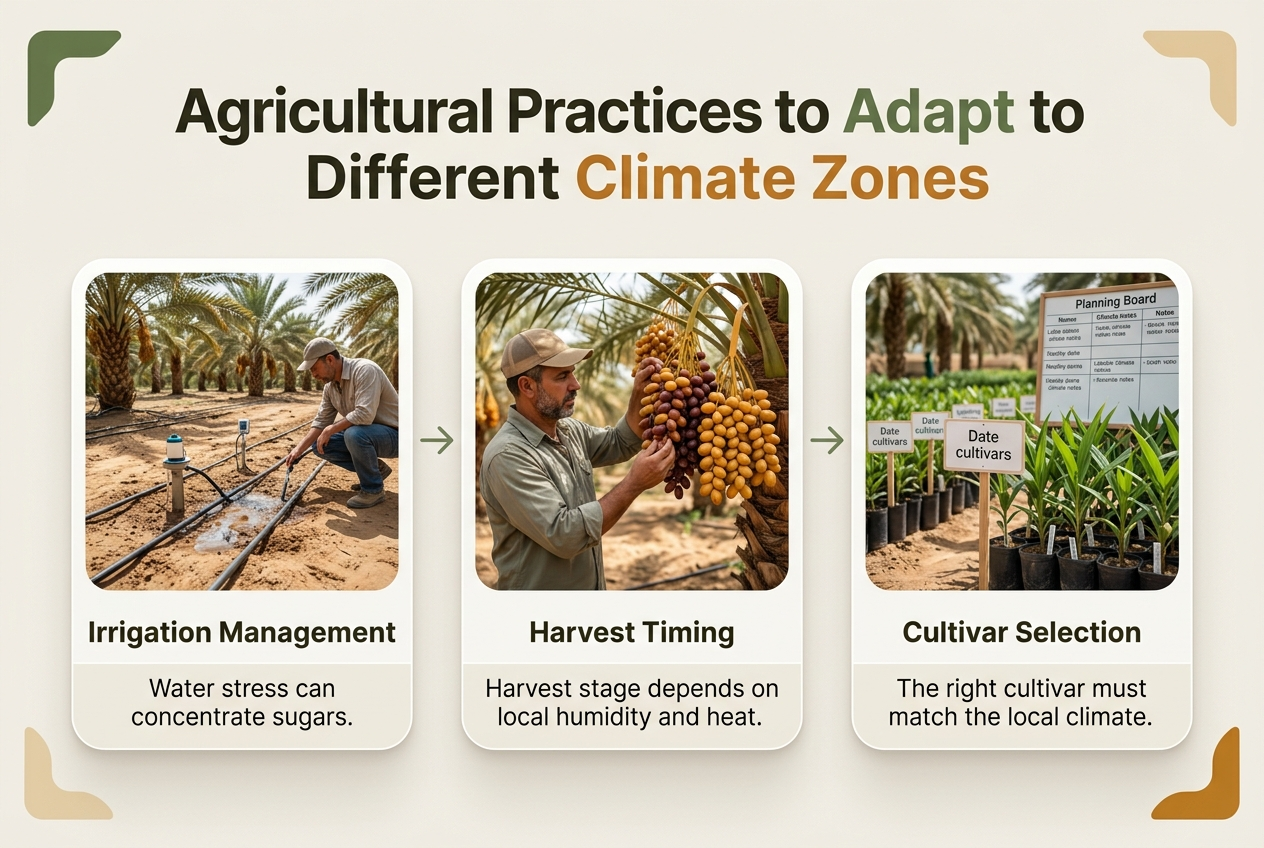
In many regions, growers use deficit irrigation techniques, intentionally applying less water at specific stages of fruit development. This controlled water stress helps to concentrate sugars and solids in the fruit, effectively mimicking the natural dehydrating effects of a drier, more arid climate.
Harvest Timing and Techniques
The decision of when to harvest is critical and climate-dependent. In more humid areas, dates may need to be harvested at the semi-ripe ‘Rutab’ stage and then cured artificially. In ideal hot and arid climates, growers can allow the fruit to fully cure to the ‘Tamar’ stage on the palm, a process that yields a more stable and often more flavorful product. This choice is a direct response to how climate zones affect date taste and long-term quality.
Cultivar Selection for Specific Climates
Perhaps the most critical adaptive strategy is selecting date palm cultivars that are best suited to the local climate. Growers in regions with shorter or less intense summers may plant early-maturing varieties, while those in hyper-arid zones can successfully cultivate late-maturing varieties that require a very long heat period.
Finally, we must consider how global climate change is impacting this delicate balance.
Challenges of Climate Change for Date Quality
Global warming is altering traditional date-growing regions, which directly relates to how climate zones affect date taste in the future.
Rising Temperatures
While date palms are thermophilic (heat-loving), there is a limit. Extreme temperature spikes above 45°C (113°F) can cause “sunburn” or blacknose on the fruit and induce heat stress in the palm, which can impair photosynthesis and reduce overall yield and quality.
Water Scarcity and Salinity Stress
Climate change is exacerbating water shortages and increasing the salinity of irrigation water in many arid and semi-arid regions. High salinity can stunt fruit growth, reduce sugar accumulation, and negatively impact the final taste and texture of the dates.
Impact on Long-Term Shelf Life
Unpredictable weather patterns, such as late-season rains or heatwaves, can disrupt the natural curing process on the tree. This directly reduces the natural shelf stability of the harvest, forcing producers to become more reliant on energy-intensive post-harvest technologies like dehydration and cold storage.
Conclusion
The taste, texture, and longevity of a date are an intricate story told by the sun, heat, and humidity of its home. From the enzymatic conversion of sugars to the physical process of dehydration, climate is the single most powerful external factor defining a date’s final character. For growers, food scientists, and connoisseurs alike, understanding how climate zones affect date taste is not merely an academic exercise; it is essential for appreciating the nuances of this ancient fruit and for securing its quality and availability in a changing world.
Related Products