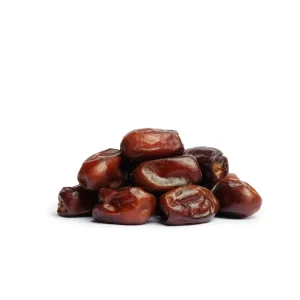
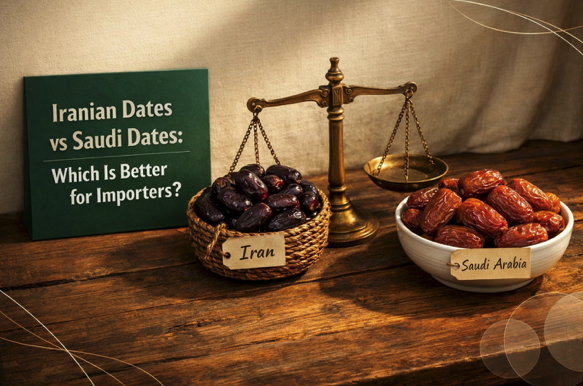
The global date market is worth over $10 billion annually, and two countries sit at the center of it: Iran and Saudi Arabia. For importers, the choice between Iranian dates vs Saudi dates goes well beyond taste. It comes down to price, supply volume, variety range, logistics, and how well the product fits your target market. Both origins have genuine strengths, but they serve different business needs. This article gives you a clear, data-based comparison so you can make a sourcing decision that actually works for your operation.
Overview of Date Production
Date Production in Iran
Iran is the world’s second-largest date producer, with an annual output of approximately 1.2 million metric tons. Key producing provinces include Kerman, Khuzestan, Bushehr, Hormozgan, and Sistan-Baluchestan. Iran cultivates over 400 date varieties, which gives exporters a product range that few other origins can match. The country exports dates to more than 50 countries, with Russia, Iraq, India, and several European markets among the top destinations.
Date Production in Saudi Arabia
Saudi Arabia produces around 1.5 million metric tons of dates per year, making it the largest producer by volume. Major growing regions include Al-Madinah, Al-Qassim, Riyadh, and Al-Ahsa. Saudi Arabia has invested heavily in modern agricultural infrastructure and positions itself as a premium supplier, particularly in Gulf, Southeast Asian, and Western markets.
When you look at Iranian dates vs Saudi dates at the production level, Iran’s advantage is variety and export flexibility. Saudi Arabia leads in volume and premium market positioning, but a large share of its production stays within the country or gets distributed through religious channels during Hajj season.
Popular Date Varieties
Popular Iranian Date Varieties
Iran’s variety range is one of its strongest selling points. Whether you need a soft date for retail, a semi-dry variety for gifting, or a dry date for industrial use, there is an Iranian variety that fits.
Mazafati Dates
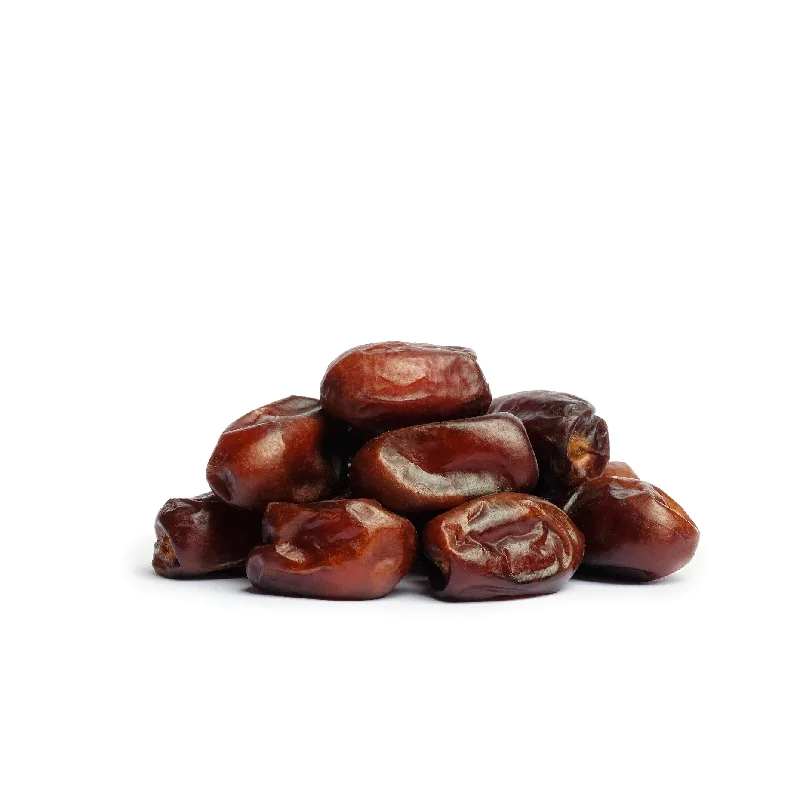
Mazafati is Iran’s most exported variety and for good reason. It is a soft, dark date with high moisture content ranging from 15 to 35 percent, and a rich, sweet flavor that consumers consistently respond well to. It is harvested mainly in Bam, Kerman. Shelf life is shorter than dry varieties and requires cold storage, but demand is strong and repeat purchase rates are high in Russia, Europe, and Central Asia.
Piarom Dates
Piarom is a semi-dry variety grown in Hajiabad, Hormozgan. It has a thin skin, relatively low sugar content, and a subtle caramel-like taste that sets it apart from most other dates on the market. It is one of the most expensive Iranian varieties and targets premium retail segments where consumers are looking for something beyond the standard offering.
Zahedi Dates
Zahedi is a dry, firm date with a shelf life of up to 18 months without refrigeration. It is light golden in color with a mild, nutty sweetness. This variety is well-suited for food processing and bulk wholesale because of its durability, consistent quality, and lower price point.
Kabkab Dates
Kabkab is a semi-dry variety from Fars and Bushehr provinces. It has a soft texture, dark brown color, and moderate sweetness. It is widely consumed domestically and is increasingly exported to neighboring countries and Russia, where it performs well in mid-range retail.
Popular Saudi Date Varieties
Saudi Arabia’s variety lineup is smaller but well-branded, and several varieties carry strong name recognition in specific markets.
Medjool Dates
Medjool is the most recognized date variety globally. It is large, soft, and very sweet with a fibrous texture. Saudi Medjool commands premium prices in Western retail markets and is frequently positioned as a health food product.
Ajwa Dates
Ajwa is a dark, soft date grown exclusively in Al-Madinah. It holds significant religious importance in Islam, which drives consistent demand during Ramadan and Hajj. Prices are high and supply is limited, which makes it difficult to build a scalable import business around this variety alone.
Sukkari Dates
Sukkari is a soft, golden-yellow date from Al-Qassim with a very sweet, honey-like flavor. It is popular in Gulf countries and Southeast Asia and is positioned as a mid-to-premium product.
Safawi Dates
Safawi is a dark, medium-soft date from Al-Madinah with a mild sweetness. It is often marketed alongside Ajwa for religious and health-conscious consumers.
Quality and Taste Comparison
Texture and Moisture Content
Iranian dates cover the full spectrum: soft, semi-dry, and dry. This range gives importers real flexibility depending on their market and logistics setup. Saudi varieties like Medjool and Sukkari are predominantly soft and high-moisture, which appeals to premium consumers but requires careful cold chain management throughout the supply chain.
Flavor Profile
Saudi dates, particularly Medjool and Sukkari, tend to be sweeter and more uniform in flavor, which works well for markets where consistency is the priority. Iranian dates offer more diversity. Piarom has a subtle, complex taste. Mazafati is rich and fudgy. Zahedi is mild and nutty. For markets that value variety and want to offer customers something different, the Iranian dates vs Saudi dates comparison clearly shows Iran has the broader flavor range.
Shelf Life
Shelf life is a practical factor that directly affects your logistics planning and waste rates. Here is how the main varieties compare:
|
Variety |
Origin |
Type |
Shelf Life (approx.) |
|
Mazafati |
Iran |
Soft |
6 months (refrigerated) |
|
Piarom |
Iran |
Semi-dry |
12 months |
|
Zahedi |
Iran |
Dry |
18 months |
|
Kabkab |
Iran |
Semi-dry |
10 months |
|
Medjool |
Saudi Arabia |
Soft |
6-12 months (refrigerated) |
|
Ajwa |
Saudi Arabia |
Soft |
12 months |
|
Sukkari |
Saudi Arabia |
Soft |
6 months |
|
Safawi |
Saudi Arabia |
Semi-soft |
12 months |
Price Comparison for Importers
Average Wholesale Price of Iranian Dates
Iranian dates are competitively priced across all segments. Zahedi dates wholesale at roughly 0.80to0.80 to 0.80to1.50 per kg. Mazafati ranges from 1.50to1.50 to 1.50to3.00 per kg depending on grade and packaging. Piarom, as a premium variety, reaches 4.00to4.00 to 4.00to6.00 per kg at export level.
Average Wholesale Price of Saudi Dates
Saudi Medjool dates wholesale between 3.00and3.00 and 3.00and7.00 per kg. Ajwa dates, due to limited supply and religious demand, can exceed 10.00perkg.SukkariandSafawisitinthe10.00 per kg. Sukkari and Safawi sit in the 10.00perkg.SukkariandSafawisitinthe2.50 to $5.00 range.
Price-to-Quality Ratio
For importers focused on volume and margin, the Iranian dates vs Saudi dates comparison shows a clear cost advantage on the Iranian side. Iranian varieties like Mazafati and Zahedi deliver strong quality at significantly lower prices than comparable Saudi products. Saudi dates justify their price in premium retail contexts, but for wholesale and food processing, Iranian dates give you better value per kilogram without compromising on product quality.
Export Availability and Supply Capacity
Iranian Export Volume
Iran exports approximately 200,000 to 250,000 metric tons of dates annually. The country has a well-established export network with active traders in Kerman, Ahvaz, and Shiraz. Export documentation, phytosanitary certification, and customs procedures are standardized for most destination markets, which keeps the process relatively smooth for experienced importers.
Saudi Export Volume
Saudi Arabia exports around 150,000 to 200,000 metric tons per year. The Saudi Date Authority actively promotes exports and has established quality grading systems. However, a significant portion of production is consumed domestically or distributed as religious gifts during Hajj, which can affect availability for commercial importers during peak seasons.
Year-Round Availability
Both countries harvest dates primarily between August and November. Iranian exporters, particularly for dry and semi-dry varieties, can supply year-round from cold storage. Mazafati stored at -5°C to 0°C remains available through spring. This consistent year-round availability is one of the practical reasons many importers in Russia and CIS countries prefer working with Iranian suppliers.
Packaging and Export Infrastructure
Iranian Export Packaging Options
Iranian exporters offer flexible packaging options: bulk cartons in 5 kg and 10 kg formats, retail packs in 250g, 500g, and 1 kg sizes, and private label options for importers who want to build their own brand. Many exporters in Kerman and Khuzestan operate ISO-certified packing facilities. Vacuum packaging is available for Mazafati to extend shelf life during transit, which is particularly useful for longer shipping routes.
Saudi Export Packaging Standards
Saudi exporters typically offer well-branded retail packaging with multilingual labeling. The Saudi Date Authority has set national standards for grading and packaging. Premium gift boxes are common for Ajwa and Medjool, targeting high-end retail and gifting markets. The packaging quality is high, but customization options are more limited compared to Iranian suppliers, and minimum order quantities tend to be larger.
Logistics and Shipping Considerations
Shipping Routes to Russia and CIS Countries
For importers in Russia, Central Asia, and the Caucasus, Iranian dates have a clear logistical advantage. Iran shares borders with Azerbaijan and Turkmenistan and has direct access to the Caspian Sea. Road transport from Iran to Russia via Azerbaijan or the North-South Transport Corridor is well-established and cost-effective. Saudi dates must travel by sea to Gulf ports, then overland or via Black Sea routes, adding both time and cost to every shipment.
Transportation Costs
Shipping Iranian dates to Moscow by road costs approximately 800to800 to 800to1,200 per ton depending on route and season. Sea freight from Saudi Arabia to Russian ports via Novorossiysk or St. Petersburg typically runs 1,500to1,500 to 1,500to2,500 per ton including port handling. That cost difference adds up quickly when you are moving container loads.
Transit Time
Iranian dates can reach Moscow in 7 to 14 days by road. Saudi dates shipped by sea to Russian ports take 25 to 40 days. For time-sensitive orders, especially for soft varieties like Mazafati, the Iranian supply chain is significantly more practical and reduces the risk of quality loss during transit.
Which Dates Are Better for Different Markets?
Best Choice for Wholesale Importers
For high-volume wholesale, the Iranian dates vs Saudi dates comparison clearly favors Iran. Zahedi and Mazafati offer strong margins, consistent supply, and lower per-unit costs. Importers supplying supermarket chains, distributors, or food service operators will find Iranian varieties more scalable and easier to build a reliable supply chain around.
Best Choice for Premium Retail Markets
Saudi Medjool and Ajwa perform well in premium retail environments where brand recognition and presentation matter. That said, Iranian Piarom is a credible premium alternative at a lower price point, particularly in markets where Saudi branding is less established. Importers who want to offer a premium product without the premium sourcing cost should take Piarom seriously.
Best Choice for Food Processing Industry
Zahedi dates from Iran are the standard choice for food processing: date paste, date syrup, energy bars, and confectionery. Their dry texture, long shelf life, and competitive price make them ideal for industrial use. Saudi varieties are rarely used in processing due to higher cost and softer texture.
Key Factors Importers Should Consider
Budget and Target Market
If your target market is price-sensitive or mid-range, Iranian dates deliver better margins and more room to compete on price. If you are targeting premium health food stores or gift markets in Western countries, Saudi varieties may justify the higher cost. The Iranian dates vs Saudi dates decision ultimately comes down to your customer profile and what they are willing to pay.
Product Type and Shelf Life
Soft dates require cold chain infrastructure throughout the supply chain. If your logistics cannot reliably support refrigerated transport, dry Iranian varieties like Zahedi are a safer and more practical choice. For markets with solid cold storage infrastructure, Mazafati is a high-demand product with strong repeat purchase rates and good consumer loyalty.
Supplier Reliability
Iran has thousands of active date exporters, which means competition keeps quality standards up and prices competitive. Vetting suppliers through export records, certifications, and sample orders is straightforward. Saudi exporters are fewer in number but often operate at larger scale with more standardized processes. For importers who are new to the market, Iranian suppliers tend to be more flexible on order size and more willing to accommodate custom packaging or labeling requirements.
Conclusion
The Iranian dates vs Saudi dates comparison does not have a single answer that fits every importer. It depends on what you are sourcing, where you are selling, and what your margins need to look like. For most wholesale importers, especially those supplying Russia, CIS countries, or price-sensitive markets, Iranian dates offer a stronger combination of variety, price, and logistics efficiency. For premium retail or religious market segments, Saudi varieties hold their ground.
Related Products