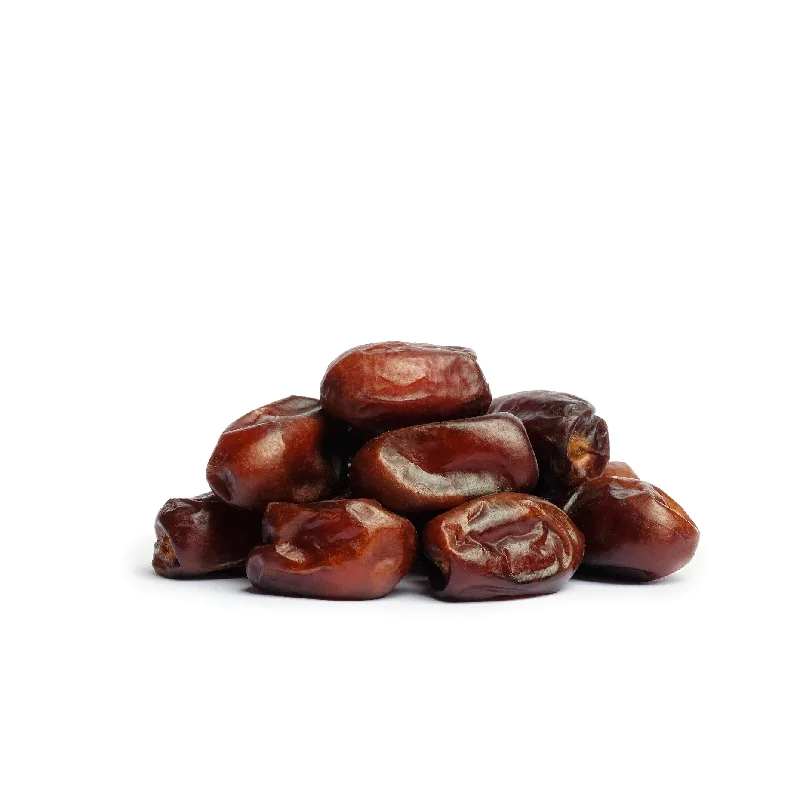
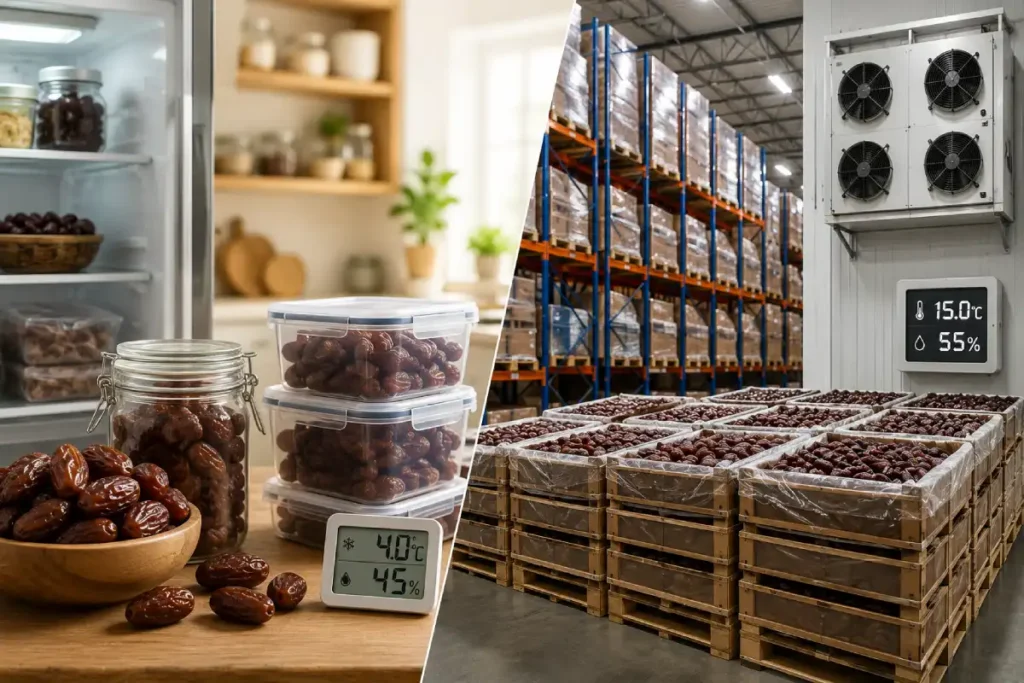
Controlling temperature and humidity is the decisive factor in preserving the nutritional profile and texture of dates, and reliable Storage Methods for Dates depend entirely on managing these two variables. Without correct Storage Methods for Dates, the fruit loses moisture, ferments, or attracts pests within weeks. In this article, we will explore the exact temperature, humidity, and packaging techniques required to keep dates fresh at home and in industrial facilities.
Why Date Storage Matters?
Dates are highly susceptible to three forms of deterioration when left unprotected: moisture loss, yeast fermentation, and pest infestation. The high sugar concentration that gives dates their stability also makes them a viable medium for microbial activity once surface moisture rises. Proper Storage Methods for Dates retain the natural invert sugars (glucose and fructose) and prevent enzymatic browning, the reaction that darkens the flesh and degrades flavour. Applying disciplined storage practices is the most direct way to extend the life of your dates while protecting their vitamin content and preventing souring.
Factors Affecting Date Shelf Life
Shelf life is the specific period during which a food product remains stable, safe, and retains its intended sensory and chemical characteristics under defined storage conditions. In practical terms for dates, it is the length of time the fruit stays edible and keeps its expected taste and texture before quality drops below an acceptable level. Storage needs differ by cultivar, so check the moisture profile of each variety in our Iranian dates range before planning warehouse space.
The date shelf life of any batch is not fixed. Two identical varieties can produce very different results depending on the storage environment, which is why managing each contributing factor matters more than the variety itself.
Temperature and Humidity
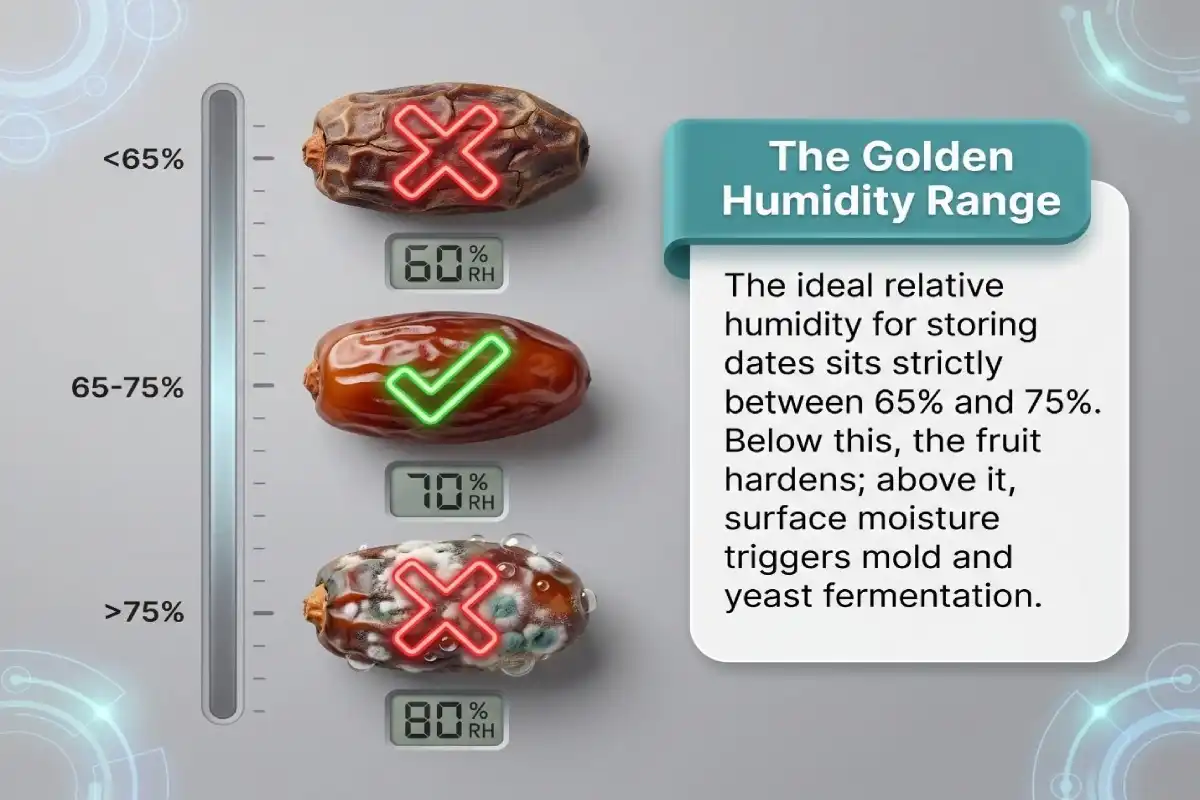
Higher temperatures accelerate both moisture loss and enzymatic browning, which shortens date shelf life considerably. The optimal storage temperature is not universal; it depends on the date type and its moisture content. The ideal relative humidity for storing dates, however, sits strictly between 65% and 75%. Below this range the fruit hardens and dries out; above it, surface moisture triggers mould and fermentation. Holding the optimal storage temperature alongside controlled humidity is the foundation of every effective storage strategy.
Light and Air Exposure
Exposure to oxygen drives rapid oxidation and accelerates microbial spoilage, which explains why open containers fail so quickly. Direct UV light degrades vital vitamins and causes severe color darkening (browning). Opaque, sealed packaging removes both threats at once.
How to Store Dates at Home
Home storage requires no specialised equipment, only the correct method matched to the right variety.
Room Temperature vs. Refrigeration
Keeping dates in a dry pantry at room temperature (approximately 20°C) yields a shelf life of 1 to 3 months. Refrigeration at 4°C to 5°C is required to extend this window to 6–12 months. When storing Medjool dates, refrigeration is particularly important: because Medjools carry higher moisture content, they are prone to souring at warm temperatures, and cold storage prevents this. The same applies to anyone storing Medjool dates in humid climates, where ambient conditions push moisture into the fermentation range.
Freezing and Storage Containers
Freezing dates at -18°C (0°F) preserves them for up to 3 years. Because of their high sugar and low free-water content, dates do not freeze into solid blocks and thaw within minutes at room temperature. Across all home methods, airtight containers or vacuum-sealed bags are mandatory. Airtight containers prevent freezer burn, block odour absorption from surrounding foods, and stabilise the humidity around the fruit. This single step does more to extend the life of your dates than any other home practice.
Industrial Storage Methods
Industrial cold storage is a heavily insulated, climate-controlled facility engineered to maintain specific thermal and atmospheric parameters that halt biological degradation. In simple terms, it is a large refrigerated warehouse where temperature, humidity, and sometimes oxygen are managed precisely to keep large volumes of dates stable for months.
These facilities exist because export-grade preservation cannot rely on domestic refrigerators. The Storage Methods for Dates applied at industrial scale are engineered systems rather than improvised solutions.
Cold Storage and Controlled Atmosphere
In dates cold storage, dry dates are typically held above zero at 0°C to 5°C, while soft commercial dates are frozen at -18°C to -20°C to stop fermentation entirely. Effective dates cold storage assumes uniform temperature throughout the chamber. A more advanced layer is Controlled Atmosphere (CA) storage, where oxygen levels are dropped below 1%. This oxygen-poor environment naturally halts insect activity and prevents yeast fermentation without chemical treatment, which makes CA-based dates cold storage valuable for organic supply chains.
Packaging and Palletizing
Industrial packaging relies on food-grade plasticizing and vacuum sealing to lock out oxygen and contaminants. Beyond the packaging, palletizing is critical: pallets must be spaced correctly inside the warehouse to allow uniform airflow. Blocking ventilation channels creates localised “hot spots” where temperature rises and concentrated spoilage follows. Correct pallet layout is therefore part of the Storage Methods for Dates, not a secondary logistics detail.
Storage Requirements by Date Type
Dates are categorised strictly by their moisture content at harvest, and this single variable dictates how each type must be stored.
| Category | Examples | Moisture Content | Recommended Storage |
|---|---|---|---|
| Soft | Medjool, Barhee, Khadrawy | >30% | Immediate refrigeration or freezing |
| Semi-Dry | Deglet Noor | 20–30% | Room temperature or cold storage (0°C) |
| Dry | Zahidi, Thoory | <20% | Room temperature, stable over a year |
Soft Dates
Soft varieties such as Medjool, Barhee, and Khadrawy contain more than 30% moisture and are highly perishable. If held above 25% moisture at warm room temperatures, they undergo yeast fermentation, commonly identified as souring. These varieties require immediate refrigeration or freezing to remain stable.
Semi-Dry and Dry Dates
Semi-dry dates such as Deglet Noor contain 20–30% moisture, while dry varieties like Zahidi and Thoory contain less than 20%. Their lower water activity makes them highly shelf-stable; they survive at room temperature or in standard cold storage at 0°C for over a year without freezing.
Date Shelf Life Under Different Conditions
Recent food science data provides a clear breakdown of expected timelines:
| Storage Condition | Temperature | Expected Shelf Life |
|---|---|---|
| Pantry / Room Temp | ~20°C | 1 to 3 months |
| Refrigerator | 4°C | 6 to 12 months |
| Freezer | -18°C | 1 to 3 years |
These timelines are not guaranteed by location alone; they depend entirely on utilising the correct Storage Methods for Dates, including sealed packaging and a stable optimal storage temperature.
Signs of Improper Storage
- Souring / Mold: A yeasty or fermented smell indicating that moisture levels were too high during storage.
- Pests: Small brown specks or insects burrowed into the flesh, common in non-fumigated organic dates.
- Sugar Spotting: White crystallisation on or beneath the skin. This alters texture but is biologically safe to eat.
- Discoloration: Severe darkening of the flesh caused by heat exposure.
Date Storage for Export
Export depends on an unbroken cold chain. For international shipment, dates are commonly either fumigated with carbon dioxide or frozen strictly at -18°C for a minimum of two days to eliminate insect eggs without chemicals. Shipping containers must maintain stable temperatures throughout transit. Temperature fluctuation causes “sweating,” the condensation that forms when warm and cold surfaces meet, and this surface moisture triggers mould within hours. Reliable export therefore treats consistent dates cold storage during transport as non-negotiable. This is also where the question of what are the best storage methods for dates carries direct commercial weight, since a single break in the chain can spoil an entire consignment.
Conclusion
Whether a consumer uses airtight containers in a home kitchen or a supplier relies on industrial dates cold storage, the outcome is governed by the same two variables. Strict temperature management and moisture control are the definitive factors in preserving date quality across every scale of operation.
FAQ
Should dates be refrigerated?
Yes, especially soft varieties or when stored in humid climates. Refrigeration at 4°C maintains moisture balance and extends freshness for up to 12 months.
Can dates be frozen?
Yes. Freezing at -18°C is the ultimate long-term method, keeping dates safe for up to 3 years; due to their high sugar content, they do not freeze solid and thaw quickly at room temperature.
How long do dates last?
Depending on moisture content and storage environment, dates last 1 to 3 months in a pantry, 6 to 12 months in the refrigerator, and up to 3 years in the freezer.
Related Products