Date packaging is an engineered barrier system designed to regulate moisture transmission, limit oxidation, and protect high-sugar agricultural products from physical, microbial, and logistical damage. In commercial terms, date packaging prevents dates from spoiling while instantly increasing market value for retailers, importers, and gift buyers. In this article, we will explore the most effective packaging materials, analyze cost versus shelf-life performance, and reveal how premium design impacts consumer purchasing decisions.
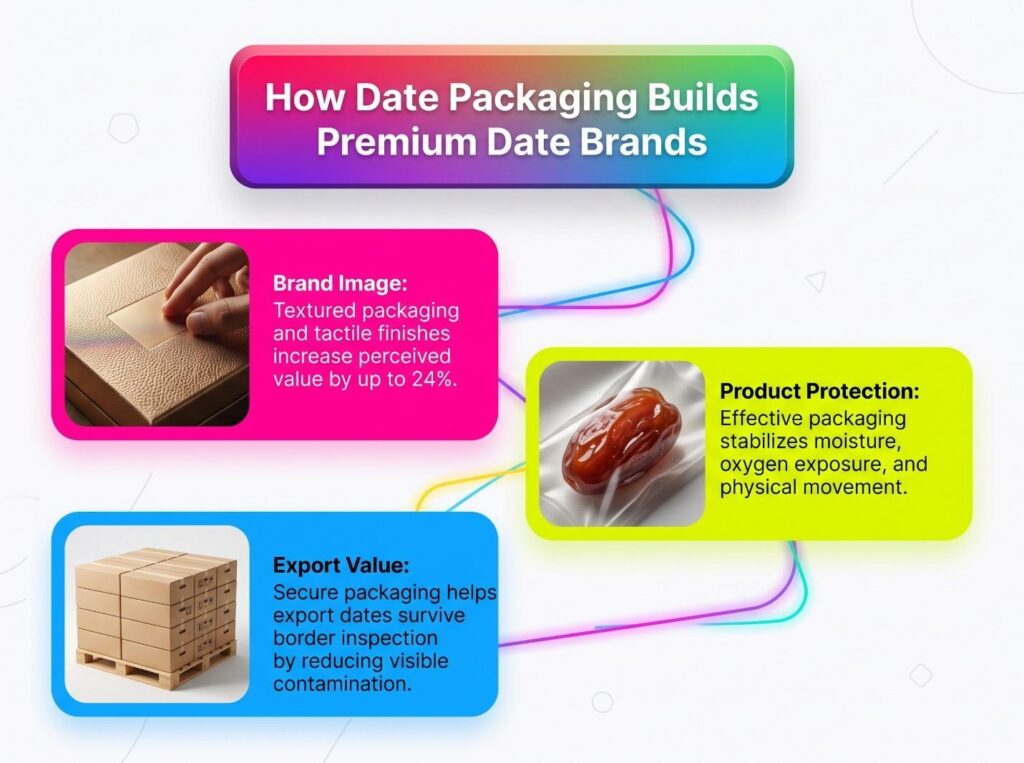
How Date Packaging Builds Premium Date Brands
Date packaging builds premium value by protecting the fruit, proving production discipline, and making buyers trust the grade before tasting. For B2B suppliers, the pack is a commercial control point, not decoration.
Brand Image
Packaging forms the first physical touchpoint. A 2024 Journal of Consumer Psychology study reported that textured packaging and tactile finishes increase perceived value by up to 24%. For premium date brands, soft-touch lamination, blind embossing, rigid board, and precise typography support higher pricing without exaggeration.
Product Protection
Effective packaging stabilizes moisture, oxygen exposure, and physical movement. Dates become hard when moisture escapes, ferment when moisture is trapped, and develop surface sugar crystallization when storage conditions fluctuate. Inserts, liners, and barrier films also reduce bruising, skin tearing, compression marks, and syrup leakage.
read more: Proper Storage Methods for Dates at Home and in Industrial Warehouses
Export Value
Export buyers judge cargo by packaging integrity because weak cartons often indicate hidden product risk. Secure packaging helps export dates survive border inspection by reducing visible contamination, fermentation, pest infestation, crushed layers, and mold-related rejection.
Main Types of Date Packaging
The correct format depends on product grade, temperature, route length, and buyer expectations. Premium retail, gifting, industrial repacking, and wholesale export need different structures.
Glass Packaging
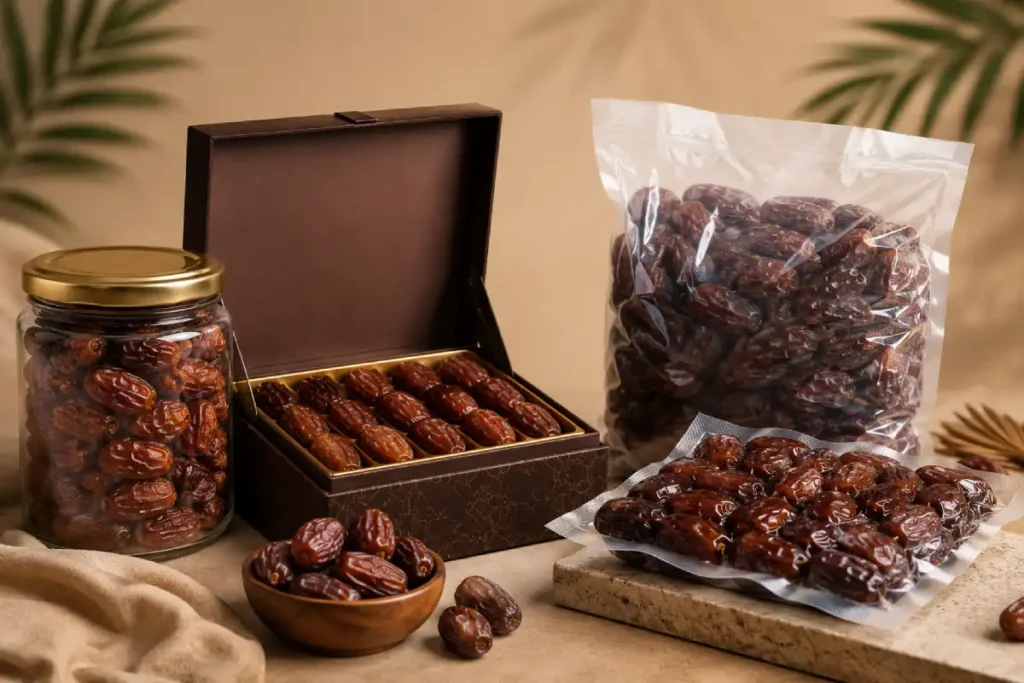
Glass packaging is an inert, non-porous silica-based containment system offering an absolute barrier against oxygen and moisture transmission. Simply, it means airtight jars that keep premium Medjool or Ajwa dates fresh while showing size, color, and cleanliness. Glass supports premium date brands, but it increases freight weight, breakage control, and cost.
Luxury Box Packaging
Luxury box packaging is a rigid paperboard or FSC-certified corrugated structure, usually combined with custom-thermoformed inserts. Simply, a luxury dates box is a strong gift box with trays, windows, magnetic closures, or sleeves. It works best for Ramadan, corporate gifting, airport retail, and luxury food counters.
Bulk Bag Packaging
Bulk bag packaging uses multi-layer polymer pouches, such as Mono-PP, or corrugated cartons lined with moisture-proof polyethylene. Simply, it is large-capacity packaging for 10kg to 25kg B2B wholesale and industrial transport. It has limited premium appeal, but it delivers low cost per kilogram and efficient handling.
Vacuum Packaging
Vacuum packaging is the mechanical evacuation of ambient air from a low-permeability film enclosure before thermal sealing, reducing oxygen and aerobic microbial activity. Simply, vacuum packaging for dates is a plastic pouch with air removed so the film tightly holds the fruit. It is economical, compact, and strong for preservation.
Thermoformed Plastic Trays
Thermoformed trays are rigid plastic sheets heated and molded into specific cavity shapes. Simply, they are clear clamshells or inner trays with individual slots that stop dates from moving. They reduce abrasion, flattening, and bruising, especially inside a luxury dates box.
Glass vs Box vs Bulk vs Vacuum Date Packaging
The best choice is the format that balances protection, unit economics, shelf life, and brand positioning. Material price alone is not enough for a profitable decision.
| Format | Cost level | Shelf-life performance | Branding potential | Best use |
|---|---|---|---|---|
| Glass jars | High | Strong when sealed and cool | High | Premium retail |
| Rigid luxury boxes | Mid-high | Strong with sealed inner pouch | Very high | Gifting |
| Bulk lined cartons | Low | Moderate to strong | Low | Wholesale |
| Vacuum pouches | Low-mid | Very strong in cold storage | Limited | Export and storage |
Cost Comparison
Glass has the highest unit cost because it adds material expense, shipping weight, breakage risk, and secondary protection. A luxury dates box is mid-to-high depending on board thickness, insert design, print method, and closures. Vacuum pouches are highly economical at scale, while lined bulk cartons offer the lowest cost per kilogram.
Shelf Life Performance
Vacuum packaging for dates gives the strongest preservation result, often supporting 12 to 24 months in cold storage when sealing and sanitation are correct. Glass can preserve freshness for more than one year. Box packaging needs sealed inner films; paperboard alone cannot extend the shelf life of dates.
Branding Potential
Boxes offer the largest printable surface and the strongest tactile impact. Embossing, foil, matte lamination, origin details, and multilingual compliance fit naturally on a luxury dates box. Glass offers premium transparency. Bulk and vacuum formats have limited aesthetics, but they provide strong functional value for export dates.
International Export Standards and Logistics for Dates
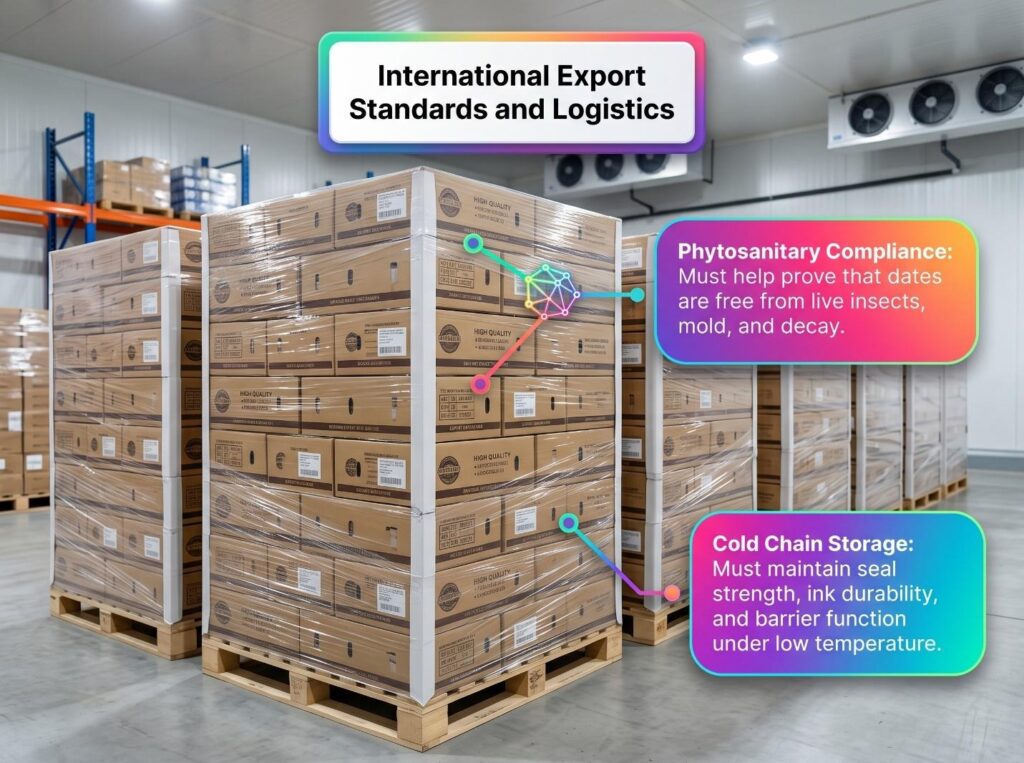
Export packaging must satisfy food safety, phytosanitary inspection, moisture control, labeling, and compression strength. Design for the longest realistic route, not only the factory warehouse.
Phytosanitary and Codex Compliance
Phytosanitary and Codex-compliant packaging means the container must support clean, safe, inspectable movement across borders. Simply, it must help prove that dates are free from live insects, visible mold, decay, pest damage, unsafe contamination, and excessive foreign matter. Labels, seals, liners, and cartons must work together.
Cold Chain Storage Compatibility
Cold-chain-compatible packaging is a material system that maintains seal strength, ink durability, adhesive performance, and barrier function under low temperature and controlled humidity. Simply, it must not soften, delaminate, bleed, or collapse in cold rooms. Maximum freshness usually requires 0°C to 4°C and 60% to 70% humidity.
Choosing the Right Packaging for Your Date Business
Choose by channel first. Retailers need visibility and persuasion, exporters need compliance and strength, and wholesalers need speed, stacking, and low handling cost.
Retail Brands
Retail brands should use packaging that combines visibility, convenience, and premium recognition. Resealable stand-up pouches suit supermarkets. A rigid luxury dates box with a window, molded tray, and sealed inner pouch suits high-value assortments. Premium date brands should use tactile finishes and restrained design.
Export Businesses
Exporters should prioritize moisture barriers, structural integrity, pallet stability, and inspection-ready labeling. Marine transport can involve dense stacking, humidity, vibration, and delays. Packaging for export dates should withstand high stowage factors, including about 1.80 m³/t, without crushing lower layers or creating syrup leakage.
Wholesale Markets
Wholesale markets require fast handling and predictable repacking. Ten-kilogram corrugated cartons with food-safe liners reduce sticking, syrup leakage, and labor time. Vacuum packaging for dates is useful when buyers store stock before processing, repacking, or private-label distribution.
Latest Trends in Date Packaging
Current trends are practical: better recyclability, controlled luxury design, and product authentication. They matter because buyers now evaluate sustainability, origin proof, and operational performance.
Eco-Friendly Materials
Eco-friendly materials are packaging systems designed to reduce environmental impact while maintaining barrier performance, food safety, and durability. Simply, this means recyclable mono-material plastics, FSC-certified paperboard, and biodegradable structures where suitable. The 2026 shift is toward Mono-PP or Mono-PE films and certified paperboards that still resist vapor, grease, puncture, and cold-room humidity.
Luxury Minimal Designs
Luxury minimal design is a controlled visual system using restrained typography, matte surfaces, blind embossing, and precise spacing. Simply, it makes the package look premium without loud color or excessive foil. For premium date brands, this approach signals origin control, grade discipline, and confidence.
Smart Labels
Smart labels are digital identity tools, such as NFC tags or QR codes, integrated into the pack to connect the physical product with verified data. Simply, buyers scan the package to confirm origin, batch, certification, or authenticity. This helps protect genuine Saudi Ajwa, Medjool, and other premium lines from counterfeit claims.
Common Date Packaging Mistakes
Most failures come from mismatching the material to the fruit, sales channel, or route. These mistakes reduce pricing power and increase claims.
Poor Material Selection
Poor material selection means using films, cartons, or liners with the wrong moisture, oxygen, puncture, or compression performance. Simply, porous materials dry dates, while unsuitable sealed systems trap excess moisture and create mold or fermentation risk. Match the material to cultivar moisture and storage temperature.
Weak Branding
Weak branding means the package does not support the claimed grade and price. Simply, putting premium dates, including $2,000/ton Medjool, in cheap generic plastic destroys trust. Premium date brands need coherent structure, clean typography, credible origin information, and finishing quality.
Ignoring Export Standards
Ignoring export standards means missing mandatory label, inspection, or documentation requirements. Simply, absent durable life dates, country of origin, nutritional facts, lot codes, or language compliance can cause customs rejection. Export labels should be moisture-resistant, scannable, and consistent across primary packs, cartons, and pallets.
FAQ About Date Packaging
These answers focus on practical B2B decisions for exporters, wholesalers, and luxury retailers. The best choice depends on transit length, storage temperature, product grade, and presentation needs.
What is the best packaging for export dates?
Sturdy corrugated cardboard cartons with food-grade, moisture-proof inner liners, or bulk vacuum-sealed bags, are the best options. They protect against humidity, syrup leakage, pest exposure, and physical crushing during long transit while supporting the shelf life of dates and border inspection requirements.
Is vacuum packaging better for dates?
Yes, for functional preservation. Vacuum packaging for dates removes oxygen, reduces aerobic spoilage pressure, and limits insect survival under correct storage. It can extend the shelf life of dates up to two years in cold storage, but it does not provide the premium appearance of rigid boxes.
Which packaging looks most premium?
Custom rigid luxury boxes with tactile finishes, such as soft-touch lamination or blind embossing, magnetic closures, and thermoformed inner trays look most premium. For premium date brands, this type of packaging communicates controlled quality, gift suitability, and retail confidence better than plain plastic.
Related Products