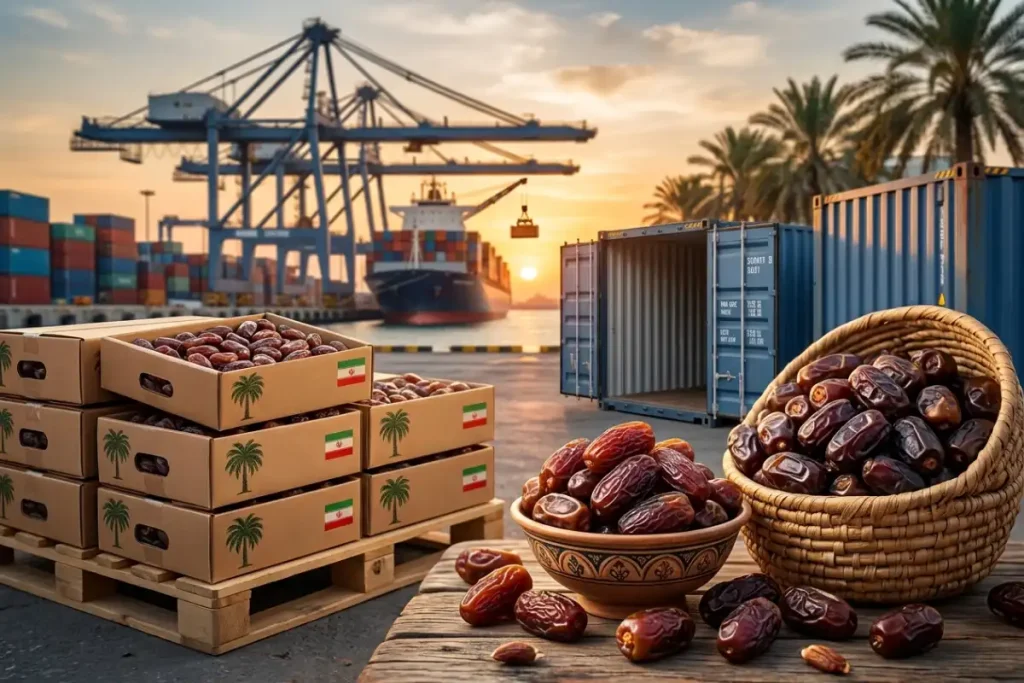
The minimum order quantity (MOQ) for importing dates from Iran is a flexible commercial threshold rather than a single industry standard. It depends entirely on whether a buyer requires a less than container load (LCL) shipment, a full container load (FCL), or custom packaging. While some suppliers accept commercial shipments as small as one to five metric tons, large-scale or customized orders demand significantly higher volumes. This guide explores how product specifications, logistics, and packaging formats shape these thresholds, helping first-time buyers estimate a practical initial shipment.
Why Exporters Set an MOQ
MOQ is the smallest commercial quantity a supplier is willing to produce, pack, or ship under a specific quotation. Date exporters set these minimums to ensure that an order’s revenue covers the fixed costs of fulfilling it.
Even a relatively small shipment requires a dedicated sorting and grading setup, packing-line calibration, and pallet preparation. Suppliers also face fixed administrative costs, including export documentation, laboratory testing, and logistics booking. When an order volume drops too low, these fixed preparation and freight expenses lead to a disproportionately high per-kilogram price, making the transaction uncompetitive for both parties. Crucially, a supplier’s commercial MOQ is an economic decision, whereas a shipping container’s maximum payload is a strict physical limit. They are not the same number.
Typical MOQ Ranges by Order Type
The commercially workable quantity for an import order depends primarily on the chosen freight format. The figures below are illustrative market examples reflecting general container economics, not an official Amin Farms MOQ policy.
| Order Type | Illustrative Commercial Scale | Freight Format | Best Fit | Main Limitation |
| Sample order | 1–10 kg | Courier / Air Freight | Quality and specification evaluation | High freight cost per unit |
| LCL | 1–5 MT | Sea Freight (Consolidated) | Trial wholesale orders | Higher handling risks and unit costs |
| 20-ft FCL | 12–20 MT | Dedicated Container | Established regional distributors | Requires larger inventory commitment |
| 40-ft FCL | 20–28 MT | Dedicated Container | Large-scale volume importers | High initial capital requirement |
Illustrative market ranges only. Confirm Amin Farms’ current MOQ, net loading quantity, packaging configuration, and container type for each quotation.
Sample Orders
A product sample is simply an evaluation tool, not a commercial MOQ. Suppliers routinely provide individual product samples, various grades for laboratory evaluation, or packaging prototypes before a buyer places a full commercial order.
Because courier or airfreight samples carry a significantly higher shipping cost per kilogram than commercial sea freight, buyers should never use sample freight rates to estimate full-order logistics. The primary goal of a sample is to approve the product specification, not to achieve commercial freight efficiency.
LCL (Less than Container Load)
LCL refers to cargo that does not fill a standard shipping container and is instead consolidated with other shipments. This format makes commercial sense when a buyer’s demand is below a full container, especially for a controlled first order.
Published Iranian supplier examples ranging from 1 to 5 MT show that smaller commercial batches are feasible on select routes. While LCL lowers your overall inventory commitment, it comes with trade-offs: higher freight and handling costs per kilogram, extra deconsolidation steps, and less suitability for high-moisture dates that require strict, continuous refrigeration.
FCL (Full Container Load)
FCL is a shipment where a single buyer’s cargo occupies the entire container. Established importers generally prefer FCL because it offers simpler cargo control and spreads freight costs across a much larger volume of goods.
Moving to FCL ensures dedicated cold-chain management and avoids consolidation delays. However, the actual net cargo weight usually falls short of the container’s theoretical maximum. To determine the true net load, you must accurately calculate carton dimensions, pallet configurations, and necessary airflow requirements rather than relying solely on the container’s structural payload limits.
Factors That Affect MOQ
The MOQ can change even for the exact same buyer because altering the product specification fundamentally shifts the production and logistics setup.
Date Variety and Packaging Format
Product characteristics directly dictate feasible order sizes. For instance, a standard, dry variety shipped in bulk 10-kilogram cartons usually allows for a lower MOQ than a highly specific retail request.
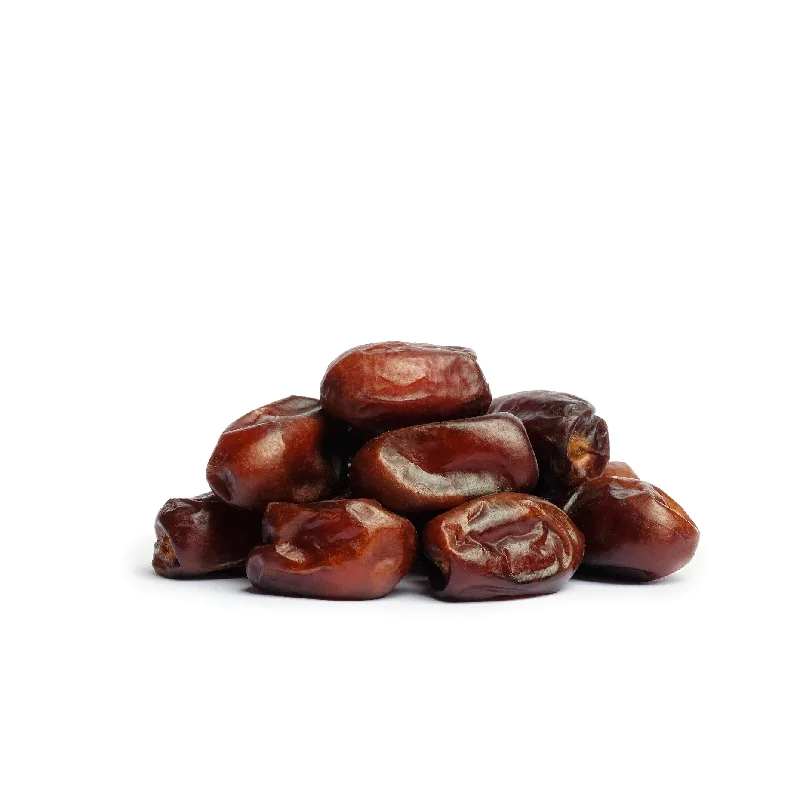
High-moisture varieties like Mazafati dates often require strict refrigerated supply chains. If LCL reefer service isn’t available on a specific route, the minimum viable order volume increases significantly. Additionally, requests for custom retail trays, private-label printing, multilingual labels, or multiple SKUs in a single order will inherently raise a supplier’s production minimums.
Destination Country
Destination-country regulations frequently influence the economically practical order quantity because fixed compliance costs can make tiny shipments financially unviable.
To import dates from Iran into the United States, for example, importers must navigate U.S. Food and Drug Administration (FDA) requirements, including facility registration, Prior Notice, and Foreign Supplier Verification Programs (FSVP). Similarly, shipments to the European Union require testing to ensure compliance with strict maximum residue levels (MRLs) for pesticides. Buyers must verify their specific destination requirements before finalizing order volumes.
Value-Added Processing (Pitted, Paste, Syrup)
Processed date products carry their own specific MOQ requirements because they demand distinct, additional factory operations.
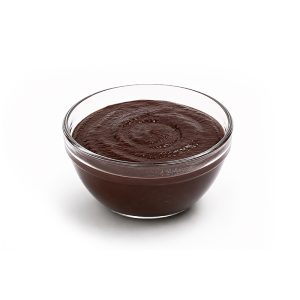
Mechanical pitting, paste manufacturing, and date syrup processing involve dedicated batch runs, industrial packaging, and often buyer-specific consistency or Brix requirements. Therefore, a supplier’s minimum volume for whole dates does not automatically apply to date paste. The Codex Alimentarius standard for dates formally distinguishes commercially prepared whole dates from mashed dates intended for industrial processing, reflecting the different manufacturing paths that dictate these minimum volumes.
Can MOQ Be Negotiated for New Buyers?
Sometimes, but MOQ flexibility depends on the product specification, available inventory, packaging, logistics, and the supplier’s production schedule—not just on a buyer asking for a discount.
An Iranian date supplier might offer a lower initial threshold if you choose an existing standard specification, use unprinted bulk packaging, select a product already in stock, or limit your first shipment to a single SKU. Conversely, flexibility almost always drops when a buyer demands custom retail packaging, private-label printing, special processing, or strict temperature-controlled shipping on complex maritime routes. Always request a quotation using a precise specification instead of simply asking for a minimum number.
How to Plan Your First Order Volume
To plan an efficient first order, buyers must first estimate their internal demand, then compare that requirement against the supplier’s MOQ and container economics.
A reliable planning heuristic uses standard reorder-point logic:
Baseline inventory requirement = (Average daily demand × planned coverage days) + Safety stock
- Average daily demand: Expected sales or manufacturing usage, measured in kilograms per day.
- Coverage period: The number of days the inventory must support sales before replacement stock can arrive.
- Safety stock: Extra inventory held to mitigate demand spikes or shipping delays.
Example Calculation:
If a food distributor expects a demand of 40 kg/day, requires 45 days of coverage during ocean transit, and wants a safety stock of 300 kg, the calculation is:
(40 × 45) + 300 = 2,100 kg
A buyer estimating 2.1 MT of initial demand should compare this figure against available LCL options, pallet configurations, and per-kilogram freight economics to decide whether to place a trial LCL shipment or increase the volume to secure an FCL rate.
Quotation Checklist:
When requesting a firm quote, always provide:
- Date variety and grade
- Format (whole, pitted, paste, syrup)
- Approximate net quantity
- Packaging size and format (standard or private label)
- Destination country and port
- Required certifications or laboratory tests
Send these exact specifications to the Amin Farms export team to confirm the current workable MOQ and optimal shipping configuration for your market.
FAQ
Is MOQ quoted in kilograms, metric tons, cartons, or pallets?
The commercial quote may use any of these units depending on the exporter’s systems. Buyers should always confirm both the net product weight and the cartons-per-pallet configuration to accurately compare different supplier quotations.
Can different Iranian date varieties be combined in one order?
Mixed shipments are sometimes possible depending on available inventory, packaging compatibility, temperature requirements, and container loading constraints. However, combining multiple varieties typically increases production complexity and requires larger overall minimum volumes.
Does seasonality change the available MOQ?
Yes. Crop availability and harvest scheduling heavily influence what quantities and specific grades are commercially available at any given time. Always confirm current validity and availability within a live quotation.
How long is a quoted MOQ valid?
There is no universal validity period. MOQ and loading arrangements fluctuate based on seasonal inventory, packaging availability, freight service schedules, and production planning. Rely strictly on the expiration date shown on your current proforma invoice.
To establish a successful supply chain, buyers must view the Iranian dates MOQ not as an arbitrary barrier, but as a reflection of processing and logistics economics. By calculating true demand, choosing standard specifications where possible, and understanding the cost differences between LCL and FCL freight, importers can confidently secure a first shipment that balances risk with commercial viability.
Related Products