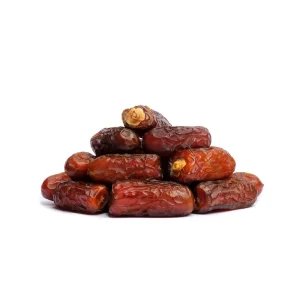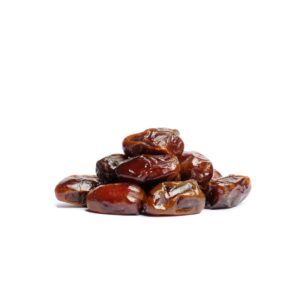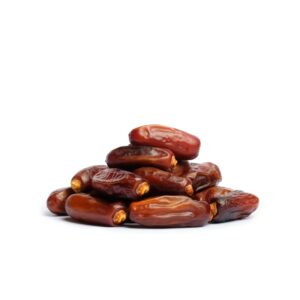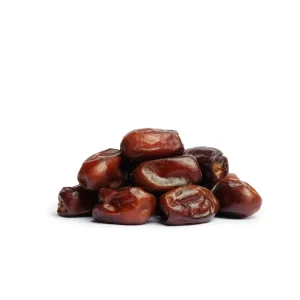
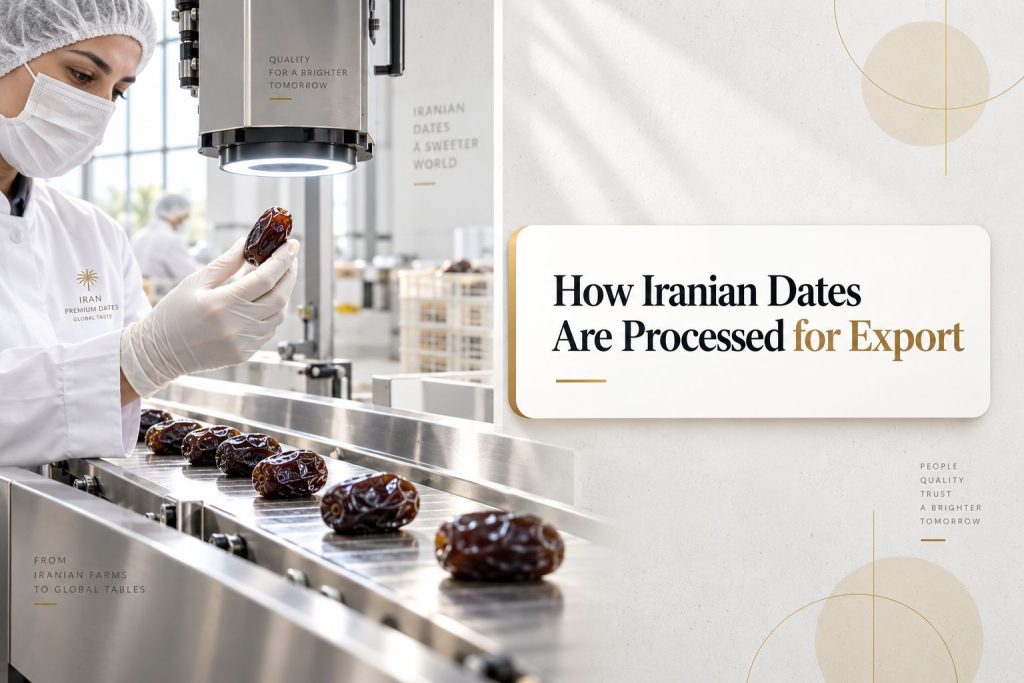
For a B2B buyer, the real date export process begins after harvesting. Iranian dates must move through a controlled sequence in which each stage protects the next one: the right maturity makes grading possible, moisture control supports storage stability, disinfestation reduces pest risk, and appropriate packaging protects the finished lot during transport. Because varieties differ considerably, the process is not identical for every shipment. Mazafati, for instance, needs much tighter cold-chain management than a dry variety such as Zahedi.
Step 1 — Harvesting at the Right Ripeness Stage
The first stage of post-harvest date processing is harvesting the fruit at the maturity stage required by the variety and target market. Iran’s main production regions include Hormozgan, Kerman, Khuzestan, Bushehr, Sistan & Baluchestan, and Fars, where cultivars such as Mazafati, Piarom, Sayer, Zahedi, Rabbi, Kabkab, Shahani, and Kalute are produced.
Dates generally pass through 3 maturity stages:
- Khalal: Fully coloured but still firm, with relatively high moisture.
- Rutab: Softer and partially ripe, with an intermediate texture and moisture level.
- Tamar: Fully ripe and softer, with the lowest moisture of the 3 stages.
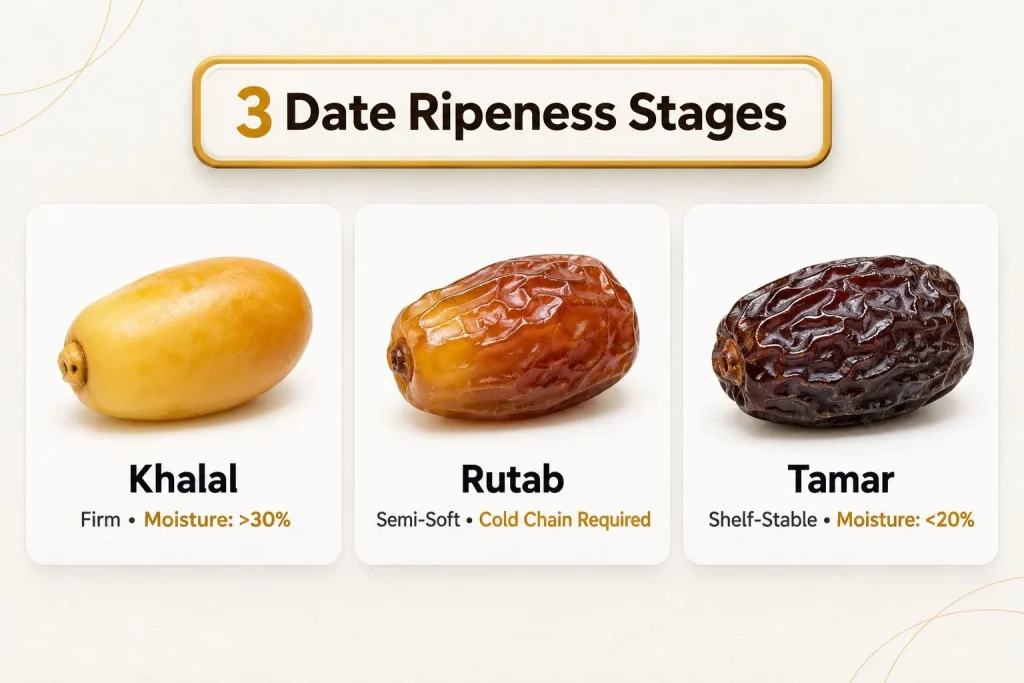
Therefore, there is no single harvest rule for all Iranian dates. Commercial guidance commonly places harvest around bunch moisture below 20%, while dates intended for non-refrigerated storage may be dried to approximately 16–19%. After harvesting, fruit should reach the packhouse quickly; soft varieties may require refrigerated transport to limit field heat and bruising. Some bulk varieties, including Rabbi, are also shipped in bulk formats.
Step 2 — Sorting and Cleaning
Once the harvested fruit reaches the packhouse, sorting and cleaning establish the physical condition of the export lot. This stage is particularly important because defects that remain in the product become more difficult and expensive to correct later.
The Iranian date processing line typically combines:
- Primary sorting: Manual and mechanical inspection removes damaged, immature, mould-affected, and unsuitable fruit, as well as foreign material.
- Washing: Where specified, controlled washing removes surface residues while limiting water absorption.
- Air-drying: An air-drying tunnel removes surface moisture before subsequent handling and packaging.
- Cross-contamination control: Product flow, equipment, and contact surfaces are managed to prevent cleaned fruit from becoming contaminated again.
The washing stage requires particular care for semi-dry varieties such as Sayer. Excessive water absorption can raise date moisture content and potentially reduce storage stability. Washing and polishing are therefore processing options rather than mandatory steps for every shipment.
Step 3 — Grading by Size and Quality
After cleaning, date grading and sorting turn agricultural variation into a consistent commercial specification. Automated grading lines can classify fruit by size, colour, and surface condition, while manual inspection provides an additional quality check.
The Codex Standard for Dates, CXS 143-1985, provides an important international reference for size and quality. For unpitted dates, Codex defines Small as more than 100 dates per 500 g, Medium as 80–100, and Large as fewer than 80. For pitted dates, the limits are more than 110, 90–110, and fewer than 90 respectively. Minimum individual weight is 4.75 g for unpitted dates and 4.0 g for pitted dates.
| Codex size classification | Unpitted dates | Pitted dates |
|---|---|---|
| Small | >100 / 500 g | >110 / 500 g |
| Medium | 80–100 / 500 g | 90–110 / 500 g |
| Large | <80 / 500 g | <90 / 500 g |
| Minimum individual weight | 4.75 g | 4.0 g |
Codex also provides defect tolerances. Dirt, insects, and mites may account for a maximum of 6% by count; blemishes are limited to 7%; and mould, scouring, and decay together are limited to 1%. The standard also requires dates to be free from live insects, insect eggs, and mites.
Commercial contracts may set stricter limits than Codex. Consequently, buyers should define the exact grade, moisture content, size range, defect tolerance, and sampling method in the contract. Consistent date grading is essential because it gives importers more predictable batches across repeat shipments.
Step 4 — Disinfestation and Food-Safety Treatment
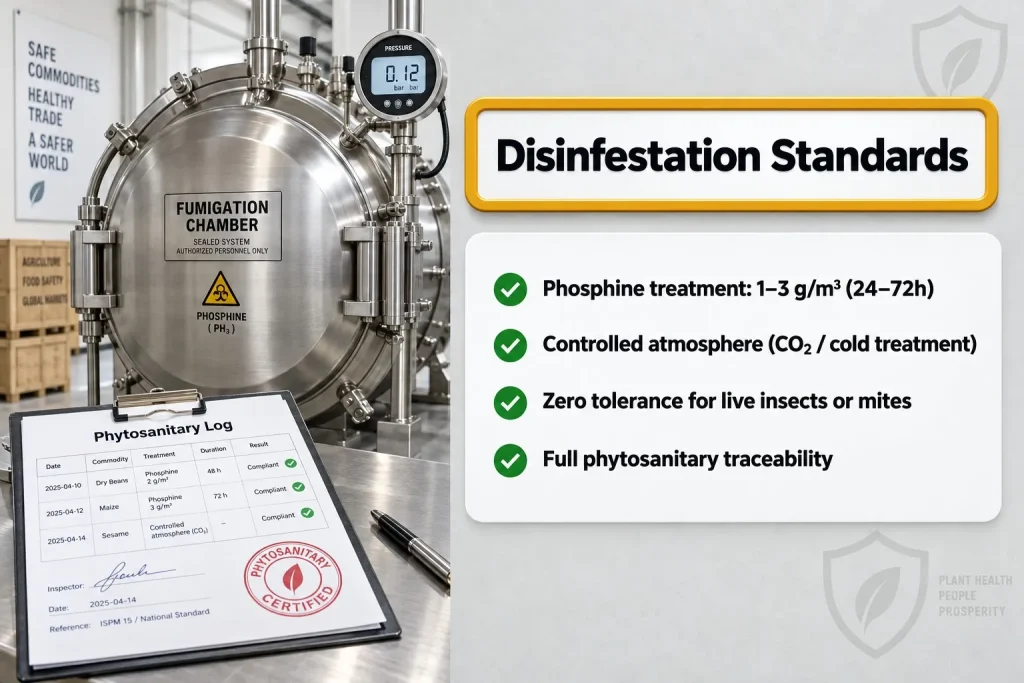
With grading complete, the next priority is protecting the shipment from stored-product pests. Two relevant pests are the sawtoothed grain beetle, Oryzaephilus surinamensis, and the carob moth or date moth, Ectomyelois ceratoniae.
Codex permits dates to be washed and/or pasteurized, so pasteurization is a recognized optional treatment. However, buyers should not assume that a supplier pasteurizes its dates. If an exporter makes that claim, the buyer should request the specific heat-treatment parameters, including temperature and holding time.
In practice, disinfestation is a major control point in export date processing. Common approaches include:
- Phosphine fumigation: Published research has evaluated approximately 1–3 g/m³ with exposure periods of 24–72 hours, depending on treatment conditions. A dosage should never be copied from another shipment without confirming the validated treatment protocol.
- Phosphine with CO₂: Controlled-atmosphere combinations have been studied for faster insect mortality, including difficult developmental stages. One reported treatment used 3 g/m³ phosphine with 98% CO₂.
- Cold and controlled-atmosphere treatment: Low-temperature or low-oxygen systems can provide non-chemical pest-control options where accepted by the destination authority.
Methyl bromide, historically used for quarantine treatment, has been phased out for most uses because of its ozone-depleting properties, although specific quarantine and pre-shipment exemptions remain under international rules.
For importers, the critical evidence is the treatment record: method, concentration, exposure time, temperature where relevant, date, lot identification, and the corresponding phytosanitary certificate should be traceable.
Step 5 — Packaging for Export
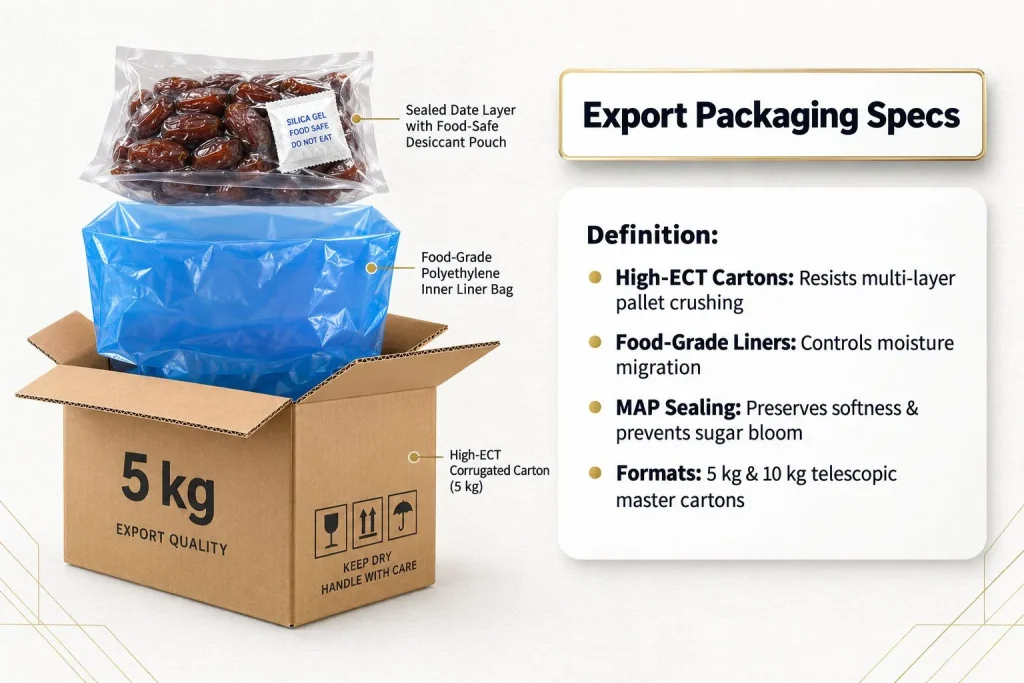
Once the dates have passed grading and treatment, packaging protects both the product and the agreed specification during transport. Export packaging can include 5 kg and 10 kg telescopic corrugated cartons, depending on the market and sales format.
Key packaging considerations include:
- Inner liners and shrink wrap can help control moisture migration and protect the fruit.
- Modified Atmosphere Packaging (MAP) may be used for selected Mazafati and other premium soft-date applications on longer routes.
- High ECT cartons are important for shipments travelling long terrestrial routes, where vibration and multi-level pallet stacking can place significant compression loads on cartons.
- Destination-specific labelling must be prepared for the target market. Eurasian shipments, for example, may require EAC-related conformity information and Russian-language product information.
Palletization should be calculated from carton dimensions, pallet matrix, stack height, and container payload. Container space is commonly planned using the basic volume relationship V = L × W × H, while actual loading must remain within the permitted weight and transport limits.
Step 6 — Quality Control and Lab Testing
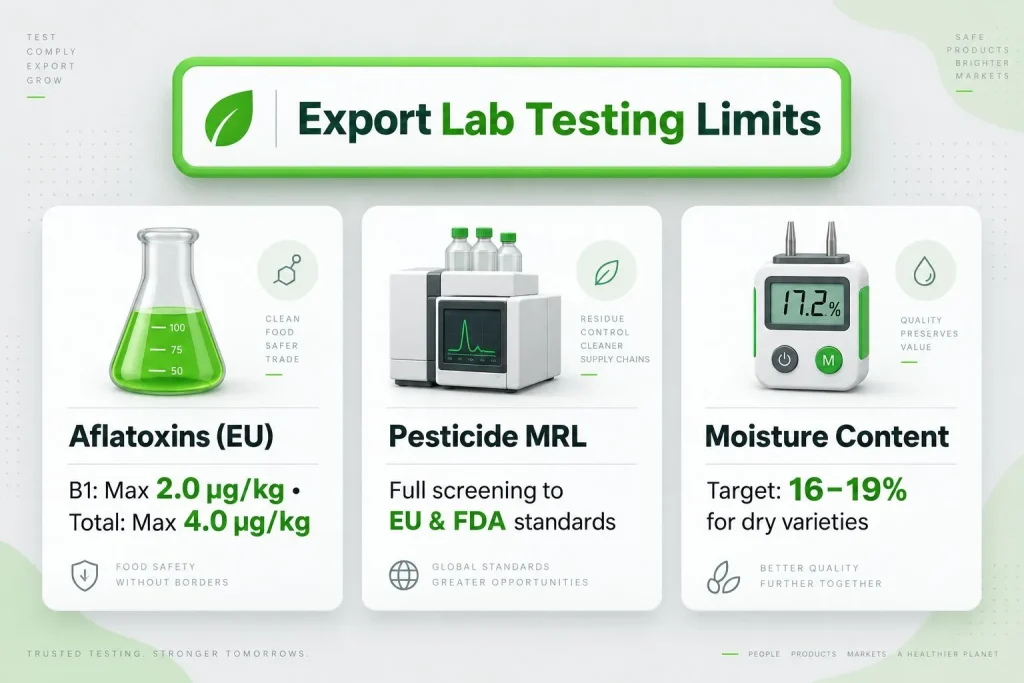
The finished shipment should then pass both in-process quality control and destination-specific laboratory requirements. During Iranian date processing, moisture content, physical integrity, cleanliness, and visible defects should be monitored continuously rather than checked only after packing.
Destination requirements vary:
- EU: Regulation (EU) 2023/915 sets contaminant limits. For dried fruit intended for direct consumption, aflatoxin limits are 2.0 μg/kg for aflatoxin B1 and 4.0 μg/kg for total aflatoxins B1+B2+G1+G2. Higher limits apply when the fruit will undergo sorting or physical treatment before consumption. Pesticide residues must also comply with applicable EU maximum residue levels.
- EAEU/Russia: Applicable GOST requirements and destination food-safety rules should be checked against the exact product and import route.
- United States: Importers must account for FDA requirements, including Prior Notice and the Foreign Supplier Verification Program.
- India: Food imports are processed through FSSAI’s Food Import Clearance System, which can involve document review, inspection, sampling, laboratory testing, and a No Objection Certificate.
HACCP and ISO 22000 may be used as food-safety management frameworks, but a buyer should request valid certificates if certification is a contractual requirement rather than assuming that every exporter holds them.
Step 7 — Loading and Container Preparation
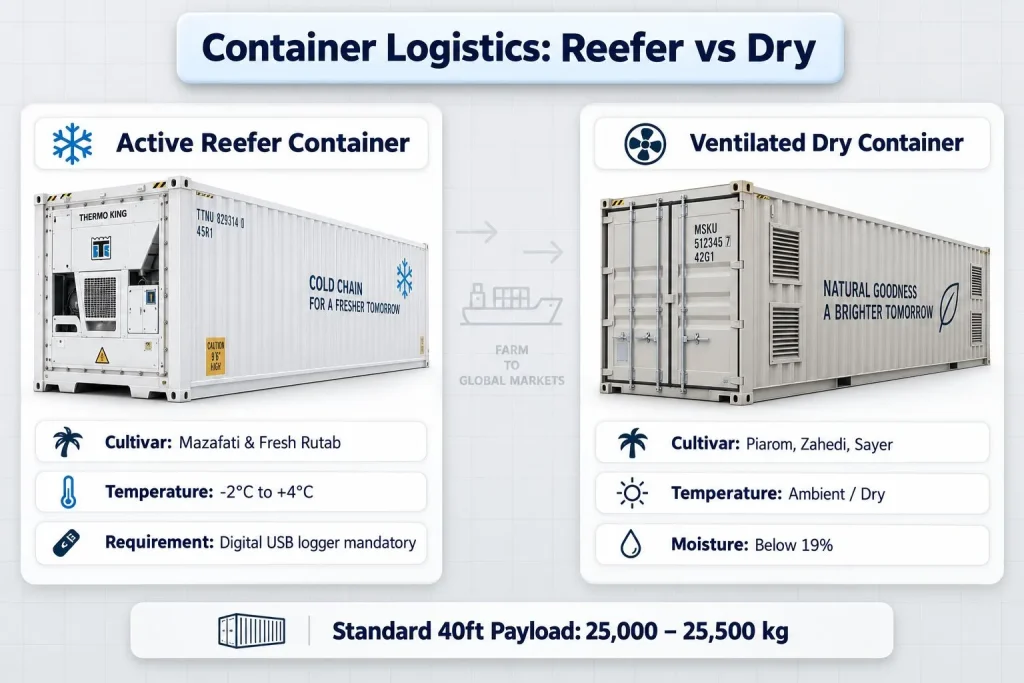
At the final logistics stage, the key decision is whether the shipment requires a reefer container or a ventilated dry container. The answer depends primarily on cultivar and moisture content.
| Cultivar | Indicative moisture | Container | Typical temperature approach |
|---|---|---|---|
| Mazafati, fresh/semi-fresh | 15–35% | Active reefer | −5°C to +5°C; commonly around −2 to 0°C or +4°C |
| Piarom, Zahedi, Sayer | Lower-moisture semi-dry/dry formats | Ventilated dry container | Ambient/ventilated |
These are indicative commercial ranges, not universal specifications. The buyer should therefore agree the exact moisture range and reefer set-point in writing before loading.
For refrigerated dates, pre-cooling at origin and a controlled cold-storage hold help bring the product to the required temperature before loading. A digital data logger can then record temperature throughout the journey, creating evidence that can be reviewed if a cold-chain breach leads to a quality dispute or insurance claim.
A 40 ft reefer carrying palletized dates may typically accommodate around 25,000–25,500 kg, while floor-loaded configurations can reach roughly 25–27 tonnes depending on the equipment and transport restrictions. Actual payload must always be calculated from container tare weight, cargo weight, packaging, pallets, and applicable road or carrier limits.
For long road routes, such as transport toward Moscow through the Astara crossing, transit can take around 10–15 days. Because reefer equipment can fail, logger verification and temperature monitoring remain important throughout the route rather than only at the loading point.
Why Processing Standards Matter for Importers
The 7 stages of Iranian date processing can be viewed as 7 connected controls against commercial risk:
- Moisture control reduces the risk of mould, fermentation, and storage deterioration.
- Disinfestation reduces the risk of quarantine problems and pest-related rejection.
- Grading improves batch uniformity and contract compliance.
- Hygienic packing supports destination-market food requirements.
- Export packaging reduces crushing and transit-damage claims.
- Laboratory testing provides evidence that destination limits have been considered.
- Cold-chain monitoring protects temperature-sensitive varieties such as Mazafati.
A complete export document package should normally include the Commercial Invoice, Packing List, Certificate of Origin, Phytosanitary Certificate, Bill of Lading or Air Waybill, and CMR Waybill when road transport is involved. The commercial invoice should clearly state the product, HS code 080410, currency, net and gross weights, and agreed Incoterm.
Common Incoterms include FCA, CIP, and DAP. Payment structures are commercially negotiated, but arrangements such as 30% advance and 70% against a copy of the Bill of Lading are used in some export transactions.
Before signing a contract, an importer should confirm:
- The exact moisture specification by variety and grade.
- The fumigation method, treatment log, and phytosanitary certificate.
- The reefer set-point, pre-cooling procedure, and data logger where refrigeration is required.
- The HS code, weights, origin, and Incoterm on the commercial documents.
- Accredited laboratory reports covering the destination market’s relevant limits.
The most reliable supplier evidence is therefore a connected record from product specification and batch QC through treatment, laboratory testing, packing, loading, and transport.
FAQ
What is the typical shelf life of Iranian dates?
When properly processed, packaged, and stored under the recommended conditions, Iranian dates can generally maintain commercial quality for several months to over a year, depending on the variety and moisture level.
Which Iranian date varieties are best suited for long-distance export?
Sayer, Zahedi, and other naturally drier varieties are generally better suited to long-distance ambient transport, while softer varieties require tighter temperature and moisture control.
Can Iranian dates be exported under a private label?
Yes. Exporters can supply dates in private-label packaging, provided the packaging, labeling, traceability, and destination-market requirements are agreed before production.
How should imported dates be stored after arrival?
Dates should be moved promptly into clean, dry storage at the temperature and humidity specified for their variety and packaging. Storage conditions should remain stable to prevent condensation and quality deterioration.
What is the main risk when importing dates in bulk?
The main commercial risk is quality deterioration caused by poor temperature, moisture, pest, or handling control during the supply chain. A written product specification and documented pre-shipment controls significantly reduce this risk.
Related Products