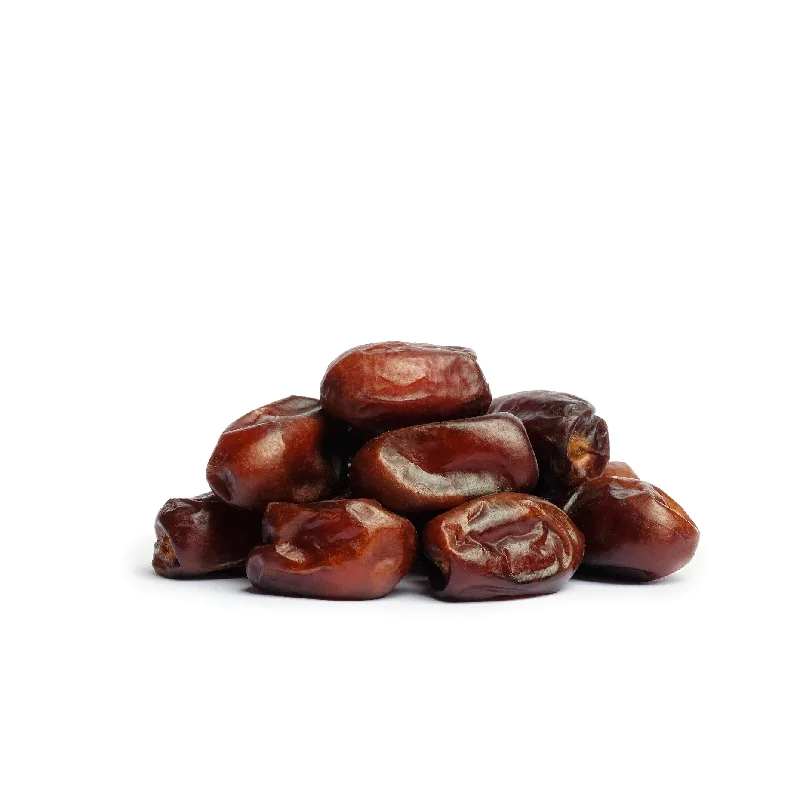

Importing date pomace and date pits from Iran connects industrial buyers to a large and growing byproduct market. Iran exported over 332,000 tons of dates worth $213 million in 2024, according to International Trade Centre data. The processing of those dates generates two distinct industrial materials: fibrous pomace from syrup extraction and hard pits from pitting operations. Both materials serve multiple industries, including animal feed, caffeine-free coffee substitutes, activated carbon, and biomass fuel. In this guide, you will learn the difference between pomace and pits, explore their industrial applications, and understand the key factors for quality, packaging, pricing, and sourcing from Iran.
What Are Date Pomace and Date Pits?
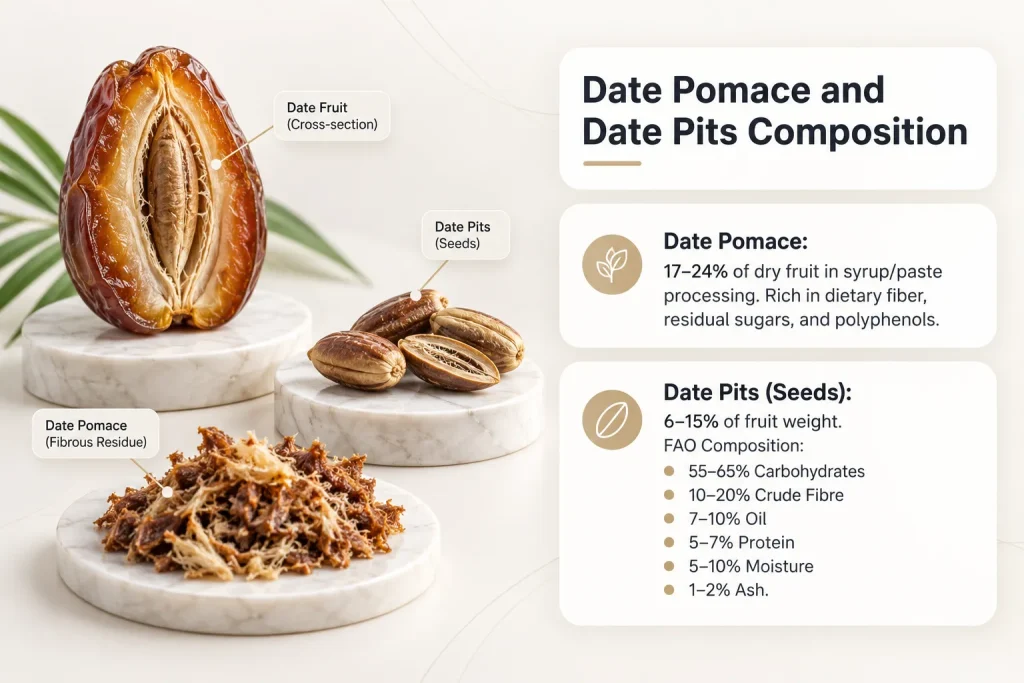
Date pomace is the fibrous residue remaining after date syrup or paste extraction. It contains dietary fiber, minerals, and phenolic compounds that make it valuable across several industrial applications. Date pits, also called seeds, stones, or kernels, are the hard inner structures removed during pitting. According to the FAO, pits constitute 6 to 12% of the date fruit’s total weight in the tamr stage, varying by variety and quality grade. Furthermore, a 2025 study published in Springer’s Discover Food confirms that date fruit syrup processing yields 17 to 24% pomace and 8 to 15% seeds on a dry fruit basis. The approximate composition of date pits, as compiled by the FAO from multiple literature sources, is summarized below:
| Component | Approximate Content |
|---|---|
| Moisture | 5 to 10% |
| Protein (N x 6.25) | 5 to 7% |
| Oil | 7 to 10% |
| Crude fibre | 10 to 20% |
| Carbohydrates | 55 to 65% |
| Ash | 1 to 2% |
Common Industrial Uses
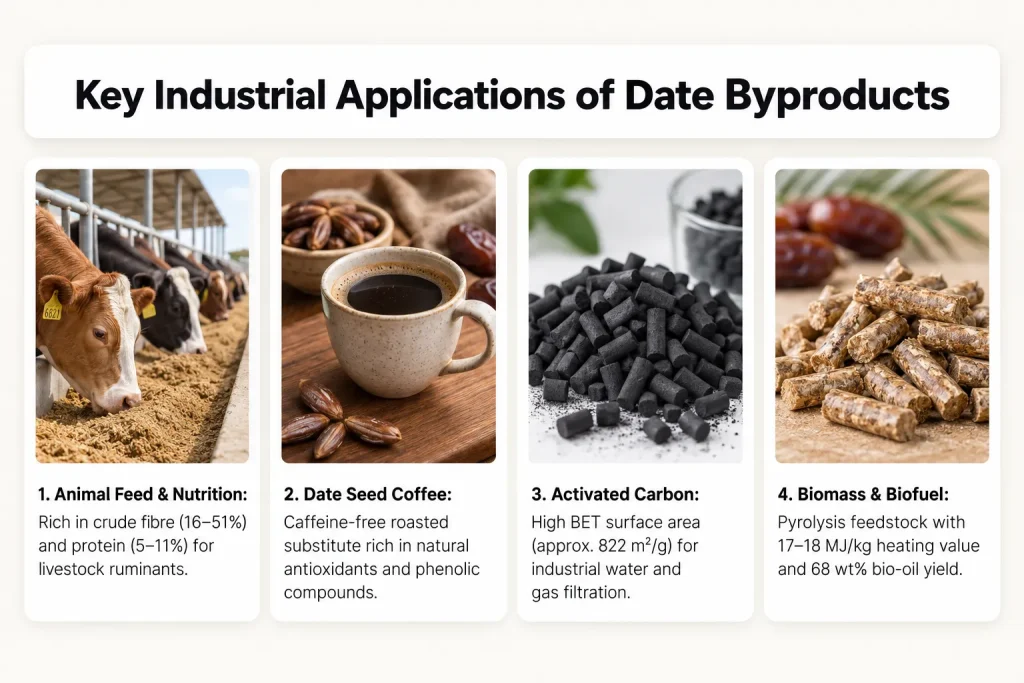
Industrial applications of date byproducts depend on material type and processing method. Pomace and pits serve different markets, from livestock nutrition to environmental filtration. For a broader overview, see industrial uses of dates in food manufacturing.
Animal Feed and Livestock Nutrition
Date pits are traditionally used as animal feed for ruminants and camels. According to Feedipedia data compiled by CIRAD, date seeds contain approximately 5 to 11% crude protein and 16 to 51% crude fibre on a dry matter basis. Their high hemicellulose content provides energy value, but the hard seed coat makes digestion difficult without processing. Therefore, grinding, typically using a hammer mill after initial crushing, breaks the seed coat and improves nutrient availability. Pomace, also rich in fiber, supplements livestock rations as a roughage source.
Date Seed Coffee and Roasted Substitutes
Roasted and milled date seed powder has served as a caffeine-free coffee ingredient in parts of the Arab world for decades, according to a 2024 review published in Food & Function. The roasting process develops a coffee-like aroma while enhancing the seed’s phenolic and antioxidant content. Processing involves washing, drying, roasting, and grinding to a fine powder. The resulting product contains phenolic acids and flavonoids and is valued primarily as a naturally caffeine-free beverage base.
Activated Carbon Production
Date pits serve as a low-cost raw material for activated carbon production due to their high carbon content. A study in the International Journal of Environmental Research and Public Health showed that chemical activation using phosphoric acid at 500 degrees Celsius produced granular activated carbon with a BET surface area of 822 m²/g. The resulting carbon has been applied to water treatment and gaseous ammonia adsorption.
Biomass and Biofuel Applications
Date palm biomass has a lignocellulosic structure consisting of cellulose, hemicellulose, and lignin, making it a renewable feedstock for biofuel production. As a 2026 review in MDPI’s Energies journal noted, “The current review considers the conventional perception of date palm by-products as ‘waste’ as an inadequacy of chemical and economic thinking.” Pyrolysis and gasification convert date pits and pomace into bio-oil, syngas, and biochar. The same review reported that date seed pyrolysis at 500 degrees Celsius yields up to 68% bio-oil by weight, with a higher heating value of 17 to 18 MJ/kg.
How These Byproducts Are Sourced and Processed in Iran
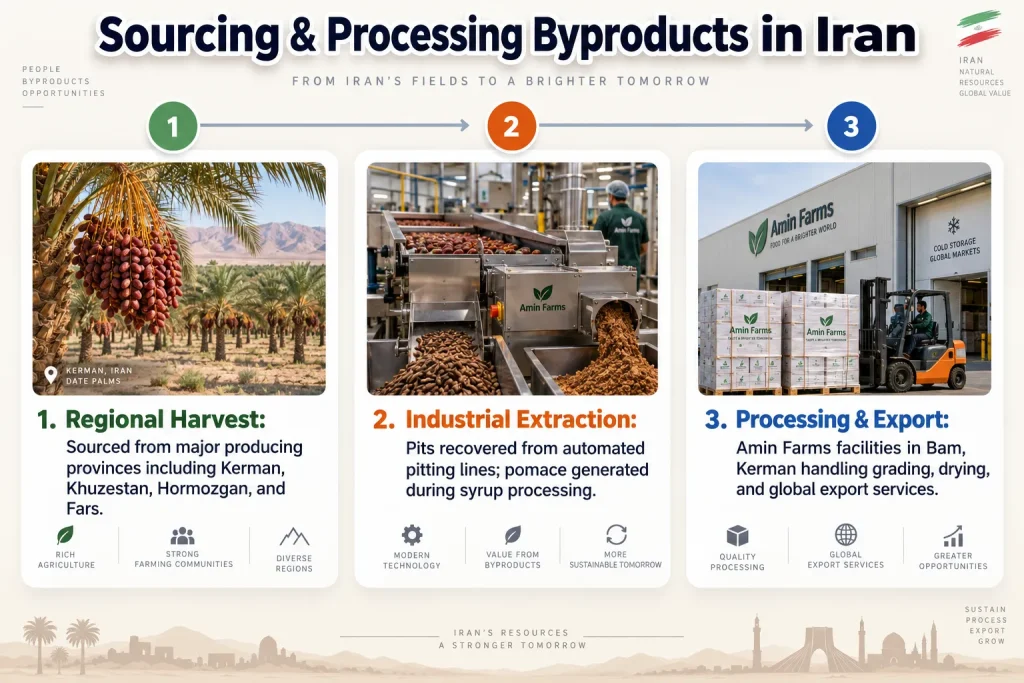
Iran is one of the world’s leading date producers. In 2024, the country exported 332,346 tons of fresh and dried dates worth over $213 million, up 25% from 2023, according to International Trade Centre data. The main date-producing provinces are Kerman, Sistan-Baluchestan, Hormozgan, Khuzestan, Bushehr, and Fars.
Pits are recovered at pitting stations in packaging and paste production facilities, while pomace is separated during syrup and paste processing. Amin Farms operates a modern cold storage and processing complex in Bam, Kerman Province, with a packaging hall exceeding 2,000 square meters, seven cold storage chambers totaling 4,700 metric tons, and an in-house laboratory. Sorting, grading, and climate control systems maintain product integrity throughout the production chain.
Quality Considerations for Buyers
When importing date pomace and date pits from Iran, three quality factors directly affect performance, shelf life, and end-use suitability:
- Moisture Content: Moisture levels influence storage stability and mold risk. The FAO reports date pit moisture at 5 to 10%. Buyers should specify an acceptable ceiling in their RFQ based on their industrial application.
- Contaminant-Free Sourcing: Freedom from fruit residue, sand, and microbial contamination is essential. Buyers should request a Certificate of Analysis and confirmation of HACCP or ISO 22000 compliance.
- Particle Size (Whole vs Ground): Pits can be supplied whole, cracked, or ground. Particle size requirements vary by application, as feed milling, activated carbon, and coffee substitutes each demand different specifications. Buyers should clearly state the required format.
Packaging and Bulk Shipping Formats
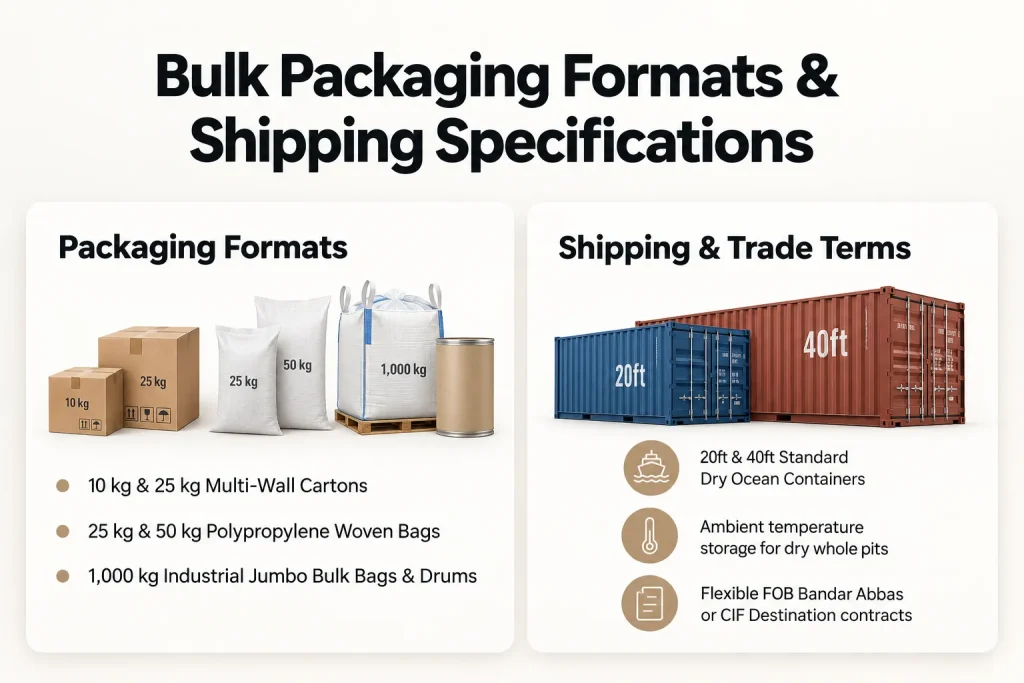
Packaging for date byproducts varies by material type. For dry powders and ground materials, standard formats include 10 kg or 25 kg cartons with polyethylene liners. For liquid derivatives such as date syrup, drums and IBC containers are common. Bulk shipping typically uses sea freight containers, with Incoterms such as FOB or CIF agreed in advance.
Dry goods like whole pits can be transported at ambient temperature. However, powders with higher moisture content require cool, dry storage to prevent caking and microbial growth. Buyers should confirm packaging formats during the inquiry, as custom arrangements may be available.
Pricing Factors for Date Byproducts
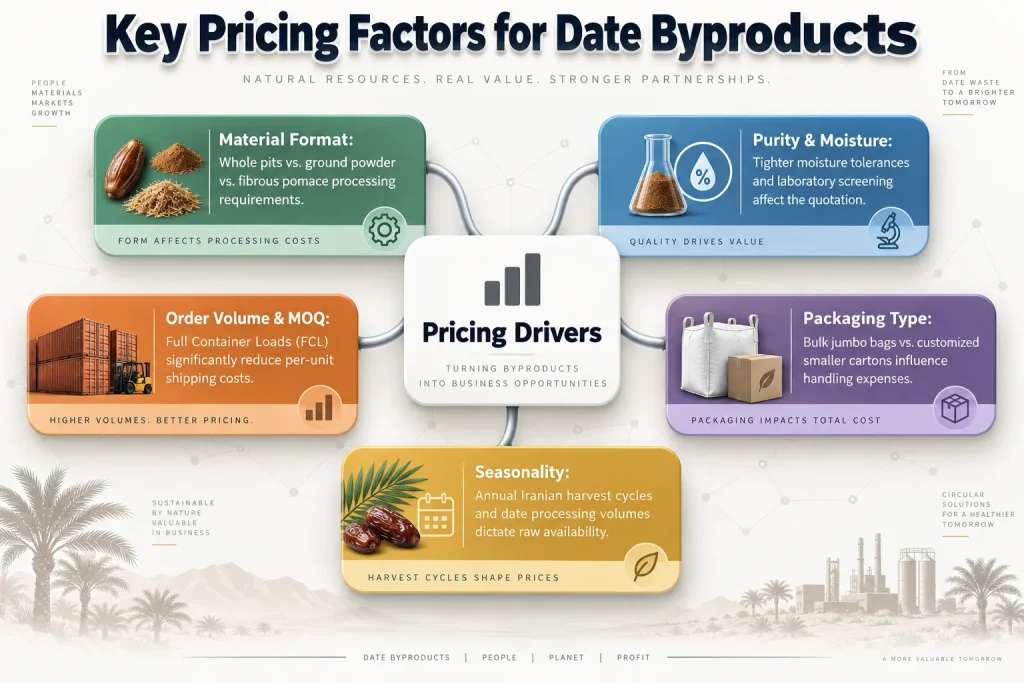
Date byproduct pricing is commodity-sensitive and varies with market conditions. No fixed price list applies across all products. The main factors influencing cost include:
- Material type: Whole pits, ground pit powder, and pomace each carry different processing costs
- Purity and moisture grade: Higher purity and lower moisture command premium pricing
- Order volume (MOQ): Larger orders typically reduce per-unit cost
- Packaging format: Custom packaging adds cost
- Shipping route and Incoterms: FOB versus CIF terms affect landed cost
- Seasonal availability: Harvest timing and inventory levels influence supply and pricing
For accurate pricing, buyers should submit a detailed RFQ directly to the supplier.
How to Source Date Pomace and Pits from Amin Farms
Amin Farms, with processing facilities in Bam, Kerman Province, and international export experience, can assist buyers in sourcing or customizing date byproducts. Inventory and supply capability should be confirmed directly. The sourcing process involves:
- Contact the sales team at info@aminfarms.com
- Provide technical specifications (product type, moisture, particle size, volume)
- Request samples and a Certificate of Analysis
- Agree on packaging, Incoterms, and shipping schedule
To begin importing date pomace and date pits from Iran, contact Amin Farms with your specifications.
FAQ
Q1: What documents should buyers request before shipment?
Buyers should request a Certificate of Analysis, commercial invoice, and health or food-safety certificates such as HACCP or ISO 22000 where applicable. The final document list depends on the destination country and product type.
Q2: Are date byproducts from Iran automatically food-grade?
No. Date byproducts can be food-grade, feed-grade, or industrial-grade depending on processing and intended use. Buyers should specify the required grade and confirm it meets destination-country requirements.
Q3: Can buyers request custom particle size or roasting?
Yes, in most cases particle size and roasting level can be customized, provided a minimum order quantity and defined technical specifications are supplied. This should be confirmed during the inquiry.
Q4: Are date byproducts from Iran subject to export restrictions?
Iranian export regulations may change. Buyers should verify current export status and required permits with the supplier and destination customs before ordering.
Q5: What should be included in an RFQ for date byproducts?
An RFQ should include product type, target moisture, particle size, order volume, packaging, Incoterms, and destination port. Complete information leads to faster responses.
Conclusion
Importing date pomace and date pits from Iran offers industrial buyers a renewable, multi-purpose raw material from one of the world’s largest date economies. Pomace provides fiber for feed and biomass, while pits serve applications from activated carbon to caffeine-free coffee. By defining moisture, purity, and particle specifications upfront and requesting Certificates of Analysis, buyers can align product quality with their industrial requirements. Amin Farms supports that process from inquiry to shipment
Related Products