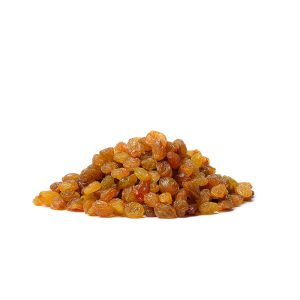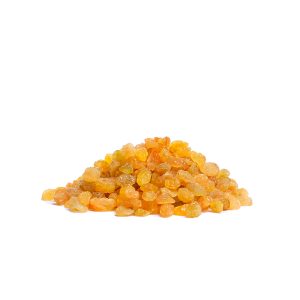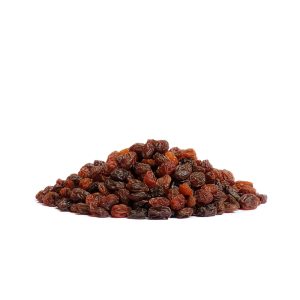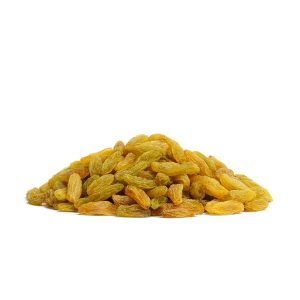
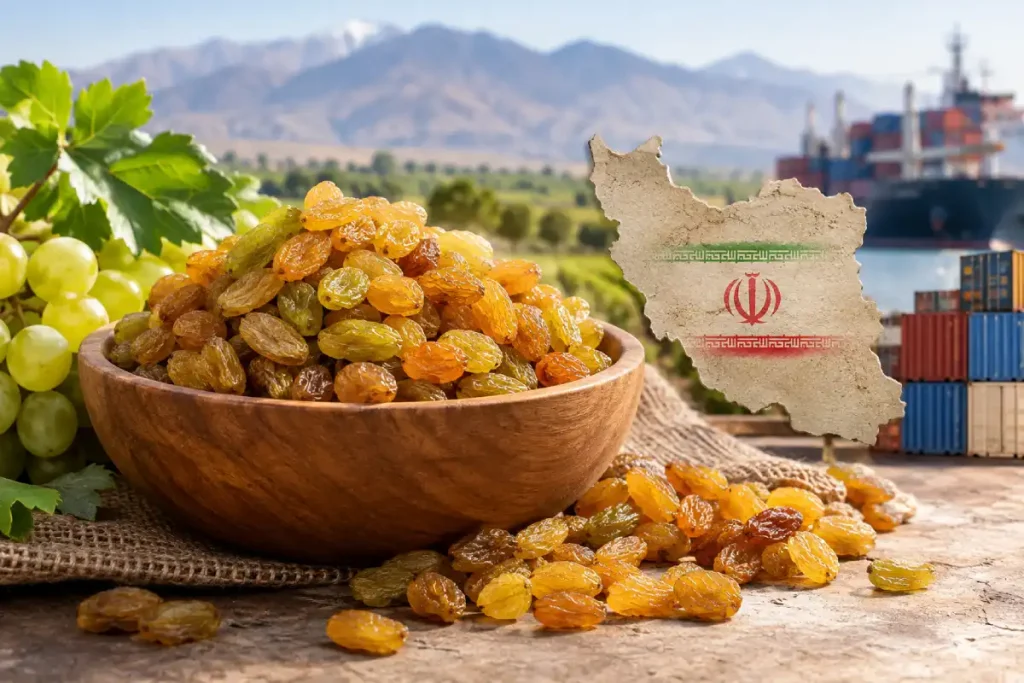
Iranian raisins serve as a foundational commodity for the global bakery, confectionery, and snack manufacturing sectors. Commercial buyers navigating the dried fruit supply chain prioritize this origin due to its reliable harvest yields, superior natural sugar retention, and specialized post-harvest treatments. This comprehensive manual breaks down the available commercial cultivars, grading classifications dictated by international regulatory bodies, a technical benchmarking against major global competitors, and the logistical protocols necessary to execute bulk maritime imports.
What Are Iranian Raisins and Why Do Importers Choose Them?
The distinct commercial viability of Iranian raisins originates from the region’s specific agricultural geography. The interplay of a semi-arid climate, prolonged solar exposure, and robust genetic diversity among grape cultivars yields a commodity with naturally high sugar content, dense cellular structure, and a complex flavor profile. For international procurement managers, these biophysical traits translate directly into optimized manufacturing yields and enhanced sensory profiles in downstream food production.
Consequently, when supply chain directors buy Iranian raisins wholesale, they base their sourcing strategy on several quantifiable agronomic and commercial advantages:
- Cost-in-Use Optimization: Production output from Iran structurally maintains a highly competitive price-to-quality ratio compared to Western origins, allowing large-scale manufacturers to optimize formulation costs without degrading texture.
- Desiccation Versatility: Exporters offer a comprehensive spectrum of post-harvest processing, accommodating demands for everything from traditional sun-cured natural goods to modern, sulfur-treated commercial variants.
- Precision Size Calibration: Advanced sorting facilities calibrate outputs to highly specific berry counts, fulfilling the exact mechanical tolerances required by automated mixing equipment.
- Supply Chain Resilience: Substantial annual harvest volumes ensure that bulk container allocations remain consistently accessible across all commercial quarters.
- Clean-Label Adaptability: A deep-rooted agricultural framework supports the high-volume output of unadulterated, fully organic sun-dried varieties tailored for health-centric brands.
Main Types of Iranian Raisins
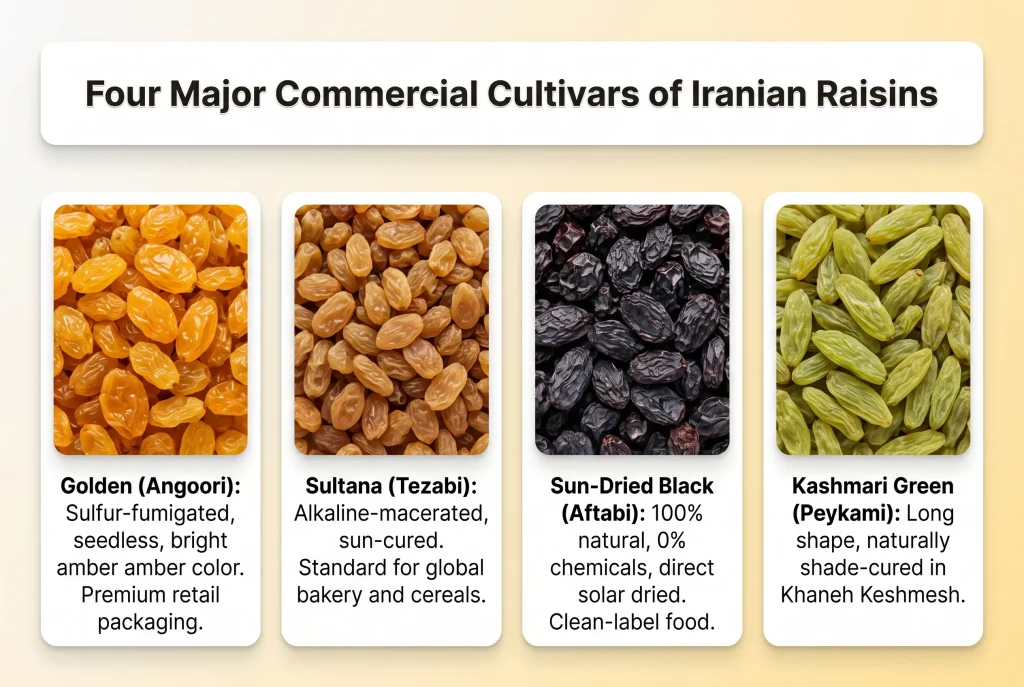
In international commodity trading, the various types of Iranian raisins are classified primarily by their post-harvest pre-treatments and desiccation methodologies rather than the underlying grape cultivar. Evaluating these processing distinctions is imperative for procurement teams attempting to match the ingredient’s chemical profile to a specific industrial application.
Golden Raisins (Angoori / California Style)
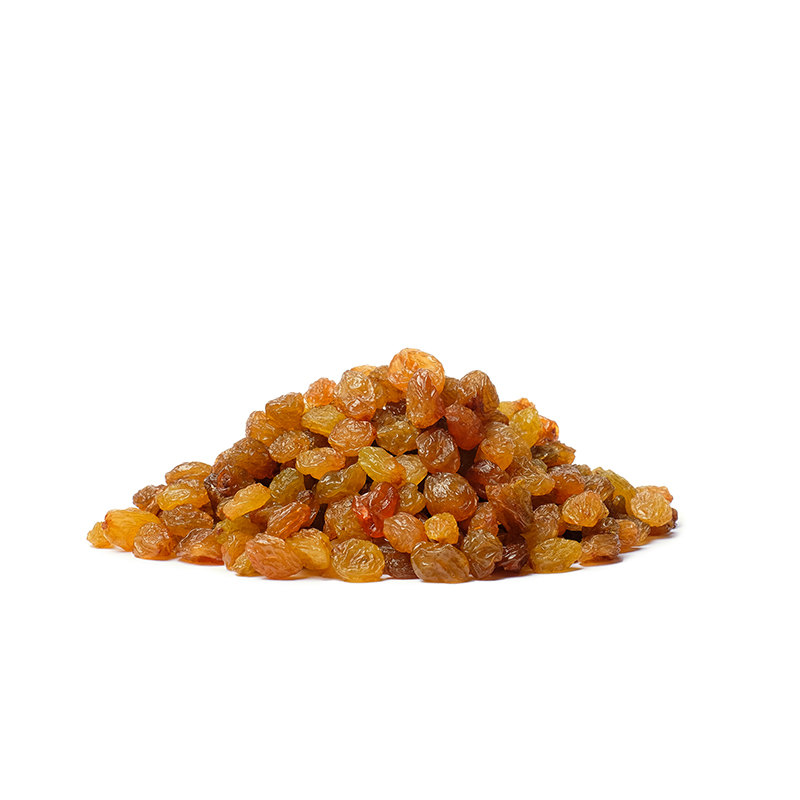
Iranian golden raisins are manufactured from seedless cultivars subjected to rigorous post-harvest interventions to stabilize their bright, luminous amber coloration. After an initial submersion in a food-grade alkaline solution, the grapes are transferred to a controlled environment for sulfur dioxide (SO2) fumigation before undergoing ambient shade-curing.
This specific variety dominates procurement requests across the Middle East, North Africa, and Eastern Europe, where buyers demand visually striking inclusions for premium retail packaging. However, due to the sulfurization process, compliance officers must meticulously align the shipment’s SO2 parts-per-million (PPM) with the statutory import tolerances of the destination market, particularly when navigating the stringent thresholds enforced by the European Union.
Sultana Raisins (Tezabi / Malayer Type)
Representing the highest volume export category, Iranian sultana raisins are globally recognized for their light brown pigmentation and highly pliable texture. The manufacturing protocol involves macerating the freshly harvested clusters in an alkaline emulsion—formulated from potassium carbonate and refined edible oils, to accelerate cellular moisture loss prior to direct solar desiccation.
In contrast to the golden variety, sultanas bypass heavy sulfur fumigation. This temperate processing profile makes them the baseline standard for the global bakery sector, extruded cereal formulations, and industrial chocolate manufacturing. Furthermore, their rapid rehydration velocity and balanced Brix levels integrate seamlessly into automated commercial dough preparation lines.
Sun-Dried Black Raisins (Aftabi)
Sun dried raisins Iran exports under the “Aftabi” designation cater exclusively to the escalating global demand for clean-label and organically certified ingredients. This cultivar undergoes desiccation entirely devoid of chemical additives, alkaline maceration, or sulfur fumigation; the raw clusters are simply exposed to direct solar radiation until optimal moisture reduction is achieved.
Consequently, the final product exhibits a dark, heavily caramelized appearance, an exceptionally dense internal structure, and concentrated natural sugars. Because it remains wholly unadulterated, this variant represents a critical raw material for health-focused snack conglomerates prioritizing preservative-free product architecture.
Kashmari Green Raisins (Long Raisins / Peykami)
Iranian green raisins Kashmar constitute a highly specialized, geographically exclusive category defined by their elongated morphology and vibrant green pigmentation. Cultivated predominantly from the Peykami grape, these specific raisins are shade-cured within traditional, aerated architectural structures known as “Khaneh Keshmesh.”
The ambient, unforced airflow gradually extracts internal moisture while halting the enzymatic browning process, successfully preserving the green hue without relying on harsh chemical stabilizers. Given their unique visual geometry and delicate organoleptic profile, they operate as a luxury commodity allocated for premium trail mixes and specialized retail distribution across India, the GCC, and Southeast Asia.
How Iranian Raisins Are Graded
To eliminate ambiguity in international fulfillment, Iranian raisin grading protocols operate in strict accordance with the national ISIRI 17 mandates and the global UNECE DDP-08 quality frameworks. Based on United Nations Economic Commission for Europe (UNECE) parameters, export-grade dried vine fruits must remain entirely free of deterioration, dictating the deployment of advanced optical sorting infrastructure across Iranian processing plants.
Size Classification (Berry Count per 100g)
Precise size calibration mitigates mechanical blockages in industrial processing and ensures contractual compliance. Procurement contracts strictly define sizing based on standard berry counts per 100 grams.
| Grade Classification | Berry Count per 100g | Primary Industrial Application |
|---|---|---|
| Jumbo | 200 – 250 berries | Premium retail packaging, luxury nut assortments |
| Standard | 251 – 340 berries | Multi-purpose industrial processing, bulk bakery |
| Medium / Midget | 341 – 500 berries | Biscuit inclusions, granola extrusion, baguettes |
Note: Due to seasonal agronomic variables, international trade standards permit a ±5% mass tolerance across distinct harvest cycles.
Moisture Content and Color Uniformity
Regulating internal moisture is the paramount operational variable for preventing microbial proliferation during extended maritime transit.
- Moisture Tolerance Limits: Commercial export mandates cap the maximum allowable moisture content strictly between 14% and 16%. Any reading exceeding the 17% threshold exponentially amplifies the probability of fermentation, surface sugaring, and fungal development inside shipping containers.
- Optical Consistency: Premium-tier shipments (categorized as AAA) demand a minimum 90% to 95% chromatic uniformity. Consequently, processing lines utilize high-resolution color sorters to systematically eject carbonized or phenotypically discolored berries.
Cleanliness, Stems, and Debris Limits
Contemporary Iranian export facilities integrate multi-stage hydro-washing, laser optical scanners, mechanical cap-stem removers, and calibrated metal detection arrays to satisfy global food safety and toxicology requirements.
- Foreign Matter Thresholds: Independent laboratory assays mandate that outbound shipments remain devoid of mineral debris, silicates, and hazardous physical contaminants.
- Cap-Stem Restrictions: Residual woody materials are rigorously restricted, generally limited to a maximum allowance of 1 to 2 cap-stems per standard bulk carton.
- Mycotoxin Compliance: Export managers must continuously assay batches to ensure alignment with international toxicology limits. Specifically, satisfying the European Commission Regulation (EU) 2023/915 requires maintaining Ochratoxin A (OTA) concentrations definitively below the 8.0 µg/kg threshold.
Key Growing Regions in Iran
Distinct provinces specialize in specific cultivars, a distribution driven by deep historical agronomy and highly localized microclimatic conditions.
- Malayer (Hamadan Province): Universally acknowledged as the epicenter for Sultana and Tezabi varieties, Malayer raisin production benefits from a Globally Important Agricultural Heritage System (GIAHS) designation issued by the FAO, yielding fruits with profound caramel notes.
- Takestan (Qazvin Province): Operating as the primary cultivation zone for sun-dried and seedless vines, this region houses the highest concentration of modern, high-capacity processing and sorting infrastructure within the country.
- Bonab and Malekan (East Azerbaijan Province): Positioned in the northwest, this territory serves as the undisputed hub for premium golden varieties, featuring sophisticated sulfurization facilities strictly calibrated for European and Middle Eastern export markets.
- Kashmar and Khalilabad (Khorasan Razavi): Located in the east, this microclimate provides the exclusive environmental parameters required to cultivate and shade-cure the highly specialized long green and long golden morphological variants.
Common Export Packaging Formats
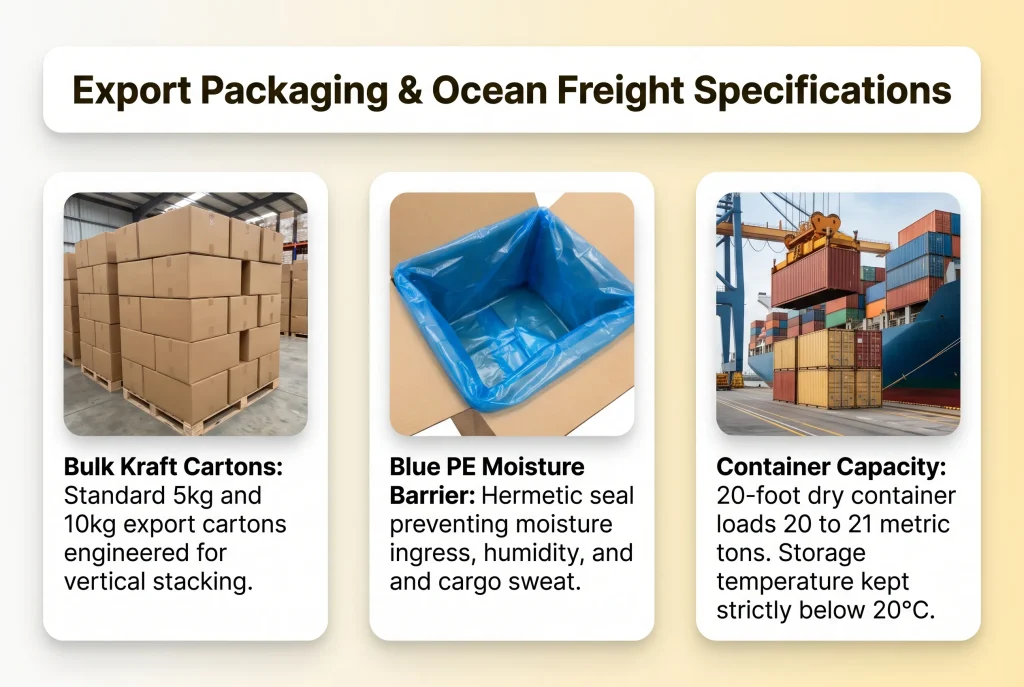
Deploying structurally sound packaging architecture is essential to preserve the commodity’s physical integrity and moisture baseline across volatile oceanic climate zones.
- Bulk Corrugated Cartons: The international B2B standard relies on heavy-duty, 5-ply corrugated kraft cartons, uniformly calibrated for 5 kg and 10 kg net material weights.
- Polyethylene Moisture Barriers: Internal packaging must feature a high-density, food-grade blue polyethylene (PE) liner. This hermetic barrier is non-negotiable for blocking external moisture ingress and mitigating pest contamination during maritime shipping.
- Retail and MAP Formats: Advanced processors execute Private Label (OEM) fulfillment, deploying vacuum-sealed or nitrogen-flushed (Modified Atmosphere Packaging) zip-lock pouches to maximize the shelf life of chemically sensitive green and golden cultivars.
- Maritime Logistics: From a volumetric standpoint, a standard 20-foot dry-van container efficiently accommodates approximately 20 to 21 metric tons of product when palletized in 10 kg cartons.
How Iranian Raisins Compare to Turkish and US Raisins
When benchmarking Iranian raisins export quality against prominent global competitors, procurement directors must analyze formulation economics simultaneously with physical and organoleptic attributes.
| Evaluation Metric | Iranian Raisins | Turkish Raisins | US (California) Raisins |
|---|---|---|---|
| Dominant Cultivars | Thompson Seedless, Askari, Peykami | Sultana No. 9, 10, 11 | Natural Thompson |
| Organoleptic Profile | Exceptionally high natural Brix indices | Moderate sweetness baseline | High natural sugar concentration |
| Commodity Pricing | Highly optimized Iranian raisins price per ton | Volatile (correlated to Lira fluctuations) | Highest premium pricing tier |
| Market Positioning | Economic formulation, global wholesale | Total European bakery dominance | Domestic retail, premium international segments |
Ultimately, for industrial food manufacturers aiming to maximize gross margins, Iranian commodities offer an unparalleled economic advantage. They deliver extreme natural sugar concentrations, enabling commercial buyers to systematically reduce synthetic ingredient costs without compromising the structural integrity or flavor profile of the end product.
How to Source and Import Iranian Raisins
Executing a secure, high-volume international transaction requires a methodical approach to laboratory verification and supply chain logistics.
- Sampling & Analytical Verification (COA): Prior to issuing a purchase order, mandate physical samples accompanied by an updated Certificate of Analysis. Procurement teams must cross-reference the laboratory data to ensure moisture percentages, SO2 limits, and microbial plates align exactly with domestic regulatory statutes.
- Incoterm Negotiation & Third-Party Assay: Define the commercial risk transfer clearly, generally operating on CFR or FOB Bandar Abbas terms. It is imperative to contract an independent auditing firm (such as SGS or Cotecna) to execute a pre-shipment inspection, verifying mass and quality metrics directly at the loading port.
- Export Documentation Protocols: Secure a comprehensive documentary credit packet from the supplier. This must include the Ocean Bill of Lading, Certificate of Origin, Commercial Invoice, Packing List, and the official Phytosanitary Certificate. Logistics personnel should consult this step-by-step guide to importing raisins to master the exact customs clearance protocols for agricultural commodities.
- Freight & Thermal Management: Enforce rigorous maritime transit conditions. The commodity must remain within a controlled cold-chain environment (optimally below 20°C). Demand well-ventilated dry containers to entirely eliminate the risk of condensation and internal cargo sweat during transoceanic voyages.
FAQ
What is the maximum permitted moisture level in export-grade Iranian raisins?
The maximum permitted moisture level for export-grade Iranian raisins is strictly capped between 14% and 16% under international standards to neutralize the risk of mold proliferation and sugaring during transit.
What is the primary difference between Iranian Golden Raisins and Sultana Raisins?
Golden raisins require sulfur dioxide fumigation to chemically lock in a bright yellow hue, whereas Sultana raisins are exclusively macerated in an alkaline solution and sun-cured to achieve a natural amber coloration.
Can Iranian raisins comply with EU regulations on Ochratoxin A and sulfur dioxide?
Yes, reputable Iranian export facilities consistently supply shipments backed by accredited laboratory COAs that verify total compliance with European Commission Regulation (EU) 2023/915, specifically maintaining Ochratoxin A levels below 8.0 µg/kg.
What is the standard shelf life of Iranian raisins packed in bulk cartons?
When stored within standardized parameters—specifically in a dry, ventilated environment below 20°C and shielded from direct ultraviolet exposure—the functional shelf life of bulk-packed Iranian raisins extends from 12 to 18 months.
Related Products